The wide-tailed warbler [1] , or the nightingale reed [1] , or the wide-tailed [1] ( lat. Cettia cetti ) is a small insectivorous warbler from the family Sylviidae, recently it has often been referred to the family of short-winged reeds (Cettidae).
| Wide-reed warbler |
|---|
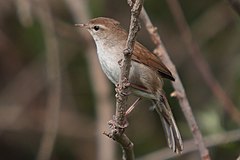
Female | 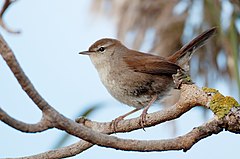
Male |
|
|
| No rank : | Bilateral symmetrical |
| Infrastructure : | Passerida |
|
|
Cettia cetti ( Temminck , 1820 ) |
|
Least ConcernedIUCN 3.1 Least Concern : 22714445 |
|
The wide-tailed reed is 13-14 cm long. By external signs, it can be confused with the reed-badger or the nightingale cricket , however its neck is shorter and the physique is more compact. The beak is sharp, the tail is wide, the wings are strongly rounded. The plumage of the upper body is from red-brown to brownish color, the lower part of the body is gray-white with brownish tones on the sides and on the belly. Sexual dimorphism is manifested in size: the male is larger than the female.
Wide-reed warbler is common in the Mediterranean . It lives in Morocco , Spain , from southern France through Italy , Greece and Western Asia to northern Iran and northern Afghanistan , reaching Kazakhstan and Central Asia in the east.
The broad-tailed warbler inhabits a dense shrub near ponds with coastal vegetation, such as reeds, willows, bamboo, papyrus, hawthorn, blackberries and nettles. Birds feed mainly on insects and their larvae, spiders, small snails and other invertebrates, sometimes plant seeds. Although they rarely leave dense thickets of plants, in search of food birds move low in the bushes and gallop on the ground.
In the summer, the male spends time in such a way as to note his presence in the area with sounds and to lure the females (usually up to three). At the same time, he moves energetically in the bush, while twitching his wings and tail in the same way as a wren . The male forms at the same time up to three unions on his site. He does not participate in the construction of nests and hatching. The female builds a cup-shaped nest from stems with a diameter of about 9 cm and a height of 7–13 cm at a height of less than 0.5 meters in a dense shrub. There, the female hatches from 3 to 5 eggs from dark orange to brown-reddish color for 13-17 days. The male is involved in feeding the chicks and the brood, which in 14-16 days becomes independent.
- ↑ 1 2 3 Boehme R. L. , Flint V. E. The Bilingual Dictionary of Animal Names. Birds. Latin, Russian, English, German, French / Ed. ed. Acad. V. E. Sokolova . - M .: Rus. lang., "RUSSO", 1994. - S. 333. - 2030 copies. - ISBN 5-200-00643-0 .
- Svensson, Grant, Mullarney, Zetterström: Der neue Kosmos-Vogelführer. Franckh-Kosmos, Stuttgart 1999, ISBN 3-440-07720-9
- Anne Puchta, Klaus Richarz: Steinbachs großer Vogelführer. Eugen Ulmer, Stuttgart 2006, ISBN 3-8001-4490-5
- Hans Bub, Harald Dorsch: Cistensänger, Seidensänger, Schwirle und Rohrsänger . 1. Auflage. Neue Brehm-Bücherei Nr. 580, A. Ziemsen Verlag, Lutherstadt Wittenberg 1988, ISBN 3-7403-0020-5 . 92 Abbildungen. 221 S. 8 °, broschiert / Taschenbuch
- Peter Kennerley and David Pearson: Reed and Bush Warblers. Christopher Helm, London 2010, ISBN 978-0-7136-6022-7