Henri Degrange ( French Henri Desgrange ; January 31, 1865 , Paris - August 16, 1940 , Bauvallon, Drome department) - French cyclist and sports journalist. The holder of a number of records on the track . Best known as the organizer of the Tour de France .
 Henri Degrange | |
|---|---|
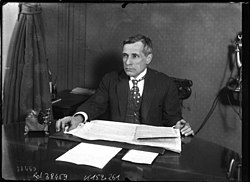 | |
| personal information | |
| Citizenship |  France France |
| Date of Birth | January 31, 1865 |
| Place of Birth | Paris |
| Date of death | August 16, 1940 (75 years old) |
| A place of death | Bovallon ( Drome , Rhone - Alps ) |
| Racer Information | |
| Specialization | , , , , |
Biography
Henri Degrange was born into a Parisian family with his twin brother Georges. In his youth, Henry worked as a clerk in a law firm. According to legend, he was fired due to the fact that he got to work on a bicycle. In the early 1890s, Degrange concentrated on cycling and achieved great success on the track. His acceleration was very weak, but endurance helped him set several records, at 50 and 100 kilometers, 100 miles, as well as in a tricycle race . On May 11, 1893, Henry updated the hourly record by driving 35,325 meters. The authority gained in races helped Degrange to take a number of leading positions. In 1897, he became director of the new Paris Velodrome, now the famous football stadium " Parc des Princes ", and in 1903 he took a similar position at the Velodrome d'Iver . When the country was soon divided by the Dreyfus affair , in 1900 L'Auto-Vélo seceded from the Le Vélo newspaper, and Degrange was invited to the post of editor-in-chief of the new newspaper. Competition extended to bicycle races organized by these newspapers.
In January 1903, Le Vélo through the court made an exception to the name of the competitor of the word Vélo, but 2 months before the editors of L'Auto decided to create a new unique race, which ultimately helped them win. The idea of the Tour de France belonged to the subordinate Degrange Jo Lefebvre , although Henry was always called the "father" of the race. Degrange was afraid of the failure of the project, and, trying to separate himself from him, did not attend the Tour de France in 1903 , citing illness. The race gained great popularity, the circulation of the newspaper took off, and in 1904 Henri himself accompanied the peloton. This time the race ended in scandal, and Degrange believed that its third version would no longer be. However, it was successfully held, and the Tour de France is still the most prestigious race in the cycling calendar. Over the next decades, Degrange remained the director of the Tour.
Endurance specialization during and after his career led Degrange. Thus, the Tour de France was an extremely difficult race with him, few reached the finish line. Henry made life difficult for riders, including mountains in the route and forbidding the use of someone else's help. He gained fame as a despot, in conflict with many racers, teams, and other sports functionaries. Henry fought off any interference in the affairs of the Tour de France, as well as ignored the complaints of the riders. One of the ugly stories was his conflict with the not-so-largest bicycle manufacturer Mercier. Two-time Tour winner Andre Leduc wanted to move from the powerful Alcyon team to Mercier. The director of Alcyon wanted revenge, and he persuaded Degrange not to invite Leduc to the Tour de France. Mercier wrote a complaint, and lawyers took up the matter. Then Degrange forbade his subordinates to write the name Mercier on the pages of the newspaper. Since the newspaper covered events involving this producer, its name was written, but intentionally with errors. When Mercier demanded to give a note indicating the error, the newspaper appeared messages like " Monsieur Cermier notifies that his name is actually Monsieur Merdier (euphemism for" shit ")."
Degrange was a fan of physical education , actively playing sports throughout his life. One of the reasons for the defeat in the Franco-Prussian war, Henry considered the weak physical fitness of the French. With the help of his newspaper, he promoted a healthy lifestyle. In addition to the elite Tour de France, Degrange was also involved in introducing a massive movement of randonners and organizing brevet marathons. After the outbreak of World War I, he urged young people from the pages of the newspaper to kill Germans at the front without taking prisoners. In 1917, Degrange, who had exchanged the sixth dozen, also joined the army, but did not take part in hostilities.
Henry had a daughter from his first marriage, after the war he lived with the avant-garde artist Jeanne Dele in a house on the Mediterranean coast. In the summer of 1939 he had two operations on the prostate . Degrange was prescribed peace, but he preferred to accompany the Peloton of Tours in the car, and shaking exacerbated the disease. In August 1940, Henri Degrange died. The monument dedicated to him was erected on one of the most formidable peaks of the Tour de France, Col du Galibier . The Henri Degrange Prize is awarded to the conqueror of Tour's highest climb.
Links
- Biography on The Biography Channel