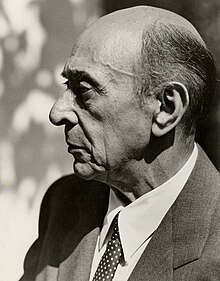
New Vienna School ( German: Zweite Wiener Schule, Neue Wiener Schule, Junge Wiener Schule , English Second Viennese School ) is the name of the school of composers , established in the world musicology discourse , whose aesthetic principles historically developed in the first third of the 20th century in Vienna , resulting from the active creative , pedagogical and organizational activities of Arnold Schoenberg and his students.
Content
Key Participants
In addition to Arnold Schoenberg himself, the creative backbone of the New Vienna School was composed by composers Anton Webern , Alban Berg , as well as Hans Eisler (in the initial period of creation), Victor Ulman , Heinrich Yalovets , Egon Velles , Theodor Adorno , Hans Erich Apostel , Rene Leibovitz and some others students and colleagues of Schoenberg, Webern and Berg.
The participants in the New Vienna School are usually only those composers and musicologists who were influenced by Schönberg's new musical ideas precisely at the time when Schönberg was engaged in his innovative teaching activities in Austria and Germany .
Those Schoenberg students who, starting in 1933 , studied with him in the United States , are not considered a New Vienna School. In particular, this can be said about John Cage , who, although he studied with Schoenberg, mainly developed his own musical innovations of a postmodern style .
It is not customary to classify among the participants of the New Vienna School and those composers whose work, although the compositional principles of the New Vienna School were sufficiently assimilated, did not become key. Ernst Kshenek can be mentioned as one of such composers [1] .
Aesthetic principles
The central and key principle of Schoenberg’s musical and compositional reform was the complete elimination of the tonal foundation of music and its replacement with specially developed atonal techniques related to the concepts of seriality , seriality , dodecafony [2] , pointillism .
See also
- Vienna Classical School
- Dodecafonia
- Expressionism in music
Notes
- ↑ Křenek, Ernst (1943). "New Developments of the Twelve-Tone Technique." The Music Review 4, no. 2 (May): 81–97.
- ↑ “Composition mit zwölf nur aufeinander bezogenen Tönen” ( Arnold Franz Walter Schoenberg ).
Literature
- Schoenberg A. , Style and idea, NY, 1958.
- Fleischmann HR , Die Jungwiener Schule, "NZfM", 1912, Jahrg. 79.
- Stefan P. , Neue Musik in Wien, W., 1921.
- Gerlach R. , Musik und Jugendstil der Wiener Schule, 1900-1908, Laaber, 1985.
- René Leibowitz, Schoenberg et son école (Paris, Editeur JB Janin, 1947) translated by Dika Newlin as Schoenberg and His School: The Contemporary Stage of the Language of Music (New York, Philosophical Library, 1949).
- Adorno T. , Philosophy of new music. Per. with him. / Translation by B. Skuratov. Int. Art. - K. Chukhrukidze. M .: Logos, 2001.
- Druskin M. , Austr. expressionism, in his book: On the West. music of the XX century., M., 1973.
- Webern A. , Lectures on music. Letters, trans. with it., M., 1975.
- Rohwer I. , Neueste Musik. Ein krilischer Bericht, Stuttg., 1964.
- Rognoni L. , La scuola musicale di Vienna. Espressionismo e dodecafonia, Torino, 1966.
- Rognoni L. , Espressionismo e dodecafonia, Torino, 1954 (bibl. Pp. 355-95).
- Constantin Grun: Arnold Schönberg und Richard Wagner. 2 Bände, Vandenhoeck & Ruprecht Unipress, Göttingen 2006. ISBN (Band 1): 3-89971-266-8, ISBN (Band 2): 3-89971-267-6
- René Leibowitz: Schoenberg et son école (1947). Paris: Janin, 1947
- Rudolf Stephan (Hrsg.): Die Wiener Schule , = Wege der Forschung Bd.643, Darmstadt: Wissenschaftliche Buchgesellschaft 1989 .-- 23 analytische Aufsätze zu den Werken Arnold Schönbergs, Alban Bergs, Anton Weberns.
- Schönbergs Verein für musikalische Privataufführungen , Musik-Konzepte Bd. 36 (Hg: Heinz-Klaus Metzger und Rainer Riehn), München 1984. - mit detailliertem Überblick aller Konzerte des Vereins.
- Carl Dahlhaus (Hrsg.): Die Wiener Schule heute , = Veröffentlichungen des Instituts für Neue Musik und Musikerziehung Bd. 24, Mainz 1983. - 9 Beiträge
- Berg A. What is atonality? // Slonimsky N. Music since 1900. NY, 1949.
- Reti R. Tonality, atonality, pantonality. L., 1958 (Russian lane. - Tonality in modern music. L., 1968).
- Druskin M. Ways of development of modern foreign music // Questions of modern music, L., 1963.
- Schneerson G. On the music of the living and the dead, M .. 1964.
- Kremlev Yu. , Essays on the Creation and Aesthetics of the New Vienna School, L., 1970.
- Mazel L. On the development of the language of modern music // Soviet Music, 1965, No. 6, 7, 8;
- Austin W. Music in the 20th century, NY, 1966 (bibl. P. 552–662).
- Strubel H. , Die Wiener Schule, Melos, 1963.
- Perle G. Serial composition and atonality: An introduction to the music of Schoenberg, Berg, and Webern. 6th edition (revised). Berkeley, Los Angeles: University of California Press, 1991.
- Kholopov Yu. N. “Atonality” - a new tonality // Harmony. Practical course. Part 2. M., 2003, ss. 512-124.