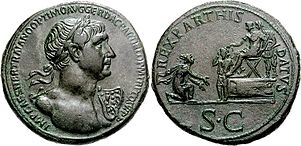
Sestertius ( lat. Sestertius ) is an ancient Roman silver coin (since August - from a copper alloy ) in denominations of two asses and one semis (½ asa), which is fixed in its name. Literally, it means "half of the third" ( Latin semis + tertius ), that is, two asses and half of the third. The denomination of the coin was denoted by the abbreviation IIS ( HS or IIS ), where II is the Roman numeral , meaning two asses, S is sevens (half). According to one of the versions, this designation became the prototype of the dollar sign - $ [1] [2] .
By 217 BC. e. (211 or 269 in other versions) in Rome was introduced a new monetary system with gold, silver and bronze coins, the basis of which was a silver denarius equal to 10 assam. Silver coins were minted - denarii (10 asses), quinarians (5 asses) and sesterces (2 ½ asses). Denarius weighed about 4.55 g (test 980) or 1 ⁄ 72 pounds (4 scrubs).
Content
See also
- Coin system of ancient Rome
- Sestertia symbol
- Dollar symbol
Notes
- ↑ Cajori (v. II), 2007 , pp. 15-29.
- ↑ America's silver dollars, Vol. 2. / By John M. Kleeberg. - American Numismatic Society, 1995. - P. 3
Literature
- Mattingly G. "Coins of Rome". - M .: Collector's Book, 2005.
- A History of Mathematical Notations / by Florian Cajori. - Vol. I. - New York: Cosimo, 2007. - ISBN 978-1-60206-685-4 .
- A History of Mathematical Notations / by Florian Cajori. - Vol. Ii. - New York: Cosimo, 2007. - ISBN 978-1-60206-714-1 .
Links
- Obnorsky N.P. Sestertius // Encyclopedic Dictionary of Brockhaus and Efron : in 86 tons (82 tons and 4 extra). - SPb. , 1890-1907.
- Nummus // Real Dictionary of Classical Antiquities / ed.-comp. F. Lubker ; Edited by members of the Society of Classical Philology and Pedagogy F. Gelbke , L. Georgievsky , F. Zelinsky , V. Kansky , M. Kutorgi and P. Nikitin . - SPb. 1885.