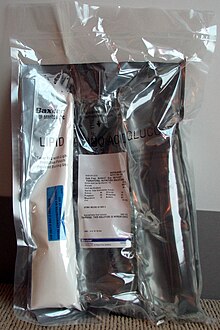
Artificial nutrition - the introduction of nutrients into the body when it is impossible to eat through the mouth. It can be parenteral (usually intravenous, through the central or peripheral veins), probe (when nutrients are introduced into the stomach , duodenum or jejunum - enteral nutrition) or can be carried out through a stoma placed on the gastrointestinal tract [1] . Previously, artificial nutrition was also introduced in enemas, which was recognized as irrational [2] .
Artificial nutrition is used after operations on the gastrointestinal tract , accompanied by loss of consciousness of severe head injuries, facial injuries, peritonitis , pancreatitis , enterocolitis, anorexia , some mental illnesses and so on. It can be either complete when all the nutrients are found in the process of nutrition, or incomplete or auxiliary [1] .
Nutrient mixtures for enteral nutrition are divided into polymeric (full-bodied mixtures based on natural high-quality products, suspensions or solutions, concentrates and soluble powders), monomer diets (proteins and carbohydrates in hydrolyzed form) and nutritional modules [1] .
Notes
- ↑ 1 2 3 V.G. Cheberyak. Artificial nutrition // Brief Medical Encyclopedia . - 2. - M .: Soviet Encyclopedia, 1989.
- ↑ Artificial nutrition // Great Soviet Encyclopedia : [in 30 vol.] / Ch. ed. A.M. Prokhorov . - 3rd ed. - M .: Soviet Encyclopedia, 1969-1978.