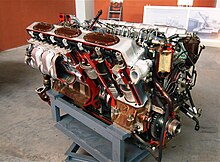
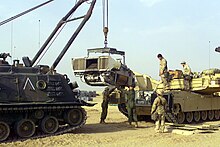
A tank engine is an internal combustion engine that is intended for installation on tanks ; Often, tank engines are also installed on armored personnel carriers and self-propelled artillery installations , etc. [1] [2] .
The main requirements for a modern tank engine are its compactness, reliability in different climates, high energy performance, efficiency and multi-fuel capacity [1] .
Before World War II , automobile and adapted aircraft engines were generally used as tank engines ; by the 1950s, they were completely supplanted by engines of special development. Currently, modern multi - fuel diesel engines with a capacity of 735–880 kW (1,000–1,200 hp) and more are used in modern tanks; gas turbine engines with power up to 1,100 kW (1,500 hp) [1] [2] are also used .
In addition to internal combustion engines, at different times, attempts were also made to equip the tanks with power plants of a different type, which did not have, however, much success. During the First World War and the interwar period there existed (including in the USSR ) a number of projects of tanks with a steam engine . Some steam tanks (for example, the American flame-throwing steam tank of 1918 ) were implemented in metal, but in general, experiments on the use of steam engines as tank engines were unsuccessful. During the Cold War , the United States was actively working on the concept of a so-called atomic tank , on which the nuclear power plant was to be used as an engine, but did not receive practical work in this direction.
In the early stages of the development of tank building, the gasoline carburetor engine of the automobile and later aviation type (including star-mounted motors) was usually used. Immediately before World War II, as well as during it, diesel engines became widespread (mainly in the USSR and the USA ), which became the main type of tank engines around the world in the second half of the 1950s, later replaced by multi-fuel engines, and in the last two Three decades and gas turbine engines (GTE) . The first production tank with GTE as the main engine was the Soviet T-80 [3] .
Power, reliability and other parameters of tank engines are constantly growing and improving. If on the early models they were content with actually automobile engines, then with an increase in the mass of tanks in the 1920s - 1940s. Adapted aircraft engines [4] became widespread, and later - specially designed tank diesel (multi-fuel) engines. To ensure acceptable performance of the tank, the specific power of its engine (the ratio of engine power to the combat weight of the tank) must be at least 18-20 liters. s./t.
| Producing country | Model of tank | Combat weight, t | Engine power, l. with. | Specific power, l. s./t | engine's type |
|---|---|---|---|---|---|
| France | Leclerc | 54.6 | 1500 | 27.4 | diesel |
| Russia | T-80U | 46.0 | 1250 | 27.2 | gas turbine |
| USA | M1A2 Abrams | 62.5 | 1500 | 24.0 | gas turbine |
| Germany | Leopard 2 A5 | 62.5 | 1500 | 24.0 | diesel |
| Israel | Merkava Mk.4 | 65.0 | 1500 | 23.1 | diesel |
| Russia | T-90 S | 46.5 | 1000 | 21.5 | diesel |
| Israel | Merkava Mk.3 | 60.0 | 1200 | 20.0 | diesel |
| Great Britain | Challenger 2 | 62.5 | 1200 | 19.2 | diesel |
In the 1930-1950s. There were disputes between supporters and opponents of using as a power plant tanks of two types of internal combustion engines - carburetor and diesel. This dispute ended with the final victory of the supporters of diesel engines. Nowadays, the main controversy is between supporters and opponents of the use of diesel engines and gas turbine engines on tanks. Both types of engines have their own advantages and disadvantages. During the First World War , a steam tank was built, and in the 1950s, a number of atomic tank projects were developed in the United States, but these types of propulsion systems did not end up being distributed.
| Advantages of GTE over a diesel engine | Advantages of a diesel engine over GTE |
|---|---|
|
|
Comparative troop tests of T-64A and T-72 tanks with 5TDF and V-46 diesel engines, respectively, and T-80 with the GTD-1000T gas turbine engine, conducted by a government commission, showed [8] :
- T-80 tanks, whose nominal power density exceeded T-64A and T-72, respectively, by 30 and 25%, have an advantage in tactical speeds in European conditions only by 9-10%, and in Central Asia - no more than 2% .
- Hourly fuel consumption of gas turbine tanks was 65–68% higher than diesel ones, kilometer consumption was 40–50%, and the range of the fuel was 26–31% lower; this led to the need, when organizing marches, to provide for the possibility of refueling T-80 tanks during daily crossings.
- At an altitude of 3 km above sea level, the power loss in the 5TDF engine reached 9%, in the B-46 - 5%, and in the GTD-1000T - 15.5%.
Diesel tanks are currently located in tank parks of 111 countries of the world, and gas turbine tanks are in tank parks of 9 countries of the world. The developers, manufacturers and suppliers of gas turbine tanks are the United States and Russia (Soviet Union). Diesel tanks form the basis of tank parks of armies of all countries of the world, with the exception of the USA [9] . The development of world tank design and tank market in 2003—2012. 25 special programs are defined, of which 23 relate to diesel tanks, only 2 to gas turbines [10] . In Germany, MTU Friedrichshafen is currently developing new high-tech diesel engines of the fourth generation 890 series for future armored combat vehicles [11] . Many countries that buy tanks prefer models with a diesel engine and even require the replacement of gas turbine engines with diesel engines as a condition for admission to the tender. For example, in 2004, Australia chose the Abrams M1A2 tank as its future tank, but on the condition that the GTD tank in it would be replaced with a diesel engine [12] . In the USA, even specifically for export purposes, the Abrams M1A2 tank with a diesel engine was developed [13] .
There are design solutions to significantly improve the performance of diesel engines. In general, despite the statements of supporters of each type of engine, at the present time it is impossible to speak of the absolute superiority of one of them.
Modern GTE, as a rule, multi-fuel, can work on the whole range of fuels: gasoline of all types, including high-octane aviation gasoline, jet fuel, diesel fuel with any cetane number , but the nominal fuel in peacetime for them is aviation kerosene . The vast majority of diesel engines are equipped with a turbocharging system, and in recent years - and intercoolers of charge air ( intercoolers ).
Notes
- ↑ 1 2 3 Tank Engine // Military Encyclopedic Dictionary / Prev. Ch. ed. Commission S. F. Akhromeev , and. about. chapters ed. S.G. Shapkin. - 2nd ed. - M .: Military Publishing , 1986. - p. 730. - 863 p. - 150 000 copies
- ↑ 1 2 Tank Engine // Dictionary of military terms / Comp. A. M. Plekhov, ed. S.G. Shapkin. - M .: Military Publishing , 1989. - p. 292. - 335 p. - 65 000 copies - ISBN 5-203-00175-8 .
- ↑ Main battle tank T-80 Museum of Technology Archived February 17, 2009.
- ↑ ... And our tanks are fast
- ↑ Diesel or gas turbine - the dispute continues Archival copy of October 17, 2007 on the Wayback Machine Military history forum (inaccessible link from 08-03-2018 [514 days])
- ↑ The World's Best Tanks. - 1999.
- ↑ What is the best diesel? Independent Military Review
- ↑ Equipment and weapons. - 2005. - № 4 .
- ↑ Jane's Armor and Artillery. - 2003—2004.
- ↑ Military Vehicles Forecast. - Forecast International / DMS, 2003.
- ↑ Jane's International Defense Review. - February 2005.
- ↑ The future is for diesel tanks Archival copy of October 10, 2006 on the Wayback Machine Military Industrial Courier (inaccessible link from 08-03-2018 [514 days])
- ↑ Jane's Armor and Artillery. - 2004–2005.
Literature
- Tank Engine // Radio Control - Tachanka / [under total. ed. N.V. Ogarkova ]. - M .: Military Publishing House of the USSR Defense Ministry , 1980. - P. 672-673. - ( Soviet military encyclopedia : [in 8 t.]; 1976-1980, t. 7).
- Military Encyclopedic Dictionary / Prev. Ch. ed. Commission S. F. Akhromeev , and. about. chapters ed. S.G. Shapkin. - 2nd ed. - M .: Military Publishing , 1986. - 863 p. - 150 000 copies
- Dictionary of military terms / Comp. A. M. Plekhov, ed. S.G. Shapkin. - M .: Military Publishing , 1989. - 335 p. - 65 000 copies - ISBN 5-203-00175-8 .