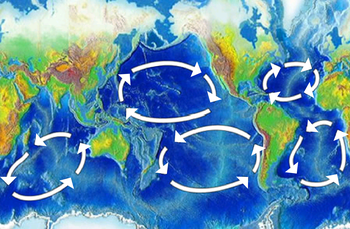

Ocean circulation is a system of closed sea currents , manifested on the scale of the oceans or the entire globe . Such currents lead to the transfer of matter and energy in both latitudinal and meridional directions, which is why they are the most important climate-forming process, affecting the weather anywhere in the world.
The main reason for the circulation of the ocean is the rotation of the Earth around its axis and the Coriolis force resulting from this rotation, according to which the main cycles of ocean currents in all world oceans have an anticyclonic direction (clockwise in the Northern Hemisphere and counterclockwise in the Southern Hemisphere).
In addition, surface winds are significantly affected by stable winds, which are mainly determined by the uneven distribution of solar energy on the planet's surface. The currents caused by the winds are called winds and are surface, which makes them obviously observable.
There are many other factors affecting sea currents, such as: the influence of the moon ( tides ), the topography and shape of the continents, the bottom topography, the discharge of mainland waters, the chemical and physical composition of sea waters ( Thermohaline circulation ), etc.
See also
- Ocean , oceans
- Sea currents
- General atmospheric circulation
Links
- Sea currents - an article from the Great Soviet Encyclopedia .
- Sea currents // Brockhaus and Efron Encyclopedic Dictionary : in 86 volumes (82 volumes and 4 additional). - SPb. , 1890-1907.