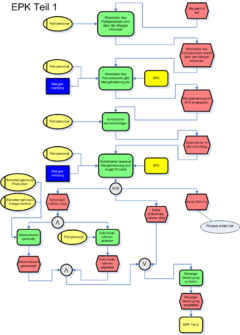
Event -driven process chain (EPC diagram) is a type of flowchart used for business modeling . EPC can be used to configure an enterprise resource planning (ERP) system, [1] and to improve business processes .
Description
Organizations use EPC diagrams to plan workflows of business processes. There are a number of tools for creating EPC diagrams; some of these tools support a non-volatile EPC data exchange format - the EPML markup language. EPC diagrams use several types of symbols to show the structure of the control flow (sequence of decisions, functions, events, and other elements) of a business process.
The EPC method was developed by August-Wilhelm Scheer as part of the work on the creation of ARIS in the early 1990s [2] . Used by many organizations for modeling, analysis and reorganization of business processes.
Process Event Chain Elements
Events are passive elements in EPC. An event is a state that occurs before or after a function, that is, it fixes the state of certain parameters at a certain point in time. Examples of events: “contract signed”, “demand recorded”, “material in stock”. In EPC, the event graph is represented as a hexagon. EPC diagrams should both begin with an event and end with an event.
Functions are active elements in the EPC. Work is a specific action performed over a period of time. Each work can be decomposed.
Organizational unit - a position in the organization (for example, “senior master”) or a unit of the organization (for example, “procurement department”), an element that can be entrusted with the performance of a function.
Information, material, or resource object - objects in the real world, for example, business objects, various entities, which can be either input data acting as the basis of a function or output data obtained using a function. Examples are “material”, “order”, depicted as a rectangle.
Logical connector - a control in the diagram that determines the branching of the workflow depending on the completion of the function or the occurrence of events.
If function F1 is completed, either event E1 or event E2 will occur. | If either event E1 or event E2 has occurred, then function F1 starts |
Logical relationships are the controls responsible for articulating flows — conjunction , disjunction, or strict disjunction .
The control flow connects events with functions, process paths, or logical relationships, creating a chronological sequence or logical interdependence between them. The control flow is represented as a dashed arrow.
The flow of information is the connection of a function and incoming and outgoing data from which a function reads changes or makes them themselves.
The purpose of an organizational unit is the relationship between an organizational unit and the function for which it is responsible.
A process path is an element that shows the relationship with other processes.
Notes
- ↑ Bart-Jan Hommes (2004). The Evaluation of Business Process Modeling Techniques . TU Delft. p.137.
- ↑ A.-Z. Scheer (2002). “ARIS. Vom Geschäftsprozess zum Anwendungssystem. " Springer p. 20.