The 1957 Eurovision Song Contest became the 2nd Eurovision song contest . It was held March 3, 1957 in Frankfurt am Main ( Germany ) in the studio of the ARD television company. This contest explains well why today there is a rule of song duration of three minutes. The song All , submitted by the UK , lasted only 1 min. 52 sec (one of the shortest songs in the history of the contest), and the next song, representing Italy ( Corde della mia chitarra ), lasted 5 minutes. 9 sec (the longest song in the history of the contest). Three countries participated in the competition for the first time, and the total number of participating countries reached 10. Not only soloists, but also duets got the right to participate in the competition. For the first time, the votes of the national jury were transmitted by telephone. The winner of the first competition, Swiss Liz Assia, again took part in it, but took only eighth place, and the Dutchwoman Corrie Brocken won the competition with the song “Net als toen”. [one]
| Eurovision 1957 | |
|---|---|
 | |
| Dates | |
| The final | March 3, 1957 |
| Carrying out | |
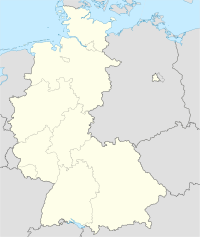
| Location |  Großer sendesaal des hessischen rundfunks Großer sendesaal des hessischen rundfunksFrankfurt , Germany |
| Leading | Anaid Ilikyan |
| Conductor | Willy Burking |
| Executive supervisor | Rolf Lieberman |
| Main broadcaster | ARD |
| Interval act | not |
| Members | |
| Total participants | ten |
| Debuting |
|
Map of participating countries   | |
| results | |
| Voting system | Each country had 10 judges, each of whom could give one vote to the song he liked. |
| Zero points | not |
| Winning song |  " Net als toen " ( Netherlands ) " Net als toen " ( Netherlands ) |
| Eurovision | |
| ← 1956 • 1957 • 1958 → | |


Venue

Frankfurt am Main ( German: Frankfurt am Main - often simply called Frankfurt , the largest city in Hesse and the fifth largest in Germany with a population of 672,000 people (as of 2009). The population with suburbs is 2,295,000 inhabitants [2] .
Located on the River Main , Frankfurt is the financial and transport center of Germany and the largest financial center of continental Europe. It houses the European Central Bank , the Federal Bank of Germany , the Frankfurt Stock Exchange and the Frankfurt Trade Fair . Frankfurt Airport ( German: Flughafen Frankfurt am Main / Rhein-Main-Flughafen ) is one of the busiest international airports, and the German ( German Frankfurt Hauptbahnhof ) and the German ( German Frankfurter Kreuz ) one of the largest terminals in Europe and the busiest transport route of continental Europe. Frankfurt is the only German city included in the “twenty alpha cities of the world” [3] . The headquarters of the American army in Germany was located in Frankfurt, and the city itself was located in the American Occupation Zone ( German Besatzungszone ) after the end of World War II.
The venue for the second Eurovision Song Contest was the Großer Sendesaal des hessischen Rundfunks building, which was used as a music room and television studio. It is also the former headquarters of the Hessian Broadcasting radio station. Today it is used only as a music room.
Format
This year, the representative of Italy Nuncio Gallo sang a song lasting 5 minutes. 9 sec (the longest song in the history of the contest), while the representative of the UK performed her song in 1 min. 52 sec (one of the shortest songs in the history of the contest). After that, the organizers of the contest decided to set a song duration limit of 3 minutes; this rule is still valid.
Also, duets were allowed to participate in the competition. Danish representatives Birte Wilke and Gustav Winkler were the first duo in the history of the competition. At the end of their performance, the couple kissed, and this kiss went down in the history of the contest as the longest. Although only people who had televisions could see him.
This was the first time the jury had phoned. The Netherlands won the competition for the first time. Another notable change was that the jury cannot vote for their country; this rule also applies to this day.
Participating countries
Belgium , France , Germany , Italy , Luxembourg , the Netherlands and Switzerland took their second part in the competition, after their debut in 1956. Austria , Denmark and the United Kingdom made their debut, although these countries wanted to participate back in 1956, but because the deadline for filing applications set by the European Broadcasting Union for the competition had expired, they missed it. Together with the acceding countries in 1957, their total number was equal to ten, which is three more than at the very first competition . [one]
Returning Artists
- Switzerland : Liz Assia ( 1956 Eurovision Song Contest ) [1]
- Netherlands : Corrie Brocken ( 1956 Eurovision ) [1]
Returning as Songwriters
- Switzerland : Geo Womard (songwriter Switzerland 1956 ) [1]
- Switzerland : Emil Garde (songwriter Switzerland 1956 ) [1]
Results
| No. | A country | Language [4] | Executor | Song | Transfer | Location [5] | Glasses |
|---|---|---|---|---|---|---|---|
| 01 | Belgium | Dutch | Bobbeian Schupen | Straatdeuntje | Street music | eight | five |
| 02 | Luxembourg | French | Daniel Dupre | Amours mortes (tant de peine) | Love is dead (so much pain) | four | eight |
| 03 | Great Britain | English | Patricia Bredin | All | Everything | 7 | 6 |
| 04 | Italy | Italian | Nuncio Gallo | Corde della mia chitarra | Strings of my guitar | 6 | 7 |
| 05 | Austria | Deutsch | Bob martin | Wohin, kleines pony? | Where are you little pony? | ten | 3 |
| 06 | Netherlands | Dutch | Corrie Brocken | Net als toen | As before | one | 31 |
| 07 | Germany | Deutsch | Margot Hilscher | Telefon, Telefon | Telephone, telephone | four | eight |
| 08 | France | French | Paul Desjardins | La belle amour | Beautiful love | 2 | 17 |
| 09 | Denmark | Danish | Birte Wilke and Gustav Winkler | Skibet skal sejle i nat | The ship sets sail at night | 3 | ten |
| ten | Switzerland | French | Liz Assia | L'enfant que j'étais | Baby i was | eight | five |
Voting
| results | ||||||||||||
|---|---|---|---|---|---|---|---|---|---|---|---|---|
| Belgium | five | - | - | - | - | - | 2 | - | 2 | one | ||
| Luxembourg | eight | - | one | four | 3 | - | - | - | - | - | ||
| Great Britain | 6 | one | one | - | one | one | - | - | - | 2 | ||
| Italy | 7 | one | one | 2 | - | 2 | - | - | one | - | ||
| Austria | 3 | - | - | 2 | - | one | - | - | - | - | ||
| Netherlands | 31 | five | 3 | one | one | 6 | one | four | 3 | 7 | ||
| Germany | eight | one | - | - | one | - | - | 6 | - | - | ||
| France | 17 | 2 | four | 2 | - | - | one | 6 | 2 | - | ||
| Denmark | ten | - | - | 2 | 3 | - | five | - | - | - | ||
| Switzerland | five | - | one | - | one | - | - | one | - | 2 | ||
Broadcast
The table below shows the order in which the votes were cast during the 1957 contest, together with the herald who was responsible for the announcement of the votes in the respective countries. Each national broadcaster also sent commentators to the contest, in order to ensure coverage of the contest in their native language. Detailed information on commentators and broadcasters is also presented in the table below. [6]
Heralds
- Switzerland - Mani Weber
- Denmark -?
- France - Claude Darget
- Germany - Joachim Fuchsberger
- Netherlands - Willem Duis
- Austria -?
- Italy - Nuncio Filogamo
- Great Britain - David Jacobs
- Luxembourg -?
- Belgium - Bob Van Bel
Commentators
- Austria - Emil Collpacher ( ORF )
- Belgium - Anton Peters ( NIR ), Jeanine Lambotte ( INR )
- Denmark - Gunnar Hansen ( Statsradiofonien TV )
- France - Robert Beauvais ( RTF ) [7]
- Germany - Wolf Mittler ( Deutsches Fernsehen )
- Luxembourg - Jacques Navadique ( Télé-Luxembourg )
- Italy - Bianca Maria Pichchinino ( Programma Nazionale )
- Netherlands - Pete te Neil ( NTS ) [8]
- Sweden - Niels Lynnman ( Radiotjänst TV ) [9]
- Switzerland - Georges Hardy ( TSR )
- UK - Berkeley Smith ( BBC Television Service ), Tom Sloan ( BBC Light Program )
Links
Notes
- ↑ 1 2 3 4 5 6 the show Eurovision Song Contest 1957 . EMU . Date of treatment June 11, 2012.
- ↑ World Urban Areas (PDF). Date of treatment September 20, 2007. Archived August 23, 2011.
- ↑ World Cities . Date of treatment January 23, 2007. Archived August 23, 2011.
- ↑ Eurovision Song Contest 1957 . The Diggiloo Thrush. Date of treatment March 4, 2012.
- ↑ Scoreboard results . Eurovision Song Contest 1957 . EMU . Date of treatment June 11, 2012.
- ↑ Eurovision 1957 Cast and Crew . IMDb Date of treatment March 5, 2012.
- ↑ Concours Eurovision de la Chanson 1957 (French) . Songcontest.free.fr (September 18, 2006). Date of treatment May 21, 2013. Archived May 23, 2013.
- ↑ Nederlandse televisiecommentatoren bij het Eurovisie Songfestival (nid.) . Eurovision Artists . Archived May 23, 2013.
- ↑ Leif Thorsson. Melodifestivalen genom tiderna ["Melodifestivalen through time"] (2006), p. 10. Stockholm: Premium Publishing AB. ISBN 91-89136-29-2