

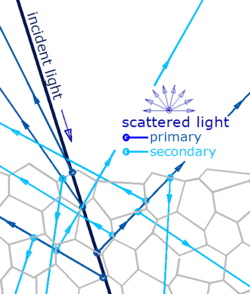
Diffuse reflection (from the Latin diffusio “propagation, spreading, scattering; interaction”) is the reflection of a light flux incident on a surface at which reflection occurs at an angle different from the incident one and not necessarily lying in the plane of the incident ray and normal to the surface ( mirror reflection).
Reflection becomes diffuse if surface irregularities are of the order of the wavelength (or exceed it) and are randomly located [2] . The criterion for surface roughness in reflection is the Rayleigh criterion:

- Where - the height of the bumps;
- - wavelength of incident light;
- - angle of incidence to the surface.
- - wavelength of incident light;


The same surface can be matte, diffusely reflective for visible or ultraviolet radiation , but smooth and mirror reflective for infrared radiation . In the case of mixed light reflection, part of the radiation is reflected specularly , and part - diffusely.
Diffuse reflection from smooth surfaces is also possible if there are light scattering centers in the transparent medium of the surface material — heterogeneities, for example, polished white marble or milk surface.
In astronomy, it is numerically characterized by a reflection coefficient relative to a completely white body, the reflection of which is taken as 1, called the albedo .
Links
- ↑ Scott M. Juds. Photoelectric sensors and controls: selection and application . - CRC Press, 1988. - P. 29. - ISBN 9780824778866 .
- ↑ Reflection of light // Great Soviet Encyclopedia : [in 30 vol.] / Ch. ed. A.M. Prokhorov . - 3rd ed. - M .: Soviet Encyclopedia, 1969-1978.