Ornitholestes ( lat. Ornitholestes hermanni , from other Greek ὄρνις - bird and λῃστής - robber) - a species of dinosaurs of the Jurassic period .
| † Ornitholestes |

Reconstruction of the appearance | 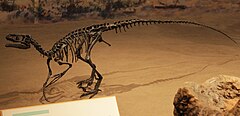
Ornitholestes skeleton |
|
| Scientific classification |
|---|
| No rank : | Bilateral symmetrical |
| Infraclass : | Archosauromorphs |
| No rank : | Archosauriformes |
| Gender: | † Ornitholestes Osborn, 1903 |
|
| International scientific name |
|---|
Ornitholestes hermanni
Osborn , 1903 |
|
A small two-legged predator with long legs. The view was described in 1903 by Henry Firefield Osborne . In 1900, parts of the skeleton of ornitholestes were discovered in the quarry of Como Bluff ( USA ). Birdworms lived in valleys and river deltas in central North America , about 154 million years ago. Type species - O. hermanni . The name “bird robber” was given in error: as soon as his skeleton was found, scientists decided that the ornitholestes ran and caught flying birds. In fact, at the end of the Jurassic period, there were no birds in North America.
The length of ornitholestes is 2 m. The head is proportionally shorter than that of many other predatory dinosaurs, but it is firmly folded. The orbits are quite large. The front teeth are somewhat conical, and the posterior more serrate. In the upper jaw there are 10 teeth, and in the lower - 12. The males may have had a nasal scallop, apparently used in mating rituals. The neck is relatively short and S-shaped. The tail is long and whip-like, accounting for more than half of the entire length. The structure of the skeleton resembles modern birds. On the front legs, one of the three fingers was opposed to the other two, which allowed the bird to grab and hold the prey: small lizards or mammals.

