The Danish-Norwegian operation or Operation Weserubung ( it. Fall Weserübung ), also: “The exercise at Weser” or “Weser maneuvers” - the German operation to seize Denmark ( Weserübung-Süd ) and Norway ( Weserübung -Nord ( him. Weserübung-Nord )) during the Second World War in April-June 1940.
| Danish-Norwegian operation | |||
|---|---|---|---|
| Main conflict: World War II | |||
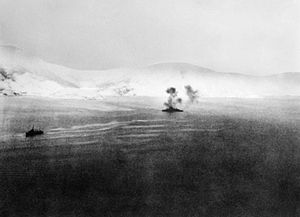 Sea battle near Narvik | |||
| date | April 9 - June 8, 1940 | ||
| A place | Denmark , Norway , North Sea | ||
| Total | The decisive victory of Germany. The occupation of Denmark and Norway by German troops. | ||
| Opponents | |||
| |||
| Commanders | |||
| |||
| Forces of the parties | |||
| |||
| Losses | |||
| |||


Background
Political Environment
Since the days of the Crimean War, the Scandinavian countries have adhered to the principle of neutrality in foreign policy [2] . From 1905 until the end of World War I, Great Britain and Germany put pressure on Norway because of the geographical position of this country, which allowed them to control the east of the North Sea [3] . Immediately before the start of the war, Denmark, Sweden and Norway held a series of summits where they emphasized their will to neutrality [4] . However, the warring parties forced the northern countries to indirectly participate in the war: Sweden and Norway transferred a significant part of their merchant fleet to the Entente , and Germany forced Denmark to partially block the Great Belt mines with mines [4] . At the end of the war, Norway, at the request of Great Britain, laid a minefield in its waters against German submarines [5] . After the defeat of Germany in the First World War, Denmark regained northern Schleswig , rejected in 1864 [5] .
On the eve of the new world war, the Scandinavians continued to maintain neutrality [5] . On May 31, 1939, a non-aggression pact was concluded between Denmark and Germany; Sweden and Norway rejected similar proposals without feeling threatened by the straits [6] . The Germans tried unsuccessfully to conclude an agreement with Norway, followed by a number of incidents: the American merchant ship City of Flint captured by the Deutschland cruiser was confiscated in October in Haugesund ; in late November, the Norwegians allowed the German ship Westerwald to enter the military port of Bergen ; On December 7–13, in the Norwegian waters of a German submarine, the British or British Walton, Deptford, and Harodfelia ships were sunk [7] .
In January 1940, the British Foreign Secretary, Lord Halifax, declared that this was forcing Britain to extend warfare to the Norwegian territorial waters [7] . It was decided to develop a plan to seize ports on the Norwegian coast, in particular Narvik , from which it was possible to occupy Swedish mines, and also to come to the aid of Finland defending against the Soviet Union [8] . The French , after the “Gelb” plan “flew” to them , were interested in opening a second front to divert the forces of the Wehrmacht [8] . At one of the receptions with the participation of journalists from the Scandinavian countries, Churchill said , as if in passing, “Sometimes it is possible to wish the northern countries to be on the opposite side, and then it was possible to capture the necessary strategic points.” “One gets the impression,” the future UN Secretary-General, Trygve Lee, wrote about this event, “that Churchill made his statement with a clear intention to make it reach the ears of the Germans” [9] . Shells were created for shipment to the Balkans and Narvik [10] .
During the autumn-winter of 1939-1940, the United Kingdom carried out a series of actions compromising the neutrality of Norway. The country was subjected to political pressure in order to obtain a significant share of its trade tonnage, they tried to impose a one-sidedly profitable trade agreement, made demands that could not be fulfilled without departing from the generally accepted norms of neutrality. At the very beginning of the war - September 5 - the British government published an extensive list of goods that it qualified as military smuggling. The adoption of this list led to the fact that a significant part of Norwegian exports to Germany was banned, and the country's foreign trade fell under English control. The Norwegian government was forced to evade the requirements of Whitehall [9] . Of particular interest was the Norwegian merchant fleet, which included 1,300 steamers (totaling 1.78 million brt ) and 682 steam-ships (totaling 2.98 million brt). Through government and private treaties at the start of the war, the UK was able to use Norwegian ships with a total capacity of 2,450,000 gross gross tons (1,650,000 of which were tankers) [11] .
Developing the Weather Exercise operation
For the Germans, Norway was both the key to the North Sea and the transit of Swedish ore; grandmaster-admiral Erich Raeder, the commander-in-chief of the kriegsmarine, particularly insisted on her capture. [12] On December 14, 1939, the Wehrmacht command received a task from Hitler to investigate the possibility of seizing Norway [13] . Initially, the General Staff was skeptical about the necessity and possibility of achieving this goal, but on January 27 a separate headquarters was created to develop a plan under the code name “Weser Exercises” ( German Weserübung ) [14] . The incident with Altmark on February 16 weakened the position of the opponents of the operation, and from that point on, preparation for it was forced [15] . On February 24, the headquarters of the 21st Corps, under the leadership of General Nikolaus von Falkenhorst, began a detailed development of the operation [16] , and after 5 days already presented the finished project to Hitler [17] . The principal feature of the plan was the desire to carry out lightning simultaneous landings in key cities, if possible without the use of weapons [18] . Raeder advised to carry out the landing until April 7, that is, until the end of the polar night [19] . At a meeting on April 2, Hitler appointed the “ninth number” of the “Weser Day” (disembarkation) [20] . Contacts were established with the leader of the slightly popular Norwegian party Nasjonal Samling , Vidkun Quisling , although this had no effect on the military operation [21] .
Initially, the operation was planned on the basis of a simultaneous offensive on the Western Front , so the minimum number of ground units was allocated to it: the 3rd Mountain Division, Major General Edward Dietl, and some reserve regiments [22] . It was later decided to divide operations in time in order to preserve operational and political freedom, and therefore considerable forces were attached to the northern campaign. The first echelon on the Norwegian coast should have landed the 69th and 169th infantry and 3rd mountain rifle divisions; the second is the 181st and 196th ; the third is the 214th [18] . Although a violation of the neutrality of another country was undesirable in political terms, the operation also included the seizure of Denmark: Jutland’s airfields were needed to supply the Norwegian landing force; it was necessary to ensure the safe movement of maritime transport through the Danish straits [22] . For Denmark, the 170th , 198th Infantry Divisions and the 11th Motorized Brigade were assigned [18] .
Almost all ships of the Reich military and merchant fleets were used for the operation [23] . The transport ships were planned to be unloaded in the seized ports immediately after landing, therefore the ships for Narvik had to leave 6 days before the “Weser Day” [17] . The warships could go out 3 days later, so that the point of no return of the beginning of the operation began at this very moment [17] . Kriegsmarine fell for the first time to transport large ground units, so submarines were used to cover the landing force and attacks against possible counter-landing forces [24] . The surface fleet had already suffered significant losses and now had the following forces: the battleships Scharnhorst and Gneisenau , the pocket battleship Lutzov , 2 heavy and 4 light cruisers, 14 destroyers , 7 torpedo boats [25] .
The Luftwaffe was charged with: transporting paratroopers and ground units to Aalborg , Oslo , Kristiansand , Stavanger and Bergen ; to defend the ships and provide support to the Wehrmacht aerial support [26] . These tasks were assigned to the 10th Air Corps of Lieutenant-General Heisler [27] . It includes the 4th, 26th, 30th battle squadrons , the 100th battle squadron group, 3 anti-aircraft units, a paratroopers battalion, 7 air transport groups, one land and a sea transport squadron [27] .
The zones of responsibility were divided as follows: Naval Forces group "Vostok" ( Admiral Rolf Carls ) - command on the water to Skagerrak ; The West Navy group ( General-Admiral Alfred Saalwachter - command in the North Sea and Norwegian waters; 21st Corps (General Falkenhorst) - in Norway after disembarkation; 31st Corps (Aviation General Kaupish ) - actions in Denmark; 10- th Air Corps (Lieutenant-General Heisler) - support for land and sea forces in Norway and Denmark [28] . At the same time, both naval groups were subordinated directly to the OKM , the 31st Army Corps - the 21st Corps, the 10th Air Corps - command Air Force [28] .
Developing Operation Wilfred and Plan R4
Britain, for its part, was planning to seize the Scandinavian countries for dispersing German forces and maintaining an economic blockade. For this, the British Defense Ministry planned several independent operations. In order not to be involved in the war with the USSR, British Prime Minister Chamberlain proposed to mine the Norwegian territorial waters (which Churchill had insisted on a long time ago) and thus expel the German ore carriers from their three-mile limits, at which the requirements of neutrality were met, under the blows of naval forces Allies, whose superiority to the sea was undeniable. The operation, code-named "Wilfred", did not expect to meet a strong German opposition [9] .
On March 31, the cruiser Birmingham with the destroyers Firless and Hostail were sent to the shores of Norway to intercept German ships breaking through to Germany. In addition, they were given the task of capturing the enemy’s fishing trawlers and covering up their forces, which were to lay mines. The detachment operated on the Norwegian coast until the evening of April 7, having managed to seize as prizes three German trawlers: Friesland (247 brts), Blankenberg (336 brts) and Nordland (392 brts).
On April 3, the British fleet was instructed to mine Norwegian waters. The exit of the ships was appointed two days later. Production in the framework of Operation Wilfred was to be carried out by several groups of ships:
- the group "WB" (destroyers "Express" and "Intrepid") - in the area of Kristiansund (62 (54'S. w., 6 (55 'E));
- group “WS” (minelayer Tevayet Bank and the destroyers Inglefield, Ileks, Imogen, Isis) - in the area of Stud. (62 (p. sh., 5 (e)) ;
- WV group (20th flotilla of destroyers-barriers (Esk, Impalsive, Ikarus, Ivanhoe) and 2nd destroyers flotilla (Hardy, Hotsper, Hovek, Hunter ") To cover) in the area of Bodø (67 (24 'N, 14) (36' E).
The compound under the command of Vice-Admiral William J. Whitworth (the battle cruiser Rinaun and the destroyers Greyhound, Glouorm, Hyperion, Hirow) was allocated for the operational cover of the barrage groups, as information was received on Narvik Norwegian battleships, moreover, it was impossible to completely eliminate the enemy’s response.
“Since our mining of Norwegian waters could have caused Germany’s response,” Churchill recalled, “it was also decided that an English brigade and French troops should be sent to Narvik to clear the port and advance to the Swedish border. Troops were also to be sent to Stavanger, Bergen and Trondheim. ”
So in general terms, and looked new plan, received the code name "R4" . It looks through the following characteristic solutions:
- reliance on the loyalty of the political leadership of Norway;
- the main emphasis was placed on the conduct of hostilities at sea, plans were made on the basis of the considerable superiority of the British fleet over the German fleet, the main forces were put on the Navy to counter possible German countermeasures;
- in the first echelon, only British troops were involved, in the second - also French and Polish forces;
- no military action was envisaged at this stage in Denmark [29] .
Allied Forces
Norway had 6 divisions, a total of 55 thousand people (after partial mobilization). The Norwegian fleet had 2 battleships of coastal defense, 7 destroyers, 8 minesweepers, 10 minelayers, 17 destroyers, 9 submarines. Norwegian aviation consisted of 190 aircraft. Denmark had 2 divisions, with a total of 14.5 thousand people. The Danish fleet consisted of 2 coastal defense battleships, 9 minesweepers, 3 minelayers, 6 destroyers, and 7 submarines. Danish aircraft had 94 aircraft. Allied troops (Great Britain, France and Poland), consisting of 4 British, 3 French and 1 Polish brigades, were sent to the aid of Denmark and Norway. The British fleet consisted of 3 aircraft carriers, 4 battleships, 21 cruisers, 21 destroyers and 18 submarines. The French fleet consisted of 2 cruisers, 11 destroyers and 1 submarine. The Polish fleet had 3 destroyers and 1 submarine.
Landing Operations
From April 3, German ports left the transports to Stavanger, Trondheim and Narvik [30] . At about 3:00 am on April 7, German warships carrying army units destined for Northern Norway gathered at the Schillig approaches (at the exit from Wilhelmshaven bay) and headed north: they were the Gneisenau battleship (flagship of Vice Admiral Günther Lutjens ) The Scharnhorst, the heavy cruiser Admiral Hipper and 12 destroyers [30] . In the afternoon, the fleet was discovered by British naval aviation, whose command decided that the compound would break into the Atlantic [31] . It sent several fleets to the North Sea and to the line of the Shetland Islands - Iceland [32] . At night, the German fleet fell into a storm that lasted several days: it caused some damage to ships and seriously hampered navigation [32] . At 10 am on April 8, Admiral Hipper rammed and sank the destroyer Glowwalm, which went alone , [33] ; whereupon he and 4 destroyers set off for Trondheim Fjord [34] . At around 21:00, when the compound fell at the West Fjord , the remaining 8 destroyers said goodbye to the battleships and went to Narvik [35] . On the night of April 9, the Norwegian Admiralty ordered to turn off the radio beacons and turn off the lights on the coast [36] . The landing party in both countries was assigned to 5:15, and half an hour before that, the battleships discovered the 2nd flotilla of destroyers Admiral William Whitford with the battle cruiser Rinaun as the flagship [36] . At 5:10, the battle between the British cruiser and the German battleships began, as a result of which the A gun turrets soon broke down, after which they preferred to retreat, which in stormy weather did not present much difficulty [37] .
Norway
Eight destroyers of the 1st airborne group led by the "Wilhelm Heidkamp" entered the Narvik bay on April 9th, where after the negotiations the Norwegian coast guard battleship "Eidsvold" and "Norg" sank [38] . The destroyers landed in the port mountain riflemen; after a brief conversation, the head of the garrison of Narvik, Colonel Zundlo, surrendered the city to Dietlu; however, two companies of the 13th Infantry Regiment did not obey the order and retreated to the Swedish border [34] . At 8:10, the destroyers were transferred to headquarters that Narvik, the main target of the invasion, was captured [34] .
The 2nd group destined for Trondheim - Admiral Hipper and 4 destroyers - for fear of meeting the British fleet already on the night of April 9, stood at the shore in front of the entrance to the Trondheim fjord [39] . At 4 am, the connection with a small artillery firefight overcame a fjord searchlight barrier [40] . At the sixth hour, the 138th Mountain Rifle Regiment began landing in the city and near the southern coastal batteries [41] . The regimental commander, Colonel Weiss, quickly reached the loyalty of local authorities [41] . The German tanker did not arrive, and the warships had a fuel problem, which was why they could not go home on April 9, as planned by the plan [41] . The airfield and the remaining batteries were occupied only on April 11; on the same day the fleet went out to sea [42] .
In the operation against Bergen participated (3rd group) light cruisers "Cologne" (flagship of Rear Admiral Schmundt) and "Koenigsberg" , artillery training ship "Bremse" , 2 destroyers and 5 torpedo boats with an escort ship "Karl Peters" [42 ] . On them were ground units led by the headquarters of the 69th division of Major General Tittel [42] . At 6 pm on April 8, the British fleet of two cruisers and 15 destroyers was 60 miles from the 3rd group, but at night it passed north of the entrance to the Corse Fjord [43] . At 4:30 am, several army units landed at the entrance to the B-fjord to capture the Kvarven battery; at 5:15 the 3rd group entered the fjord [44] . Kvarven's battery responded with fire that damaged the Karl Peters, but the rest of the ships sailed to Bergen harbor [45] . At 6:20, the landing ended, and after 3 hours, the fire batteries of Kvarven and Sandviken [45] were captured. At noon, Bergen was under German control, but in the evening the British fleet of 3 battleships, 10 cruisers and 20 destroyers was to approach the fjord [45] . Schmundt decided to immediately take the ships away, and the army units prepared for the defense of the coast [45] .
During the “Weser time” Stavanger was attacked by dive bombers, after which paratroopers parachuted [45] . Infantrymen and anti-aircraft gunners were delivered by air; the city and the airfield of Sola were captured very quickly [46] . The Norwegian destroyer Aeger sank the German ship Roda in the harbor, after which the Luftwaffe was destroyed [46] . Soon the 193rd Infantry Regiment (Colonel Beeren) of the 69th Division landed in the port, taking control of part of Stavanger [46] . On the morning of April 9, half of the 2nd flotilla of minesweepers seized a cable station in Egersund , and the Norwegian destroyer Skarw was sunk [46] .
Some problems arose in the landing in Kristiansand [46] . The fourth group consisted of a light cruiser “Karlsruhe” (captain Rive), three destroyers and eight torpedo boats [46] . Due to dense fog it was only at 6:00 on April 9 that Riva decided to enter the fjord, where he was attacked by the Odderøe battery [47] . Ironically, just at this time, fleeing the British fleet, a German merchant ship "Seattle" came to the fjord, breaking through the British blockade from Curaçao ; being at the wrong time in an unsuitable place, he was sunk by the Norwegian battery and the destroyer Giller [47] . The batteries, Odderöy and Gleoddin, stubbornly resisted under the attacks of the Luftwaffe, but were captured at noon [48] . By 17:00, the 310th German infantry regiment was stationed in Kristiansand [48] .
The success and speed of the capture of Oslo were extremely important for the Germans, both militarily and politically, but it was this landing that turned out to be the most unsuccessful for them [48] . Half of the 324th Infantry Regiment of the 163rd Division was to fly over to the airfield of Oslo-Forneby after it was captured by a company of paratroopers; the second half of the regiment planned to land in the port of Oslo from the ships of the 5th airborne group [49] . It consisted of the heavy cruisers "Blucher" (the flagship of Rear-Admiral Kummets, it also housed the division headquarters of Major General Engelbrecht) and the "Lutz" , the light cruiser Emden , 3 destroyers, 8 minesweepers and 2 armed whalers [49] . After passing through the searchlight fence between Bolaerne and Rauja, assault groups were sent to capture these fortifications and the main military port of Norway, Horten [49] . Counting that there would be no serious resistance, Kummets decided to break through the narrowest point of the Oslo fjord , the Drebak pass [50] . At the north exit of the passage was the island-fort Oscarsborg [50] . At 5:20, unexpectedly for the Germans, two batteries of the fort opened crossfire from 280-millimeter guns at the first Blucher from a distance of 500 meters [50] . On the cruiser, the fire control system immediately refused and fires began; maneuvering, he fired indiscriminate fire from anti-aircraft guns [51] . At this time, the ship received two torpedo holes from a perfectly camouflaged coastal torpedo installation in Cajolme [51] . At 7:23, “Blucher” sank at a 90-meter depth, 400 meters from the shore [51] . Despite the absence of most of the life jackets and lifeboats, spilled burning fuel and ice (3 degrees Celsius) water, most sailors and soldiers were able to reach the coast; there they were briefly captured by Norwegian captives [51] . “Emden” and “Lutzov” back out of the aisle, after which Captain Thiele (“Lutzov”), who assumed the command, decided to land the infantry at Sonbukten to support Dryobak's breakthrough from land [52] . At that time, the German minesweeper R-17 and the Norwegian submarine A-2 were sunk in the battles for Rauoy and Horten; The Norwegian Admiral passed the port [52] . In the evening, the Luftwaffe attacked Drebak and Oskarsborg; Shuttle negotiations were conducted with batteries in the Oslo fjord [52] . German ships entered the port of Oslo only on the morning of April 10 [52] .
Paratroopers failed to land at Oslo-Forneby during “Weser time” because of strong anti-aircraft fire, but the assault infantry group under the cover of bomber landed and seized the airport [53] . At the ninth hour, the landing of transports began; In the afternoon, infantry under the command of Colonel Polman broke into Oslo, which was soon captured [53] . Small German forces anxiously watched the two Norwegian divisions stationed at Fredrikstad and Gardermoena [53] .
Denmark
On the evening of April 8, the 170th Infantry Division and the 11th Infantry Brigade were constricted to the Danish-German border in Schleswig [53] . At 5:25 on April 9, they crossed the border, the Danish battalion retreated [54] . With local clashes, the 170th division advanced into the interior of Jutland , while the Luftwaffe bombed airfields, on which paratroopers soon landed [54] . The 11th brigade quickly reached Skagen [54] .
On the night of April 9, the 190th Division set sail on the transports from Kiel and Warnemünde [55] . The paratroopers seized the bridge between Falster and Zealand , and Korsør was captured from the sea [55] . This made it possible to quickly occupy Zealand; another navy took Bornholm [55] .
The key to seizing Denmark with little or no struggle was the rapid capture of the capital [55] . For this purpose, the “Hanseatic City of Danzig” motor ship took on board the 308th infantry regiment of Major Glein, went around Zealand from the west and north, and together with the icebreaker “Stettin” entered the port of Copenhagen [56] . From the fort Middelgrund saw the German military flag on the "Danzig"; The commandant ordered a warning shot to be made to stop the court, but the shot was never heard [56] . The "Stettin" stopped, and the "Danzig" landed at the pier at 5:20 [56] . The infantry on bicycles got to , where they began an exchange of fire with the guards [56] . At 7:20 the Danish king Christian X ordered to stop the resistance; German and Danish commanders exchanged politeness visits [56] . Considering that Germany is at war with Sweden, one Danish colonel led the battalion through Øresund to Helsingborg [56] . As early as April 9, the Germans engaged Danish airfields, highways and railways to supply units in Norway [56] .
Battle of Norway
On the night of April 9-10, the Germans attempted to capture King Haakon VII near the city of Elverum , but their attacks were repelled. Overcoming the resistance of the Norwegian troops, the Germans occupied most of southern Norway by April 22. At the same time, some cities where the Norwegian troops resisted were subjected to heavy aerial bombardments: Ondalsnes , Molde , Kristiansand , Steinkjer , Namsos , Bodø , Narvik . During the bombing, many civilians died, cities were destroyed, many residents fled from cities to the countryside. On April 10, near Narvik, a naval battle took place between the approaching forces of the English fleet and the German destroyers. The British managed to sink or damage the German ships near Narvik, thereby cutting off the units of the second and third mountain divisions operating in the city. As a result, the Germans failed in the early days of the campaign to develop an offensive in the north of the country.
On April 13, the British again defeated the forces of the German fleet approaching Narvik , and on April 14 began the landing of the united Anglo-French-Polish contingent in the city of Harstad , where they joined the Norwegian 6th division and launched an offensive on Narvik. On April 14, the Anglo-French contingent landed also in the city of Namsos and launched a dense offensive in the center of the country. On April 17, British forces landed in Ondalsnes . However, the Allied offensive from Namsus and Ondalsnes to the center of the country ended in defeats in the Steinkjer and Lillehammer areas, and they were again forced to withdraw to the coastal cities.
On May 12, the Allies, after long battles, occupied the northern part of Narvik , and on May 28 they occupied the whole city and forced the Germans to withdraw to the West Fjord. However, the plight of the Allies in France forced them to evacuate all their troops from Norway on June 3-8 (operation Alphabet [57] ). Together with them, the Norwegian king and government were evacuated. On June 2, the last Norwegian troops operating in Central Norway surrendered, and on June 10, in Northern Norway. By June 16, the Germans occupied the whole territory of Norway.
Party Losses
During the fighting in Denmark, the losses of the Danish army were 13 people killed [58] , the losses of the German troops - 2 dead and 10 wounded [59] .
During the fighting in Norway, the losses of the Norwegian army amounted to 1,335 people killed and missing, up to 60 thousand prisoners; British troops in combat on land lost 1896 people killed, missing and seriously wounded (the total number of dead and wounded - 4,400 British), French and Polish troops - 530 killed. The British aircraft carrier Glories , an anti-aircraft cruiser, 7 destroyers, 4 submarines were sunk; Damage received 2 battleships and 7 cruisers. The French fleet lost a submarine sunk by 1, the Polish Navy working together with them lost 1 submarine.
German losses in Norway - 1307 killed, 2375 missing and 1604 wounded. Losses in the air amounted to 127 aircraft. The German fleet suffered particularly heavy losses - the heavy cruiser “Blucher”, the light cruisers “Karlsruhe” and “Konigsberg”, 10 destroyers, the artillery training ship “Brummer”, 8 submarines, destroyer, 11 transports and more than 10 small ships were sunk. The battleship “Scharnhorst” and “Gneisenau”, the pocket battleship “Lutzov”, the heavy cruiser “Admiral Hipper”, the light cruiser “Emden”, the artillery training ship “Bremse” [60] were damaged.
Summary
As a result of the successful completion of the campaign the Germans managed to occupy Denmark and Norway. Germany received a strategically important bridgehead in the north of Europe , improved the basing of German submarines and aircraft and ensured the supply of strategic raw materials from the Scandinavian countries. However, the substantial losses of the German fleet, the Kriegsmarine, led to a lack of strength for the landing operation in Britain .
Notes
- ↑ 1 2 Earl Zimke. German occupation of northern Europe. 1940-1945
- ↑ Khubach, Walter. Capture Denmark and Norway. Operation Teachings Weser. 1940-1941 = Die Deutsche Besetzung von Danemark und Norwegen 1940. - Center Polygraph, 2006. - p. 8. - 460 p. - (Behind the front line. Military history). - ISBN 5952424465 .
- ↑ Khubach, Walter. Capture Denmark and Norway. Operation Teachings Weser. 1940-1941 = Die Deutsche Besetzung von Danemark und Norwegen 1940. - Center Polygraph, 2006. - p. 9. - 460 p. - (Behind the front line. Military history). - ISBN 5952424465 .
- ↑ 1 2 Khubach, Walter. Capture Denmark and Norway. Operation Teachings Weser. 1940-1941 = Die Deutsche Besetzung von Danemark und Norwegen 1940. - Center Polygraph, 2006. - P. 11. - 460 p. - (Behind the front line. Military history). - ISBN 5952424465 .
- ↑ 1 2 3 Khubach, Walter. Capture Denmark and Norway. Operation Teachings Weser. 1940-1941 = Die Deutsche Besetzung von Danemark und Norwegen 1940. - Center Polygraph, 2006. - p. 13. - 460 p. - (Behind the front line. Military history). - ISBN 5952424465 .
- ↑ Khubach, Walter. Capture Denmark and Norway. Operation Teachings Weser. 1940-1941 = Die Deutsche Besetzung von Danemark und Norwegen 1940. - Center Polygraph, 2006. - P. 14. - 460 p. - (Behind the front line. Military history). - ISBN 5952424465 .
- ↑ 1 2 Khubach, Walter. Capture Denmark and Norway. Operation Teachings Weser. 1940-1941 = Die Deutsche Besetzung von Danemark und Norwegen 1940. - Center Polygraph, 2006. - P. 15. - 460 p. - (Behind the front line. Military history). - ISBN 5952424465 .
- ↑ 1 2 Khubach, Walter. Capture Denmark and Norway. Operation Teachings Weser. 1940-1941 = Die Deutsche Besetzung von Danemark und Norwegen 1940. - Center Polygraph, 2006. - p. 20. - 460 p. - (Behind the front line. Military history). - ISBN 5952424465 .
- ↑ 1 2 3 Patyanin, Sergey Vladimirovich. “Vezeryubung”: the Norwegian campaign of 1940. - Patyanin S. V. “Vezeryubung”: the Norwegian campaign of 1940 @ 2004 . - 2004. - pp. Ch.1.1. - 360 s. - (Military literature).
- ↑ Khubach, Walter. Capture Denmark and Norway. Operation Teachings Weser. 1940—1941 = Die Deutsche Besetzung von Danemark und Norwegen 1940. — Центрполиграф, 2006. — С. 21. — 460 с. — (За линией фронта. Военная история). — ISBN 5952424465 .
- ↑ Хубач, Вальтер. Захват Дании и Норвегии. Операция «Учение Везер». 1940—1941 = Die Deutsche Besetzung von Danemark und Norwegen 1940. — Центрполиграф, 2006. — С. 16. — 460 с. — (За линией фронта. Военная история). — ISBN 5952424465 .
- ↑ Хубач, Вальтер. Захват Дании и Норвегии. Операция «Учение Везер». 1940—1941 = Die Deutsche Besetzung von Danemark und Norwegen 1940. — Центрполиграф, 2006. — С. 28. — 460 с. — (За линией фронта. Военная история). — ISBN 5952424465 .
- ↑ Хубач, Вальтер. Захват Дании и Норвегии. Операция «Учение Везер». 1940—1941 = Die Deutsche Besetzung von Danemark und Norwegen 1940. — Центрполиграф, 2006. — С. 29. — 460 с. — (За линией фронта. Военная история). — ISBN 5952424465 .
- ↑ Хубач, Вальтер. Захват Дании и Норвегии. Операция «Учение Везер». 1940—1941 = Die Deutsche Besetzung von Danemark und Norwegen 1940. — Центрполиграф, 2006. — С. 30. — 460 с. — (За линией фронта. Военная история). — ISBN 5952424465 .
- ↑ Хубач, Вальтер. Захват Дании и Норвегии. Операция «Учение Везер». 1940—1941 = Die Deutsche Besetzung von Danemark und Norwegen 1940. — Центрполиграф, 2006. — С. 36. — 460 с. — (За линией фронта. Военная история). — ISBN 5952424465 .
- ↑ Хубач, Вальтер. Захват Дании и Норвегии. Операция «Учение Везер». 1940—1941 = Die Deutsche Besetzung von Danemark und Norwegen 1940. — Центрполиграф, 2006. — С. 37. — 460 с. — (За линией фронта. Военная история). — ISBN 5952424465 .
- ↑ 1 2 3 Хубач, Вальтер. Захват Дании и Норвегии. Операция «Учение Везер». 1940—1941 = Die Deutsche Besetzung von Danemark und Norwegen 1940. — Центрполиграф, 2006. — С. 43. — 460 с. — (За линией фронта. Военная история). — ISBN 5952424465 .
- ↑ 1 2 3 Хубач, Вальтер. Захват Дании и Норвегии. Операция «Учение Везер». 1940—1941 = Die Deutsche Besetzung von Danemark und Norwegen 1940. — Центрполиграф, 2006. — С. 44. — 460 с. — (За линией фронта. Военная история). — ISBN 5952424465 .
- ↑ Хубач, Вальтер. Захват Дании и Норвегии. Операция «Учение Везер». 1940—1941 = Die Deutsche Besetzung von Danemark und Norwegen 1940. — Центрполиграф, 2006. — С. 52. — 460 с. — (За линией фронта. Военная история). — ISBN 5952424465 .
- ↑ Хубач, Вальтер. Захват Дании и Норвегии. Операция «Учение Везер». 1940—1941 = Die Deutsche Besetzung von Danemark und Norwegen 1940. — Центрполиграф, 2006. — С. 53. — 460 с. — (За линией фронта. Военная история). — ISBN 5952424465 .
- ↑ Хубач, Вальтер. Захват Дании и Норвегии. Операция «Учение Везер». 1940—1941 = Die Deutsche Besetzung von Danemark und Norwegen 1940. — Центрполиграф, 2006. — С. 54. — 460 с. — (За линией фронта. Военная история). — ISBN 5952424465 .
- ↑ 1 2 Хубач, Вальтер. Захват Дании и Норвегии. Операция «Учение Везер». 1940—1941 = Die Deutsche Besetzung von Danemark und Norwegen 1940. — Центрполиграф, 2006. — С. 39. — 460 с. — (За линией фронта. Военная история). — ISBN 5952424465 .
- ↑ Хубач, Вальтер. Захват Дании и Норвегии. Операция «Учение Везер». 1940—1941 = Die Deutsche Besetzung von Danemark und Norwegen 1940. — Центрполиграф, 2006. — С. 41. — 460 с. — (За линией фронта. Военная история). — ISBN 5952424465 .
- ↑ Хубач, Вальтер. Захват Дании и Норвегии. Операция «Учение Везер». 1940—1941 = Die Deutsche Besetzung von Danemark und Norwegen 1940. — Центрполиграф, 2006. — С. 47. — 460 с. — (За линией фронта. Военная история). — ISBN 5952424465 .
- ↑ Хубач, Вальтер. Захват Дании и Норвегии. Операция «Учение Везер». 1940—1941 = Die Deutsche Besetzung von Danemark und Norwegen 1940. — Центрполиграф, 2006. — С. 42. — 460 с. — (За линией фронта. Военная история). — ISBN 5952424465 .
- ↑ Хубач, Вальтер. Захват Дании и Норвегии. Операция «Учение Везер». 1940—1941 = Die Deutsche Besetzung von Danemark und Norwegen 1940. — Центрполиграф, 2006. — С. 48. — 460 с. — (За линией фронта. Военная история). — ISBN 5952424465 .
- ↑ 1 2 Хубач, Вальтер. Захват Дании и Норвегии. Операция «Учение Везер». 1940—1941 = Die Deutsche Besetzung von Danemark und Norwegen 1940. — Центрполиграф, 2006. — С. 49. — 460 с. — (За линией фронта. Военная история). — ISBN 5952424465 .
- ↑ 1 2 Хубач, Вальтер. Захват Дании и Норвегии. Операция «Учение Везер». 1940—1941 = Die Deutsche Besetzung von Danemark und Norwegen 1940. — Центрполиграф, 2006. — С. 50. — 460 с. — (За линией фронта. Военная история). — ISBN 5952424465 .
- ↑ Патянин, Сергей Владимирович. «Везерюбунг»: Норвежская кампания 1940 г.. — Патянин С. В. «Везерюбунг»: Норвежская кампания 1940 г. @ 2004 г. . — 2004. — С. гл.1.1. — 360 с. — (Военная литература).
- ↑ 1 2 Хубач, Вальтер. Захват Дании и Норвегии. Операция «Учение Везер». 1940—1941 = Die Deutsche Besetzung von Danemark und Norwegen 1940. — Центрполиграф, 2006. — С. 55. — 460 с. — (За линией фронта. Военная история). — ISBN 5952424465 .
- ↑ Хубач, Вальтер. Захват Дании и Норвегии. Операция «Учение Везер». 1940—1941 = Die Deutsche Besetzung von Danemark und Norwegen 1940. — Центрполиграф, 2006. — С. 57. — 460 с. — (За линией фронта. Военная история). — ISBN 5952424465 .
- ↑ 1 2 Хубач, Вальтер. Захват Дании и Норвегии. Операция «Учение Везер». 1940—1941 = Die Deutsche Besetzung von Danemark und Norwegen 1940. — Центрполиграф, 2006. — С. 58. — 460 с. — (За линией фронта. Военная история). — ISBN 5952424465 .
- ↑ Хубач, Вальтер. Захват Дании и Норвегии. Операция «Учение Везер». 1940—1941 = Die Deutsche Besetzung von Danemark und Norwegen 1940. — Центрполиграф, 2006. — С. 60. — 460 с. — (За линией фронта. Военная история). — ISBN 5952424465 .
- ↑ 1 2 3 Хубач, Вальтер. Захват Дании и Норвегии. Операция «Учение Везер». 1940—1941 = Die Deutsche Besetzung von Danemark und Norwegen 1940. — Центрполиграф, 2006. — С. 68. — 460 с. — (За линией фронта. Военная история). — ISBN 5952424465 .
- ↑ Хубач, Вальтер. Захват Дании и Норвегии. Операция «Учение Везер». 1940—1941 = Die Deutsche Besetzung von Danemark und Norwegen 1940. — Центрполиграф, 2006. — С. 62. — 460 с. — (За линией фронта. Военная история). — ISBN 5952424465 .
- ↑ 1 2 Хубач, Вальтер. Захват Дании и Норвегии. Операция «Учение Везер». 1940—1941 = Die Deutsche Besetzung von Danemark und Norwegen 1940. — Центрполиграф, 2006. — С. 63. — 460 с. — (За линией фронта. Военная история). — ISBN 5952424465 .
- ↑ Хубач, Вальтер. Захват Дании и Норвегии. Операция «Учение Везер». 1940—1941 = Die Deutsche Besetzung von Danemark und Norwegen 1940. — Центрполиграф, 2006. — С. 65. — 460 с. — (За линией фронта. Военная история). — ISBN 5952424465 .
- ↑ Хубач, Вальтер. Захват Дании и Норвегии. Операция «Учение Везер». 1940—1941 = Die Deutsche Besetzung von Danemark und Norwegen 1940. — Центрполиграф, 2006. — С. 67. — 460 с. — (За линией фронта. Военная история). — ISBN 5952424465 .
- ↑ Хубач, Вальтер. Захват Дании и Норвегии. Операция «Учение Везер». 1940—1941 = Die Deutsche Besetzung von Danemark und Norwegen 1940. — Центрполиграф, 2006. — С. 69. — 460 с. — (За линией фронта. Военная история). — ISBN 5952424465 .
- ↑ Хубач, Вальтер. Захват Дании и Норвегии. Операция «Учение Везер». 1940—1941 = Die Deutsche Besetzung von Danemark und Norwegen 1940. — Центрполиграф, 2006. — С. 70. — 460 с. — (За линией фронта. Военная история). — ISBN 5952424465 .
- ↑ 1 2 3 Хубач, Вальтер. Захват Дании и Норвегии. Операция «Учение Везер». 1940—1941 = Die Deutsche Besetzung von Danemark und Norwegen 1940. — Центрполиграф, 2006. — С. 72. — 460 с. — (За линией фронта. Военная история). — ISBN 5952424465 .
- ↑ 1 2 3 Хубач, Вальтер. Захват Дании и Норвегии. Операция «Учение Везер». 1940—1941 = Die Deutsche Besetzung von Danemark und Norwegen 1940. — Центрполиграф, 2006. — С. 73. — 460 с. — (За линией фронта. Военная история). — ISBN 5952424465 .
- ↑ Хубач, Вальтер. Захват Дании и Норвегии. Операция «Учение Везер». 1940—1941 = Die Deutsche Besetzung von Danemark und Norwegen 1940. — Центрполиграф, 2006. — С. 74. — 460 с. — (За линией фронта. Военная история). — ISBN 5952424465 .
- ↑ Хубач, Вальтер. Захват Дании и Норвегии. Операция «Учение Везер». 1940—1941 = Die Deutsche Besetzung von Danemark und Norwegen 1940. — Центрполиграф, 2006. — С. 75. — 460 с. — (За линией фронта. Военная история). — ISBN 5952424465 .
- ↑ 1 2 3 4 5 Хубач, Вальтер. Захват Дании и Норвегии. Операция «Учение Везер». 1940—1941 = Die Deutsche Besetzung von Danemark und Norwegen 1940. — Центрполиграф, 2006. — С. 76. — 460 с. — (За линией фронта. Военная история). — ISBN 5952424465 .
- ↑ 1 2 3 4 5 6 Хубач, Вальтер. Захват Дании и Норвегии. Операция «Учение Везер». 1940—1941 = Die Deutsche Besetzung von Danemark und Norwegen 1940. — Центрполиграф, 2006. — С. 77. — 460 с. — (За линией фронта. Военная история). — ISBN 5952424465 .
- ↑ 1 2 Хубач, Вальтер. Захват Дании и Норвегии. Операция «Учение Везер». 1940—1941 = Die Deutsche Besetzung von Danemark und Norwegen 1940. — Центрполиграф, 2006. — С. 78. — 460 с. — (За линией фронта. Военная история). — ISBN 5952424465 .
- ↑ 1 2 3 Хубач, Вальтер. Захват Дании и Норвегии. Операция «Учение Везер». 1940—1941 = Die Deutsche Besetzung von Danemark und Norwegen 1940. — Центрполиграф, 2006. — С. 79. — 460 с. — (За линией фронта. Военная история). — ISBN 5952424465 .
- ↑ 1 2 3 Хубач, Вальтер. Захват Дании и Норвегии. Операция «Учение Везер». 1940—1941 = Die Deutsche Besetzung von Danemark und Norwegen 1940. — Центрполиграф, 2006. — С. 80. — 460 с. — (За линией фронта. Военная история). — ISBN 5952424465 .
- ↑ 1 2 3 Хубач, Вальтер. Захват Дании и Норвегии. Операция «Учение Везер». 1940—1941 = Die Deutsche Besetzung von Danemark und Norwegen 1940. — Центрполиграф, 2006. — С. 82. — 460 с. — (За линией фронта. Военная история). — ISBN 5952424465 .
- ↑ 1 2 3 4 Хубач, Вальтер. Захват Дании и Норвегии. Операция «Учение Везер». 1940—1941 = Die Deutsche Besetzung von Danemark und Norwegen 1940. — Центрполиграф, 2006. — С. 83. — 460 с. — (За линией фронта. Военная история). — ISBN 5952424465 .
- ↑ 1 2 3 4 Хубач, Вальтер. Захват Дании и Норвегии. Операция «Учение Везер». 1940—1941 = Die Deutsche Besetzung von Danemark und Norwegen 1940. — Центрполиграф, 2006. — С. 84. — 460 с. — (За линией фронта. Военная история). — ISBN 5952424465 .
- ↑ 1 2 3 4 Хубач, Вальтер. Захват Дании и Норвегии. Операция «Учение Везер». 1940—1941 = Die Deutsche Besetzung von Danemark und Norwegen 1940. — Центрполиграф, 2006. — С. 85. — 460 с. — (За линией фронта. Военная история). — ISBN 5952424465 .
- ↑ 1 2 3 Хубач, Вальтер. Захват Дании и Норвегии. Операция «Учение Везер». 1940—1941 = Die Deutsche Besetzung von Danemark und Norwegen 1940. — Центрполиграф, 2006. — С. 86. — 460 с. — (За линией фронта. Военная история). — ISBN 5952424465 .
- ↑ 1 2 3 4 Хубач, Вальтер. Захват Дании и Норвегии. Операция «Учение Везер». 1940—1941 = Die Deutsche Besetzung von Danemark und Norwegen 1940. — Центрполиграф, 2006. — С. 88. — 460 с. — (За линией фронта. Военная история). — ISBN 5952424465 .
- ↑ 1 2 3 4 5 6 7 Хубач, Вальтер. Захват Дании и Норвегии. Операция «Учение Везер». 1940—1941 = Die Deutsche Besetzung von Danemark und Norwegen 1940. — Центрполиграф, 2006. — С. 90. — 460 с. — (За линией фронта. Военная история). — ISBN 5952424465 .
- ↑ Описание операции «Alphabet» (эвакуация войск союзников из Норвегии) Архивная копия от 24 июля 2011 на Wayback Machine
- ↑ Соколов Б. Кто воевал числом, а кто — умением. — Москва: «ЯУЗА-ПРЕСС», 2011. — С.206.
- ↑ Линия адаптивной радиосвязи — Объектовая противовоздушная оборона / [под общ. ed. Н. В. Огаркова ]. — М. : Военное изд-во М-ва обороны СССР , 1978. — С. 631. — ( Советская военная энциклопедия : [в 8 т.] ; 1976—1980, т. 5).
- ↑ Залесский К. А. Кригсмарине. Военно-морской флот Третьего рейха. — М. : Эксмо , 2005. — С. 64.
Literature
- Норвежская операция // Линия адаптивной радиосвязи — Объектовая противовоздушная оборона / [под общ. ed. N.V. Ogarkova ]. — М. : Военное изд-во М-ва обороны СССР , 1978. — ( Советская военная энциклопедия : [в 8 т.] ; 1976—1980, т. 5).
- Зимке Эрл Ф. Немецкая оккупация Северной Европы. 1940-1945. Боевые операции третьего рейха. 1940-1945 гг. = Ziemke, EF The German Northern Theater of Operations 1940-1945. — Washington DC: Department of the Army, 1959. — 342 p.. — Москва: Центрополиграф, 2005. — 432 с. — (За линией фронта. Мемуары). — 6000 экз. — ISBN 5-9524-2084-2 .
- Патянин Сергей Владимирович. «Везерюбунг»: Норвежская кампания 1940 г. / Под редакцией канд. ист. наук М. Э. Морозова. — 2004.
- Хубач, Вальтер. Захват Дании и Норвегии. Операция «Учение Везер». 1940—1941 = Die Deutsche Besetzung von Danemark und Norwegen 1940. — Центрполиграф, 2006. — 460 с. — (За линией фронта. Военная история). - 5000 copies — ISBN 5952424465 .
Links
- На Викискладе есть медиафайлы по теме Оккупация Норвегии нацистской Германией