In classical mechanics , the task of two bodies is to determine the motion of two point particles that interact only with each other. Common examples include a satellite orbiting a planet , a planet orbiting a star , two stars orbiting each other (a binary star ), and a classic electron moving around an atomic nucleus .
The two- body problem can be represented as two independent tasks of one body , which attract a solution for the motion of one particle in an external potential . Since many problems with one body can be solved exactly, the corresponding problem with two bodies can also be solved. In contrast, the three-body problem (and, more broadly, the n-body problem ) cannot be solved, except in special cases.
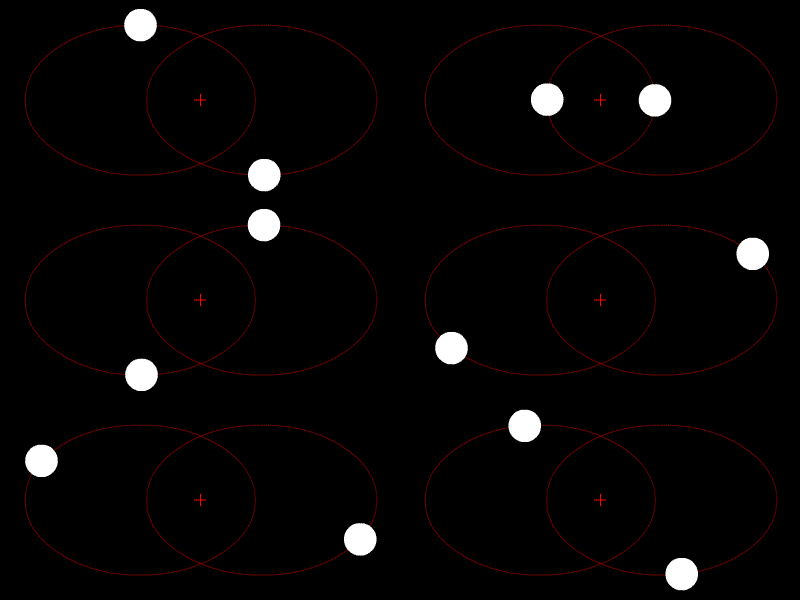

Statement of the problem
Let be 


-
,

and speeds
-
,
.
Newton’s second law for this system states that


Where
-
- the force acting on the first body due to interaction with the second body, and
- the force acting on the second body from the side of the first.
Adding and subtracting these two equations, you can divide one problem into two problems with one body, which can be solved independently. The “addition” of equations (1) and (2) leads to an equation describing the motion of the center of mass . In contrast, “subtracting” equation (2) from equation (1) leads to an equation that describes how the vector between the masses varies with time. Solving these independent tasks can help you find trajectories. and .
The motion of the center of mass (first task)
Addition of equations (1) and (2) leads to equality
where we used Newton’s third law and where
position of the center of mass of the system. The equation is written as
It shows that speed center of mass is constant. It follows that the total moment of momentum also saved ( momentum conservation ). The position and velocity of the center of mass can be obtained at any time.
Displacement vector motion (second task)
Subtracting equation (2) from equation (1) and transforming, we arrive at the equation
where we again used Newton’s third law and where (defined above) is the displacement vector directed from the second body to the first.
The force between two bodies should be a function only not absolute provisions and ; otherwise, the problem does not have translational symmetry , that is, the laws of physics would vary from point to point. Thus, you can write:
Where - reduced mass .
As soon as we find a solution for and , the initial trajectories can be written as
as can be shown by substituting into the equations for and .
Solving the two-body problem for gravitational forces
Let gravitational attraction act between the bodies. The force acting between them is equal to:
The equation of motion is written as
or
- Where
Vectorly multiplying the last equation by r and integrating, we obtain
The constant vector h , which is the integration constant, is called the kinetic moment of the system. The mutual motion of bodies occurs in a plane perpendicular to this vector. We introduce the system of cylindrical coordinates r , φ, z . The unit vectors along the radial, transversal, and vertical axes are denoted by i , j, and k . Projections of speed on the radial and transverse axes will be
Then
On the left side of the last expression is the doubled area of the triangle described by the radius vector r per unit time. Thus, this relation is a mathematical notation of Kepler’s second law.
Equation (3) is scalarly multiplied by speed and integrate. Get
We write the last expression in coordinates:
notice, that
Then
Integrating both parts, we get
The last relation is an expression of the law of conservation of mechanical energy in the system.
The movement of two bodies in a plane
It is remarkable that the motion of two bodies always occurs in the plane. We determine the linear momentum and angular momentum
The rate of change of the angular momentum is equal to the moment of force
However, Newton’s laws of motion are satisfied for all physical forces, and state that the force acting between two particles (material points) is directed along the line connecting their positions, that is . From here and the angular momentum is maintained . Then the displacement vector and his speed lie in a plane perpendicular to the constant vector .
General solution for distance-dependent force
It is often useful to go into polar coordinates , because the movement occurs in the plane and for many physical problems, the force is a radius function ( central forces ). Since the r component of acceleration equals , equation for the r component of the displacement vector can be rewritten as
Where and angular momentum saved. Preservation of angular momentum will allow finding a solution for the trajectory using variable substitution. Going from to
we get the equation of motion
This equation becomes quasilinear when changing variables and multiplying both sides of the equation by
Application
For strength inversely proportional to the squared distance, such as gravity or electrostatics in classical physics, we obtain
for some constants , the equation for the paths becomes linear
The solution to this equation
Where and constants. This solution shows that the orbit is a conical section , i.e. an ellipse , a hyperbola or a parabola , whichever is less expressions , more or equal.
The Two-Body Problem in GRT
The normal orbit of any body captured by the attraction of another body is an ellipse or circle - these are the orbits we see in the solar system. However, the general theory of relativity claims that in the vicinity of extremely massive bodies - where space is strongly curved due to the presence of a colossal gravitational field - the spectrum of possible stable orbits expands significantly. On the contrary, stable orbits in the classical two-body problem turn out to be unstable in the relativistic two-body problem . At small distances from the attracting center, the “centrifugal barrier” existing in the classical Kepler problem disappears, preventing the test particle from falling onto the attracting center.
In fact, even in a relatively weak gravitational field in the solar system, relativistic deviations from classical elliptical orbits are observed. Such a deviation for Mercury (the rotation of the perihelion of the orbit at a speed of about 43 arc seconds per century), not predicted by Newtonian mechanics, was known long before the creation of the general theory of relativity, which could explain this previously mysterious effect.
Example
Any classical system consisting of two particles is, by definition, a two-body problem. In many cases, however, one body is much heavier than another, such as in the Earth and Sun systems. In such cases, the heavier particle plays the role of the center of mass and the problem reduces to the problem of the motion of one body in the potential field of another body [1] .
Actually, Newton’s law of universal gravitation considers just such a situation, so far on the planet its accuracy is enough with a huge excess. However, one should not forget that there is a risk of losing the accuracy of calculations required for real actions - if abuse of simplification is used. In particular, without taking into account the interaction of masses, or, in other words, the gravitational-inertial potentials of both bodies [2] [3], modern space calculations are impossible. Finding the place of the center of rotation in a more massive body is vague, and in realities one still needs to take into account other bodies and fields. A preliminary analysis is necessary, especially when calculating steady and stationary orbits: multiple rotation will inevitably accumulate inaccuracies to an unacceptable error value.
See also
- Kepler's laws
- Virial theorem
- The task of three bodies
- Gravity problem N bodies
- Bertrand's challenge
Notes
- ↑ David Shiga. 'Periodic table' organizations zoo of black hole orbits . NewScientist.com (February 13, 2008). Archived June 3, 2012.
- ↑ Mazhenov, Nurbek. Refined Newton's law of universal gravitation . © NIT. Preprint, 1997 .. nt.ru (May 23, 2000). - "... Newton's law of universal gravitation is a special case of formulas (4) and (5)." The parameters of both bodies are taken into account. The force F of attraction is general, accelerations are inversely proportional to the masses of bodies. Date of treatment April 15, 2019.
- ↑ VU Huy Toan. Nature of inertia (2013/06).
Literature
- Landau and Lifshitz Theoretical Physics Course
- H. Goldstein, (1980) Classical Mechanics , 2nd. ed., Addison-Wesley. ISBN 0-201-02918-9