Shy shark ( lat. Carcharhinus cautus ) - one of the species of the genus of gray sharks of the family Carcharhinidae . This shark got its name because of timid behavior towards people. It lives in the shallow coastal waters of northern Australia , Papua New Guinea and the Solomon Islands . This is a small brownish or grayish shark 1.0-1.3 m in size. It has a short, blunt muzzle, oval eyes and a relatively large second dorsal fin . The front edges of the fins have a black border, the lower lobe of the caudal fin with a black tip.
| Shy shark |
|---|
 |
|
| No rank : | Bilateral symmetrical |
| Subfamily : | Gray or Sawtooth Sharks |
|
|
Carcharhinus cautus (Whitley, 1945) |
|
Galeolamna greyi cauta whitley, 1945 |
|
|
|
Not enough data IUCN Data Deficient : 41733 |
|
The basis of the diet of the shy shark is small bony fish , in addition, it eats crustaceans , mollusks and snakes . This is a live-bearing species of sharks. The start time of the breeding season and the duration of pregnancy vary depending on the breadth of habitat. In the litter from 1 to 6 sharks, females bring offspring annually or once every 2 years. Harmless shy sharks sometimes fall into gillnets and less often into trawls . The International Union for Conservation of Nature ( IUCN ) does not have enough data to assess the conservation status of this species, with the exception of Australian waters, where the population of these sharks is not a concern.
In 1945, Australian ichthyologist Gilbert Percy Whiteley described the shy shark as a subspecies of Galeolamna greyi (now the youngest synonym for the dark shark Carcharhinus obscurus ). Species epithet comes from the word lat. cauta - “careful” for her fearful behavior when meeting people. [1] [2] . Subsequent authors recognized this shark as a separate species of the genus Carcharhinus . The species was described based on a study of a sample of the skin and teeth of a female 92 cm long, caught in Shark Bay in Western Australia . [3] .
Based on morphology, Jack Garrick in 1982 suggested that the shy shark is closely related to the Malagasy nocturnal shark ( Carcharhinus melanopterus ). [4] Leonard Compagno in 1988 tentatively grouped these two species with black-nosed ( Carcharhinus acronotus ), narrow-toothed ( Carcharhinus brachyurus ), silk ( Carcharhinus falciformis ) and Cuban nocturnal shark ( Carcharhinus signatus ) [5] . A close relationship between the timid shark and the Malgash nocturnal shark was confirmed in 1992 by the results of allozyme analysis [6] and in 2011 by research on nuclear and mitochondrial genes [7] .
The shy shark has a rather thick spindle-shaped body and a short wide rounded muzzle. The front edge of each nostril has a nipple protrusion. Rather large oval-shaped eyes are equipped with a blinking membrane . A mouth without noticeable grooves in the corners. It has 25-30 upper and 23-28 dentitions. Upper teeth narrow and beveled, with roughly serrated edges. The lower teeth are thinner and straighter, the notches are smaller. The shy shark has five pairs of gill slits of medium length. [8] [3]
The pectoral fins are moderately long, narrow, and pointed. The base of the first dorsal fin lies at the level of the posterior ends of the pectoral fins. The first dorsal fin is large, sickle-shaped, with a sharp apex. The second dorsal fin is located opposite the anal fin, it is relatively large and high. There is no crest between the dorsal fins. On the caudal stem in front of the base of the upper lobe of the caudal fin there is a crescent-shaped notch. Caudal fin asymmetrical, with developed lower and large upper lobes. At the tip of the upper lobe there is a ventral notch. [3] [8] The scales overlap each other and carry three horizontal ridges (five in adults), ending in a tooth. [9] The color on top is bronze, the bottom is white, with a white stripe on the sides. A thin black line runs along the front edges of the dorsal and pectoral fins and the upper lobe of the tail; the lower lobe of the caudal fin and the tips of the pectoral fins are also black. The average length of the shy shark is 1.0-1.3 m, the maximum - 1.5 m. [9] Females are larger than males. [10]
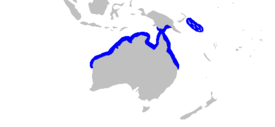
A shy shark lives on the continental and island shelf in northern Australia from Shark Bay in the west to Morton Bay in the east, as well as off the coast of Papua New Guinea and the Solomon Islands [8] . This is one of the most common sharks in Darwin Harbor, Carpentaria Bay and Shark Bay. [11] This species usually inhabits shallow coastal waters. He probably prefers mangrove swamps with a sandy and silty bottom and avoids areas heavily overgrown with algae [11] [12] .
Ration
The diet of the shy shark consists mainly of small bony fish , including atherin , hake , and squid . Crustaceans ( shrimps and crabs ) and mollusks (mainly cephalopods , as well as bivalves and gastropods ) are secondary sources of nutrition [13] [14] . It is also known that shy sharks sometimes prey on semi-aquatic snakes such as dog-headed Cerberus rynchops and Fordonia leucobalia . [fifteen]
Reproduction
Like other sharks of the genus Carcharhinus , shy sharks are viviparous . Adult females have one functioning ovary and two functioning uterus. Embryos are initially fed by the yolk sac . When the yolk sac is empty, it forms a placental connection through which the embryo receives nutrients until the end of pregnancy. As a prelude to mating, the male bites the female. After mating, the female retains sperm for about four weeks until fertilization. In Darwin Harbor, mating takes place from January to March, and childbirth occurs in October and November; pregnancy lasts from eight to nine months. In Shark Bay, mating occurs from the end of October until the beginning of November, and the birth occurs at about the same time the following year; pregnancy lasts 11 months. The slowed-down reproductive cycle is probably due to the fact that water temperature is lower in Shark Bay. [10] [16] Females bring offspring to Darwin Harbor annually, and to Shark Bay once every two years. In the litter from one to six sharks, their number does not depend on the size of the female. Newborns are born large - 35-40 cm in shallow areas, such as Herald Bay in Shark Bay. Shy sharks grow quite quickly; in Darwin Harbor, males and females become sexually mature reaching a length of about 84 and 91 cm, respectively, and in Shark Bay - 91 and 101 cm, respectively. Puberty occurs at the age of four for males and six years for females. The maximum life expectancy is at least 12 years for males and 16 years for females. [10] [16]
Shy timid sharks do not pose a danger to humans. [3] Sometimes they are used as food. [8] This species in the coastal waters of northern Australia accidentally enters gillnets. They are also caught by shrimp trawlers. Most likely, the Australian shy shark population does not threaten fishing activities; The International Union for Conservation of Nature ( IUCN ) rated its status at the regional level “Least Concern” (LC). But in general, there is insufficient data sufficient to assess the conservation of the species throughout the range. A shy shark's overall status is defined as “Not enough data” (DD). [eleven]

