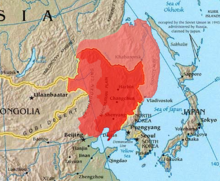
The annexation of the Amur Region and Primorye to Russia - the annexation to the Russian Empire of the territories of the left bank of the Amur River and the right bank of Ussuri .
Background
In the XVII century, Russian pioneers, advancing to the east, faced the Manchu Qing empire . The Russo-Qing border conflict, which lasted almost half a century, culminated in the signing of the Nerchinsky Treaty in 1689, according to which the disengagement of the Russian and Qing territories in the upper reaches of the Amur River , the lands further east (of which both contracting parties had a very vague idea) were left unlimited:
The river, by the name of Gorbitsa, which flows down to the Shilka River, on the left side, near the Chernaya River, decide the boundary between the two states. Similarly, from the top of the river to the Kamenny Mountains, which begin from the top of the river and along the very peaks of the mountains, even extended to the sea, the two powers are taco divided, like all small or great rivers that flow from the mountains from the mountains into the Amur River from half days , be under the control of the Khin state. Similarly, to all the rivers that go from other sides of those mountains, so be under the power of the Tsarist Majesty of the Russian state. Other rivers that lie in the middle between the Udyu River under the Russian state and between limited mountains, which are kept near the Amur River, the possessions of the Khinsky state, flow into the sea and the earth in the midst of things, between the aforementioned Udyu River and between the mountains that the borders should not be limited, now they are staying, while on these lands the great and plenipotentiary ambassadors, who do not have the decree of the tsar's majesty, are postponed until another prosperous time, in which when the ambassadors return from both sides, the king something Majesty deigns and bugdyhanovo Highness pohochet about oboslatisya ambassadors or envoys lyubitelnymi forward, and then either through letters or through appointed ambassadors Tide unlimited land had rest and decent uspokoiti cases and can delineate.
The Manchu did not intend to develop the territory left by the Russians; it was for them a buffer zone, on which there was no taxable population.
First Russian military posts
The first official Russian military posts and settlements appeared in the Amur Region and Primorye during the Amur expedition of 1849-1855 . In 1849, G. I. Nevelskaya on the Baikal ship discovered the Tatar Strait , proving that Sakhalin is an island, not a peninsula. In 1850, he arbitrarily founded at the mouth of the Amur, in the territory, according to the Nerchinsk treaty of the Qing empire, the Nikolaev post and declared these lands the possession of the Russian empire. The self-governing actions of Nevelsky caused discontent and irritation in the government circles of Russia, however, after listening to the report of the Governor of Eastern Siberia Nikolai Nikolayevich Muravyov, Emperor Nikolai I imposed the famous resolution on the report of the Special Committee:
Wherever the Russian flag is hoisted, it should not be lowered there.
Joining the Amur Region
During the Crimean War, the Anglo-French squadron in 1854 attacked Petropavlovsk-Kamchatsky . Even before the attack on the city, the governor Muravyov asked Emperor Nicholas I for permission to raft troops and property down Amur to reinforce Petropavlovsk. Two ships were built at the Shilkinsky factory, which in the spring, together with a flotilla of barges and longboats (a total of 77 vessels) set sail down the Amur River; Governor N. N. Muravyov personally led the campaign. On June 14, ships reached the mouth of the Amur.
After that, on the orders of Muravyov, 51 peasant families were taken in the Irkutsk province and relocated to the lower reaches of the Amur. In 1854, along with Muravyov, a hundred Cossacks of the Transbaikal Cossack army sailed along the Amur River, another hundred Cossacks arrived in the next navigation. On November 1, 1856, Emperor Alexander II decided to relocate two horse regiments and four battalions of the Trans-Baikal Cossack army to Amur (in reality, only four horse-drawn Cossack hundreds and two foot soldiers were relocated by 1860, of which the Amur Cossack brigade was formed).
In connection with a change in the situation on the Amur, in 1857 negotiations began between the Russian and Qing empires on the delimitation of the middle and lower reaches of the river. Weakened by the Second Opium War, the Qing Empire was forced to sign the Tianjin Treaty in 1858, and then the Treaty of Aigun , according to which the left bank of the Amur River from the Argun River to the mouth of the Amur River was recognized as the property of Russia, and the Ussuri Territory from the confluence of the Ussuri River into the Amur Sea remained in common ownership until the boundary is determined. Navigation on the Amur , Sungari and Ussuri was allowed only to Russian and Chinese vessels and was forbidden to everyone else.
Joining Primorye
Since the Aigun Treaty did not distinguish land from Ussuri to the sea, the Russian government sent a special mission to Beijing for further negotiations, headed by Count N.P. Ignatiev . From the Qing side, Grand Duke Gong took part in the negotiations. With the assistance of Ignatieff and under the threat of looting of Beijing by the occupying forces , the Qing side ceded Russia to the right bank of the Ussuri . The border was drawn on the map with a red line along the Chinese coast of the Amur, Ussuri, as well as the Kazakevich channel.
See also
- Far East of Russia
Sources
- A. B. Shirokorad "Russia and China. Conflicts and cooperation ”- Moscow: Veche, 2004. ISBN 5-94538-399-6
Links
- “Aigun Treaty” Exposition at the Aigun Historical Museum (Chinese)