European Mink [1] ( lat. Mustela lutreola ) - a predatory mammal from the family marten ; characterized by a swimming membrane between the toes, found in Eastern Europe , along the banks of rivers, feeds on fish , frogs , crayfish . For a long time it was the object of fishing because of the valuable fur . Currently, its number is declining everywhere due to the crowding out of the American mink ( lat. Neovison vison ). However, according to some researchers [2] , the decline began even before the introduction of American mink and, possibly, due to some other reasons.
| European mink | |||||||||||||||||||||||||||||||||||||||
| Scientific classification | |||||||||||||||||||||||||||||||||||||||
|---|---|---|---|---|---|---|---|---|---|---|---|---|---|---|---|---|---|---|---|---|---|---|---|---|---|---|---|---|---|---|---|---|---|---|---|---|---|---|---|
| |||||||||||||||||||||||||||||||||||||||
| International scientific name | |||||||||||||||||||||||||||||||||||||||
Mustela lutreola ( Linnaeus , 1761) | |||||||||||||||||||||||||||||||||||||||
| Area | |||||||||||||||||||||||||||||||||||||||
| |||||||||||||||||||||||||||||||||||||||
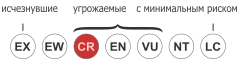
| Security status | |||||||||||||||||||||||||||||||||||||||

Appearance
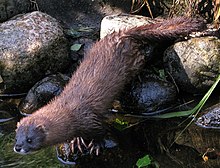
A small animal with a flexible elongated body, short limbs, a relatively short non-furry tail. Body length 28–43 cm, weight 550–800 g, tail length 12–19 cm. The fur is short, thick, dense, with a very dense undercoat that does not get wet even after prolonged exposure to water. The difference in the structure of the fur coat in summer and winter is small. The muzzle is narrow, flattened from above, the ears are small, rounded, almost do not protrude from the fur, the fingers are connected by a pronounced membrane, especially wide on the hind legs, leaving only the terminal phalanges of the fingers free. The color of the fur is one-color, from reddish brown to dark brown, lighter on the underside of the body and darker on the limbs and tail. Almost black or brownish-red individuals are occasionally found. There is a white spot on the chin that captures the upper and lower lip. Sometimes a white spot also occurs on the chest.
Lifestyle
Closely related to the aquatic environment. Typical habitats in the forest zone are cluttered areas of small, deaf flowing water bodies (rivers and streams) with gently sloping banks covered with alder and grasses and practically do not live on the main waterways of the forest zone. Penetrates into the steppe zone, on the contrary, along the valleys of large rivers and settles here in their deltas, elders and floodplains. It also lives in lakes overgrown with reeds and shrubs, ponds, and less often swamps. It rises along river valleys to the foothills, where it is found in fast-flowing rivers with steep, forested shores.
It feeds on almost all small animals found in or near water bodies. The basis of the diet is mouse-like rodents (mainly water rats ), fish ( perch , gudgeon , tench , squint , brown trout ), amphibians ( frogs , their roe and tadpoles), crayfish, aquatic insects and mollusks.
Near the villages they sometimes catch poultry; during the nourishment period they pick up food waste. He prefers to eat fresh prey: in open-air cages, in the absence of fresh food, he starves for 3-4 days before switching to rotten meat.
Before the cold weather begins, he always makes reserves in his shelters from frogs, fish, small rodents, and sometimes birds. In shallow pools, it stores immobilized bites in the head and folded in heaps of frogs. Willingly replenishes its winter pantries.
Active in the dark (at dusk and at night), but sometimes hunts during the day. He spends most of his time on land, seeking food from the shore. In summer, less than a kilometer runs per day, mainly on a short stretch of creek serving as the pivot of its hunting grounds. In winter, it overcomes long distances - up to two kilometers, bypassing wormwood, through which it goes into the water in search of food and, in case of danger, in the snow. In snowy frosty winters, he prefers to move along snowy trenches and rarely appears on the surface. Avoids continuous ice cover.
Swims and dives perfectly. It moves in water with jerks, as it simultaneously rowes with all its paws. The course of a swimming mink does not serve as a serious obstacle: in lowland rivers, which are not too fast, it almost never blows it downstream. Noticing the danger, dives, emerges after 10-20 meters, catching his breath for several seconds, again hides under the water. Sometimes it hides in aquatic vegetation, putting a muzzle out of the water. It walks along the bottom, clinging with its paws to uneven ground. Climbing poorly, only a serious danger makes you climb a bush or tree.
He arranges burrows near water, digs them on his own or uses natural cracks and indentations, old burrows of water rats, hummocks, low hollows, reed blockages. It is used by them as a permanent dwelling more often than other marten (hence its name comes from), it leaves only during a flood or a hungry winter. The hole is not shallow, it is arranged simply: the main chamber, the restroom, two exits. One leads to a reservoir, opens above the surface of the water or below its level. Another is a spare snout, leaves in dense coastal thickets. The main residential chamber is lined with dry grass, leaves, bird feathers, moss.
Mating from February to April, pregnancy 40–43 days [3] , cubs are born in April-May, in the brood usually four to five (2-7) cubs. The rut passes through the snow. During this period, they are especially active, trampling along the shores of the trail - "currents". A few males chase after the female, who scream loudly and fight. With the end of the rut, males and females live separately. By mid-July, young minks reach half the size of their mother, in August they are compared with adults. At this time, the cubs stop receiving milk and switch entirely to the meat diet. Mother leaves in the fall.
Shedding occurs in spring and autumn, but its timing is very long.
The European mink is usually a silent animal, however, being in a good mood, minks make a booming sound, reminiscent of the cackling of a chicken (males also whine during the mating season), and in case of danger they hiss, chirp and tickle.
Distribution
The historical range of the European mink stretched from Finland to the eastern slopes of the Ural Mountains, limiting from the south to the Caucasus Mountains and Northern Spain. The relatively recent appearance of mink in France (1839) and eastern Spain (1951) suggests a rather late spread of the species to the west. Over the past 150 years, it has been greatly reduced in numbers and has been exterminated or significantly reduced over most of its former range.
At present, the range consists of several isolated fragments: in northern Spain and western France, in the Danube Delta in Romania, in Ukraine and in Russia. It occurs at an altitude of up to 1120 m above sea level.
The species has survived only in an insignificant part of its range and is in decline even in the surviving enclaves. As exceptions, only Romania, the Vologda, Tver and Arkhangelsk regions of Russia can be considered. In Romania, the presence of European mink in the Danube Delta was confirmed in 1999. European mink seems to be still widespread there. Repeated inspections of traps since 2001 show that the mink lives on an area of no more than 2500 sq. Km. In the Vologda Oblast, given the rapid decline in species in neighboring regions and the presence of American mink, it is unlikely that the population of European mink will persist for a long time. In the Arkhangelsk region, the population exists in the northwestern part of the region, which is located near the northern border of the range with a very low abundance of the species. The presence of American mink is likely to pose a serious threat to its long-term existence there.
Security Measures
The species European mink is listed in the IUCN Red List , Red Books of the Republic of Bashkortostan, Komi Republic, Perm Territory, Yamalo-Nenets Autonomous Okrug, Orenburg, Pskov, Sverdlovsk [4] , Novgorod, Chelyabinsk and Tyumen Regions, Sakhalin Region. [5] .
Subspecies Caucasian European mink ( Mustela lutreola turovi ) is listed in the Red Book of Russia .
Subspecies Central Russian European mink ( Mustela lutreola novikovi ) is listed in the IUCN Red List.
Protected by law in all countries. At least part of the population lives within the protected areas, in Russia - within the Central Forest Biosphere Reserve in the Tver Region.
For 2011, the following security programs were in place:
- EEP Mink program since 1992 - genome conservation. In captivity contains about 250 individuals. The coordinators are Tallinn Zoo and the Lutreola Foundation (Estonia).
- Spanish Genome Conservation Program since 2004.
- Trial replenishment in Alava (Spain) since 2008.
- Special program for the control of American mink around and inside the range (Spain).
- Habitat restoration in Navarre (Spain).
- France’s state program on genome conservation and reintroduction since 2010 for six years.
- Genome Conservation Program in Osnabruck (Germany).
- Reintroductive programs in Saarland and Lower Saxony (Germany).
- Regular monitoring in the Danube Delta (Romania) since 2001.
- Stabilization of the population on the island of Hiumaa (Estonia) since 2000.
It was introduced to the islands of the Kuril ridge: Kunashir (in 1981–85, 134 individuals) and Iturup (1986–1989, 254 individuals) to create a reserve population that is not susceptible to crossbreeding with the American mink [5] . According to IUCN (2014), the introduction was unsuccessful; a stable population on the islands could not be found [6] .
Notes
- ↑ Sokolov V.E. The pagan dictionary of animal names. Mammals Latin, Russian, English, German, French. / edited by Acad. V. E. Sokolova. - M .: Rus. lang., 1984. - S. 100. - 10,000 copies.
- ↑ The disappearance of European mink
- ↑ Cavendish, 1993 , p. 734.
- ↑ Regulation on the Red Book of the Sverdlovsk Region . Russian Bird Conservation Union. Date of treatment March 6, 2011. Archived on August 24, 2011.
- ↑ 1 2 Savelyev A.P. Alien species in the Holarctic - "TYPES - SEATS IN THE REGIONAL RED BOOKS OF RUSSIA" // Russian Academy of Sciences: abstracts. - 2005 .-- S. 27 .
- ↑ Mustela lutreola (European Mink) . www.iucnredlist.org. Date of treatment April 8, 2017.
Literature
- Mink // Brockhaus and Efron Encyclopedic Dictionary : in 86 volumes (82 volumes and 4 additional). - SPb. , 1890-1907.
- Cavendish, Marshall. Endangered Wildlife of the World. - Marshall Cavendish Corp, 1993 .-- 1536 p. - ISBN 978-1854354891 .
- Mustela lutreola on the IUCN Red List site -
Links
- European mink - article and photos on the inFerretGroup website Pavlinova I. Ya.
- European mink - an article on the Ecosystem website
- European mink - article on the website of the A. N. Severtsov Institute of Ecology and Evolution
- European mink - article on the website of the Karelian Science Center RAS