15 cm Kanone 18 ( German: 15 cm cannon of the 1918 model ) is a 150 mm German artillery gun used in the Second World War .
| 15 cm gun arr. 1918 (15 cm Kanone 18) | |
|---|---|
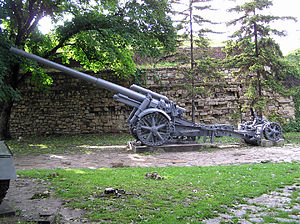 15 cm K 18 at the Belgrade Military Museum | |
| Caliber mm | 150 |
| Instances | 101 |
| Muzzle velocity, m / s | 865 |
| Maximum range, m | 24,500 |
| Trunk | |
| Barrel length, mm / klb | 8195/55 |
| Weight | |
| Mass in the stowed position, kg | 18 600 |
| Weight in combat position, kg | 12,640 |
| Dimensions in the stowed position | |
| Length mm | 8600 |
| Firing angles | |
| AngleVN , hail | from -2 ° to + 43 ° |
| Angle GN , hail | 10 ° (on wheels) 360 ° (on the platform) |
Content
History
The gun was created in 1933 by the German company Rheinmetall to replace the old 15 cm Kanone 16 gun, which was actively used in the First World War . The first guns came off the assembly line in 1938. Compared with the old gun, the new Kanone 18 gun became two tons heavier, but the firing range increased by 2290 m. The gun met the army’s requirements for firing range, but was too heavy for transportation, and heavy tracked transporters were specially ordered for it to transport to long distance. Quite a lot of time was spent on preparing the guns for firing , which complicated the fighting .
In total, from 1939 to 1943, 101 guns were produced. It did not become popular in the army due to transportation problems, and production ceased in August 1943. Subsequently, these guns were used in the coastal batteries of the German troops.
Rating
K.18 at a range of almost the same with the Br-2 superior to the Soviet cannon in all other respects. Also, German guns had a significantly larger assortment of ammunition, which included three varieties of high-explosive fragmentation shells : concrete-piercing , armor-piercing and semi-armor-piercing shells . The advantage of the Br-2 can be called a slightly more powerful high-explosive fragmentation projectile containing 1 kg more explosives compared to the German counterpart.
The American "Lanky Tom", in turn, with a slightly shorter range than K.18 exceeded it in all other respects, and most importantly - the American gun was built in much larger quantities. The longevity of the Lanky Tom, together with the presence of powerful tractors and high firing accuracy, clearly puts K.18 at a disadvantage even with the shorter firing range of the Lanky Tom compared to K.18.
Images
At the american museum
Shot from Kanone 18
In Belgrade, front view
She, rear view
See also
152 mm howitzer gun model 1937 (ML-20)
152 mm cannon of the 1935 model (Br-2)
15 cm Kanone 16
15 cm L / 40 Feldkanone iR
155 mm gun M1 / M2 / M59
Literature
- Joachim Engelmann, Horst Scheibert. Deutsche Artillerie 1934-1945: Eine Dokumentation in Text, Skizzen und Bildern: Ausrüstung, Gliederung, Ausbildung, Führung, Einsatz . Limburg / Lahn, Germany: CA Starke, 1974
- Terry Gander, Peter Chamberlain. Weapons of the Third Reich: An Encyclopedic Survey of All Small Arms, Artillery and Special Weapons of the German Land Forces 1939-1945 . New York: Doubleday, 1979 ISBN 0-385-15090-3
- Ian V. Hogg. German Artillery of World War Two . 2nd corrected edition. Mechanicsville, PA: Stackpole Books, 1997 ISBN 1-85367-480-X