
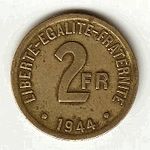
Military franc - banknotes made in the USA during the Second World War with the aim of replacing banknotes of the Vichy government .
The names also apply: banknotes with a flag ( French Billet drapeau ) (due to the presence of French flag banknotes on the back) and the occupation franc ( Eng. Occupation franc ).
Content
History
Allied
After the Americans landed on June 6, 1944 on the Normandy coast, the US government, which has so far refused to recognize the decision of General Charles de Gaulle, decides to issue new banknotes in order to replace banknotes issued during the German occupation of France [1] . This draft monetary policy of the member countries of the Alliance was part of the measures established by the US military administration in liberated France.
Production
The banknotes were printed in February - May 1944 in the United States, at the Bureau of Engraving and Printing, which is a division of the US Department of the Treasury.
Conversion to a Liberated France
After a period of uncertainty when the Americans introduced banknotes in Normandy, Republic Commissioner Francois Coulet recommended that banks not accept new banknotes. And later, on June 27, 1944, the head of the Provisional Government of the French Republic, General Charles de Gaulle decided to ban the circulation of banknotes with a flag on the territory of the French Republic [1] .
Features
These banknotes do not have the inscription of the institution in which they are printed. There is only the name of the country - France, as well as the republican motto "Freedom, Equality, Brotherhood" on the reverse of the banknote. The US dollar was chosen as a model for banknotes. Banknotes are issued in denominations of 2 to 500 francs [2] . Brass coins with a face value of 2 francs were also issued [3] .
Banknote Exchange
In February 2002, after France adopted the euro, the Bank of France issued circular number 123 on the exchange of banknotes and coins in French francs for euros. Exchange of banknotes with a flag could be made before January 1, 2004. Most banknotes "with flags" were returned to the United States until June 15, 1945 [4] .
Banknote Gallery (1944)
Banknote 2 francs 1944 (obverse)
Banknote 2 francs 1944 (reverse)
Banknote of 5 francs 1944 (obverse)
Banknote 5 francs 1944 (reverse)
Banknote of 10 francs 1944 (obverse)
Banknote of 10 francs 1944 (reverse)
Banknote of 100 francs 1944 (obverse)
Banknote Gallery (1945)
Banknote of 50 francs 1945 (obverse)
Banknote of 100 francs 1945 (obverse)
Notes
- ↑ 1 2 Dubious Liberators: Allied Plans to Occupy France, 1942-1944 . Ted Rall. Date of treatment January 28 . 2008 . Archived on September 13, 2012.
- ↑ Cuhaj, 2008 , pp. 511-512.
- ↑ Cuhaj, 2011 , p. 799.
- ↑ Banque de France note d'information N ° 123 concernant l'échange des billets et des pièces en francs français contre euros
Literature
- Cuhaj GS Standard Catalog of World Paper Money. General Issues 1368-1960. - 12th ed. - Iola: Krause Publications, 2008 .-- 1223 p. - ISBN 978-0-89689-730-4 .
- Cuhaj G., Michael T., Miller H. Standard Catalog of World Coins 1901-2000. - 39th ed. - Iola: Krause Publications, 2011 .-- 2345 p. - ISBN 978-1-4402-1172-8 .