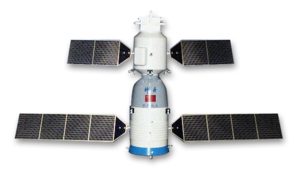
Shenzhou ( Chinese ex. 神舟 , pinyin : Shénzhōu , “The Magic Rook ” / “The Holy Shuttle”) is China’s third manned space flight program. Work on the program began in 1992 under the name "Project 921-1." The first manned flight of the Shenzhou-5 spacecraft made China in 2003 the third country in the world to send man into space on its own. Two previous Chinese manned programs - Shuguang (late 1960s - early 1970s) and manned FSW (late 1970s - early 1980s) - were discontinued, not reaching the goal. In March 2005 , an asteroid was named after spacecraft.
Program
We will steadily move forward towards the set goal and make a proper contribution to the development and use of space by man.
It includes three stages [2] :
- launching unmanned and manned spacecraft into low Earth orbit while ensuring the guaranteed return of descent vehicles to Earth;
- the exit of taikunauts into outer space, the creation of an autonomous space station for a short stay of expeditions;
- the creation of large space stations for long-term stay of expeditions.
Completed Missions

Shenzhou-1
Being in orbit: 11/20/1999 - 11/21/1999 The uninhabited spacecraft was in orbit for 21 hours 11 minutes. and made 14 turns around the earth. The descent module landed in the steppes of Inner Mongolia .
Shenzhou 2
Being in orbit: 01/10/2001 - 01/17/2001. The unmanned vehicle made 108 turns. During the flight, experiments on field mice and Drosophila flies were carried out on board the apparatus, aimed at providing the first manned flight.
Shenzhou 3
Orbiting: 03/25/2002 - 04/01/2002. An unmanned apparatus with equipment for monitoring human activity was launched by the Changzheng-2F launch vehicle .
Shenzhou 4
Being in orbit: 12/30/2002 - 05/05/2003. Unmanned vehicle.
Shenzhou 5
Being in orbit: 10/15/2003. The first manned flight of the Chinese spacecraft: "Shenzhou-5" with PLA Air Force Colonel Yang Liwei made 14 orbits around the Earth.
Shenzhou 6
Being in orbit: 10/12/2005 - 10/16/2005. The second manned space flight in China was carried out by the Taikonauts Fei Junlong and Nie Haisheng . "Shenzhou-6" started from the Jiuquan cosmodrome in Gansu province and made 30 orbits around the Earth. [3]
Shenzhou 7
Being in orbit: September 25, 2008 - September 28, 2008. The launch was made from the Jiuquan Cosmodrome, on board the spacecraft was a team of three Taikonauts ( Zhai Zhigang , Jiang Haipeng and Liu Bomin ). During the flight, Colonel Zhai Zhigang, for the first time in the history of Chinese astronautics, made a 17-minute spacewalk in the Feitian spacesuit. Liu Bomin in the Russian Orlan spacesuit insured Zhai in the orbital module. The entire flight lasted more than 70 hours.
Shenzhou-8
Being in orbit since 11/11/2011. Unmanned. The first of the ships of the series, which is equipped with a docking station. The flight program provides for docking with the first Chinese orbital station Tiangong-1 .
Shenzhou-9
The start of Shenzhou-9 June 16, 2012 . The crew - Jing Haipeng , Liu Wang and Liu Yang - the first female tyconaut . The docking with the Tiangong-1 orbital station on June 18 is the first expedition to the station. Landing June 29, 2012 .
Shenzhou-10
The launch was carried out on June 11, 2013 . The crew - Nie Haysheng , Zhang Xiaoguang and Wang Yaping - the second female tycoonaut . On June 13th, a docking with Tiangong-1 station took place. June 20 was a manual undocking and docking with the station. Landing took place on June 26 .
Shenzhou 11
The launch of the manned ship "Shenzhou-11" was carried out on October 16, 2016 at 23:30. Crew: Jing Haipeng (3rd space flight) and Chen Dong (1st space flight). After entering orbit, the ship successfully docked with the Tiangong-2 space laboratory . November 18, 2016 the flight was successfully completed.
| Mission | Emblem | Launch | Duration | Landing | Crew | Notes |
|---|---|---|---|---|---|---|
| Shenzhou-1 | November 19, 1999 | 22 hours 11 minutes | November 20, 1999 | Test flight of the new spacecraft Shenzhou | ||
| Shenzhou-2 | January 9, 2001 | 7 d. 10 h. 22 min. | January 16, 2001 | Scientific experiments with living organisms | ||
| Shenzhou-3 | March 25, 2002 | 6 d. 18 h. 51 min. | April 1, 2002 | Human flight simulation experiments (mannequin) | ||
| Shenzhou 4 | December 29, 2002 | 7 d. 10 h. 22 min. | January 5, 2003 | Human flight simulation experiments (mannequin in a spacesuit) | ||
| Shenzhou 5 | October 15, 2003 | 21 hours 22 minutes | October 15, 2003 | Yang Liwei | The first Chinese manned flight | |
| Shenzhou 6 | October 12, 2005 | 4 d. 19 h. 33 min. | October 16, 2005 | Fei Junlong | The first space flight of two tyconauts | |
| Not haisheng | ||||||
| Shenzhou 7 | September 25, 2008 | 2 d. 20 h. 27 min. | September 28, 2008 | Liu Bomin | The first space flight of three tyconauts. First spacewalk (17 min.) | |
| Zhai Zhigang | ||||||
| Jing Haipeng | ||||||
| Shenzhou-8 | October 31, 2011 | 16 d. 13 h. 34 min. | November 3, 2011 | Testing the technology of rendezvous and docking with the Tiangong-1 orbital station | ||
| Shenzhou 9 | June 16, 2012 | 12 d. 15 h. 24 min. | June 29, 2012 | Jing Haipeng | The first expedition and docking with the Tiangong-1 space module. The first female tyconaut. Scientific and technical experiments made | |
| Liu Wang | ||||||
| Liu Yang | ||||||
| Shenzhou 10 | June 11, 2013 | 14 d. 14 h. 29 min. | June 26, 2013 | Not haisheng | Successful docking with the Tiangong-1 space laboratory; manual docking mode was also tested. The second female tyconaut | |
| Zhang Xiaoguang | ||||||
| Van Yaping | ||||||
| Shenzhou 11 | October 16, 2016 | 32 d. 6 h. 13 min. | November 18, 2016 | Jing Haipeng | Successful docking with the Tiangong-2 space laboratory. Zero Gravity Experiments | |
| Chen Dong |
Current Mission
Booster
"Shenzhou" spacecraft are launched into orbit by the CZ-2F (Changzheng-2F ) carrier rocket, developed specifically for manned spacecraft. The length of CZ-2F is 58.3 m, the starting weight is 479.8 tons, the fuel is asymmetric dimethylhydrazine (UDMH, heptyl), and the oxidizing agent is nitrogen tetraoxide (AT, amyl).
Interesting Facts
- The spacecraft "Shenzhou" in many respects repeats the Russian spacecraft "Soyuz" . “Shenzhou” has exactly the same layout of the modules as “Soyuz” - the instrument-and-aggregate compartment, the lander and the household compartment. Shenzhou is about the same size as the Union. The entire structure of the ship and all its systems are approximately identical (taking into account the standards applicable in the PRC) of the Soviet spacecraft of the Soyuz series, and the orbital module is built using the technologies used in the Salyut space station series.
- In 2005, the director of TsNIIMash-Export CJSC Igor Reshetin and four employees of the same CJSC were arrested on suspicion of spying for China and the transfer of space technology. In 2007, Academician Reshetin was sentenced to 11.5 years in a maximum security prison [4] . The Chinese government requests the release of Igor Reshetin and four workers who were arrested and sentenced to 11 years in prison in Russia and asks them to be transferred to their custody in China.
- The first group of Chinese cosmonauts was preparing for a flight at the Gagarin Cosmonaut Training Center in the Star City near Moscow.
Notes
- ↑ Li Peng and other executives watched the successful launch of the Shenzhou 4 spacecraft Renmin Ribao
- ↑ Foreign Military Review , 12/2008
- ↑ Chinese space exploration.
- ↑ "Russian newspaper". "Long term to the academician" (12/04/2007). Date of treatment August 10, 2008.