
The history of Tokyo is a chronicle of the growth of Japan's largest urban center. In the eastern part of the mainland, Tokyo occupies land in the Kanto region , together with the modern Saitama Prefecture , the city of Kawasaki and the eastern part of Yokohama , made Musashi , one of the provinces within the framework of the Ritsuryo system [1] .
Content
- 1 Tokyo before and during the Edo period
- 2 Age of Meiji
- 3 Age of Taisho
- 4 Age of Showa
- 5 Age of Heisei
- 6 See also
- 7 notes
- 8 Literature
Tokyo before and during the Edo period
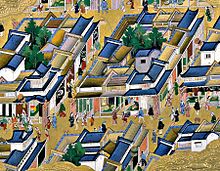
The Edo period began in 1603, when Tokugawa Ieyasu became a shogun [2] . Tokyo was then a fishing village. In the XII century, the local warrior Edo Tara Shigenada built a fort here. The original name of Tokyo is Edo (until 1869). According to tradition, the name Edo ( 江 江 ext. "Entrance to the bay" ) he received at the place of residence. In 1457, Otto Dokan ( 太 田 道 灌 ) , the ruler of the Kanto region under the Japanese shogun , began the construction of Edo Castle ( 江 戸 城 城 ) .
By order of Uesugi Motitomo, the construction of the castle began in the place where the East Garden of the Imperial Palace is currently located [3] . In 1524, Hode Uditsuna entered the castle. In 1590, Ieyasu Tokugawa , the founder of the shogun clan, took control of him. In 1603, he made the city the residence of the shogunate , the city of Kyoto remained the imperial capital (the cities of Tokyo and Kyoto are connected by Japan's oldest land road, Tokaido ). Thus began the era of Edo ( 江 戸 時代 時代 ) , or the Tokugawa era ( 徳 川 時代 ) in the history of Japan. Edo began to grow rapidly and by the 18th century it became one of the largest cities in the world. In 1615, Ieyasu destroyed his opponents - the Toyotomi clan , thereby gaining absolute power for about 250 years.
In 1637, the construction of the castle, including the main tower, was completed. In 1657, the "Great Edo Fire" began, which destroyed the castle and most of the red light district of Asakusa ( 浅 草 ) . Killed 100,000 people.
In 1707, the volcano of Fuji wakes up and ashes cover the city.
In 1721, Edo became the largest city in the world with a population of 1.1 million people [4] . The growth of Edo was caused in part after the Meiraki Great Fire of 1772 in which there were approximately 6,000 casualties [5] .
In 1855, the "Big Earthquake" occurred, which caused significant damage [6] .
Meiji Age
As a result of the Meiji restoration of 1868, the shogunate came to an end. A new era began in the life of Japan - the Meiji era. In September, Emperor Mutsuhito moved the capital here, calling it the "Eastern Capital" - Tokyo - and making the city castle the Imperial Palace. The proposal was made by Okubo Toshimichi , one of the most active participants in the coup. He told the new emperor that the monarch should face his people, which are separated from the emperor by the wall of the court nobility of Kyoto and centuries-old prejudices. Mutsuhito accepted the offer with horror, but later agreed. In Kyoto, this decision generated great excitement. When the day of departure arrived, a thousandth crowd gathered at the palace and sobbedly begged the monarch not to leave the holy land.
During the Meiji era , 1868-1912, Japan was influenced by the assimilation of Western civilization. The new capital, like other cities in Japan, began to acquire a new face: buildings made of stone and brick were built instead of the feudal mansions, modern roads were laid, industry and shipbuilding began to develop rapidly. In 1869, the first telegraph line was opened between Tokyo and Yokagama . In 1872, the feudal system was abolished, Japan was divided into prefectures, and Tokyo expanded to the now familiar 23 districts. In the same year, the Tokyo - Yokohama railway was built, in 1877 - Kobe - Osaka - Tokyo. In 1874, the Tokyo Police Department was established. The look of Tokyo citizens has also changed: western hairstyles have replaced the traditional bunch of feathers for men, and bowler hats, high collars and puffy skirts have become a fashion trend.
Taisho Age
In the Taisho era , 1912-1926, Tokyo continued to flourish. The number of people working in the city (as in other cities in Japan) has increased. Educational standards improved, the number of girls - students in universities increased. Various arts flourish, especially theater and opera .
On September 1, 1923, the Great Kanto earthquake of 7–9 on the Richter scale occurred in Tokyo and its environs. Almost half of the city was destroyed (more than 300,000 buildings), a strong fire began. 90,000 people became victims. After the earthquake, a plan for urban reconstruction was created, but the costs went beyond the national budget. The city began to partially recover.
The Age of Sow
The era of Sow , 1926-1989, began in a depressed mood. Nevertheless, the first metro line (Ginza line) was launched between Asakusa ( Japanese 浅 浅 ) and Ueno ( Japanese 上 野 ) in 1927, and in 1928 the first general elections to the House of Representatives of the Parliament took place. In 1931, Haneda Airport ( Tokyo International Airport ) was built. In 1941, the Port of Tokyo was opened. By 1935, the number of inhabitants of the city reached 6.36 million, comparable with the population of New York and London .
In 1936, during a coup attempt, about 1,500 junior officers and the Japanese army occupied the National Parliament building, the residence of Prime Minister Kantei and other key places. The coup was crushed by the army and naval forces for three days.
The city again suffered heavy losses during World War II . Tokyo was subjected to massive air attacks (it was bombed 102 times . More than 100,000 inhabitants were killed in just one B-29 raid. Many wooden buildings burned down, the Imperial Palace was damaged. The heaviest air raid was on March 10, 1945, resulting in large casualties among the population. and the destruction of urban structures.In 1943, the dual system of Tokyo Prefecture and the city of Tokyo were abolished, and the prefecture and city were combined to create the capital of Tokyo.The capital administration system was established and a governor was appointed. after the war in October 1945, the population was 3.49 million, which was half its level in 1940. The losses that Tokyo suffered in the war were like two atomic bombs dropped on Hiroshima and Nagasaki combined.
Since September 1945, the city has been under military occupation and is regulated by Allied forces. General Douglas MacArthur set up headquarters in the DN-21 Tower (formerly the Dai-Iti Seimei Building) overlooking the Imperial Palace. There are currently several US military bases in Japan.
July 1, 1943 the city of Tokyo was abolished. From the former city of Tokyo and Tokyo Prefecture, the Tokyo Metropolitan District was formed, the Governor of Tokyo became a member of the Cabinet, reporting directly to the Prime Minister
In May 1947, the new Constitution of Japan and the local Autonomy Law began to operate, and Seichira Yasui was elected Tokyo's first governor for the new vote counting system. In August this year, an area of 23 special districts of Tokyo was organized.
In the middle of the 20th century (starting from the 1950s), the country's economy began to revive rapidly (which was described as the “Economic Miracle” ) and in 1966 it became the second largest economy in the world. Broadcasting began in 1953. In 1954, the second metro line ( Marunouchi line ) was launched between Ikebukuro and Okatimati . Japan joined the United Nations in 1956. Thanks to technological innovations and the introduction of new industry and technology, this period was marked by the beginning of the mass production of synthetic fibers and family electrical household appliances, such as televisions , refrigerators and washing machines. In 1962, the population of Tokyo exceeded 10 million.
On October 10, 1964, the Summer Olympic Games were held in Tokyo, where the city showed itself favorably in the international arena. In the same year, 10 days before the games, on October 1, the Tokaido-shinkansen passenger train line (“bullet train”) was launched and the capital express was opened, which laid the foundation for Tokyo's future prosperity.
Since the 70s, Tokyo has been swept by a wave of labor from rural areas, which entailed the further development of the city. But at the same time, environmental problems began to make themselves felt: air , water, high noise levels. The oil crisis of 1973 contributed to the suspension of the economic development of the city.
In 1978, New Tokyo International Airport or Narita Airport was opened in neighboring Chiba Prefecture . Haneda Airport began serving mainly domestic flights.
In the 1980s, Tokyo became one of the largest agglomerations in the world, and on the other hand, problems such as environmental degradation, traffic jams and lack of preparedness for disasters began to grow.
The Age of Heisei
Since 1986, land and stock prices have soared (the “soap bubble” effect). In 1990, Japan received great benefits from this, but then the soap bubble burst, there was a depreciation of tax revenues caused by a sharp drop in prices over a long period, which led to a critical condition among the capital's finances. The 1990s are called the “ lost decade ” in Japan ( 失 わ れ た 10 年 usinavareta ju: nen ) .
On March 20, 1995, a gas attack using sarin occurred in the Tokyo subway. The attack was carried out by the non-religious organization Aum Shinrikyo . As a result, 5,000 people were injured, 11 of them died [7] .
In 1999, Shintaro Ishihara was elected the new governor of Tokyo [8] . In 2003, he was re-elected for a second term.
Seismic activity in the Tokyo area led to discussions about moving the capital of Japan to another city. Three candidates were named: Nasu (300 km north), Higashin (near Nagano , central Japan) and a new city in Mie province, near Nagoya 450 km west of Tokyo). A government decision has already been received, although no further action has yet been taken.
In 2008, an application was submitted to the IOC for the right to host the Tokyo Olympic Games in 2016. The Fukutosin line begins. The metro network is almost 400 km long.
In 2011, Tokyo Sky Tree , the tallest building in Japan, was completed (634 m high, displacing the CN Tower in Toronto as the tallest free-standing building in the world).
Tokyo is currently continuing to evolve. Projects to create artificial islands are being consistently implemented. The most notable project is Odaiba ( お 台 場 ) , which now plays the role of the main shopping and entertainment center.
See also
- Edo (city)
- Tokyo (city)
- History of Japan
- Special Districts of Tokyo
Notes
- ↑ Nussbaum, Louis Frederick. (2005). Tokyo in Japan Encyclopedia , pp. 981-982 in Google Books ; Kanto on page 479 in Google Books
- ↑ Nussbaum , “ Edo Jidai ” at p. 409 in Google Books
- ↑ Naito, Akira. "From Old Edo to Modern Tokyo: 400 Years," Nipponia. No. June 25, 15, 2003;
- ↑ International Press Center. (1997). Japan: Eyes on the Country, Views of the 47 Prefectures, p. 127.
- ↑ Iwao, Seichi et al. (2002). Historical Dictionary of Japan, p. 507.
- ↑ Smitts, Gregory. “Shaking up Japan: Edo Society and the 1855 Catfish Picture Prints,” Journal of Social History , No. 39, 4, Summer 2006.
- ↑ Hongo, Jun, “Last trial brings dark Aum era to end” // Japan Times , November 22, 2011
- ↑ Zubov N. O Brave New Mayor . Kommersant Power (10.30.2001). Archived March 31, 2012.
Literature
- Cullen, Louis M. (2003). History of Japan, 1582-1941: Cambridge inner and outer world . Cambridge University Press. ISBN 0-52-182155-X / 13- ISBN 978-0-52-182155-1 ; ISBN 0-52-152918-2 / 13- ISBN 978-0-52-152918-1 ; OCLC 50694793
- Titsing, Isaac (1834). Nihon Otai Itiran ; or, Annales des empereurs du Japon. Paris: Royal Asiatic Society, East Translation Fund of Great Britain and Ireland. OCLC 5850691 .
- Bogdanovich T. A. Essays from the past and present of Japan. Moscow: MONOLITH-EUROLINZ-TRADITION. 1905. ISBN 5-93662-019-0 .
- I know the world: Children encyclopedia: Countries and peoples: Asia, America, Australia, Africa / Autostat. L. A. Bagrova; Edited by O. G. Hinn. - Moscow: LLC "Publishing house AST", 1999-592 p. ISBN 5-237-00204-8 .