Elizabeth Gould (July 18, 1804, Ramsgate, England - August 15, 1841, England) is an English illustrator and wife of the zoologist John Gould . For his ornithological books, she produced many lithographs . Despite this, the value of her work for the scientific work of John Gould was forgotten.
| Elizabeth Gould | |
|---|---|
| English Elizabeth Gould | |
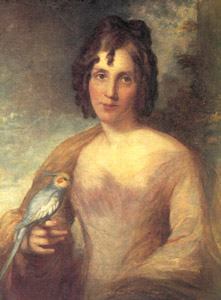 Elizabeth Gould Holds Corella | |
| Date of Birth | July 18, 1804 |
| Place of Birth | Ramsgate |
| Date of death | August 15, 1841 (37 years old) |
| Place of death | |
| Nationality | United Kingdom of Great Britain and Ireland |
Content
Biography
Elizabeth Gould was born into a military family. She worked as a teacher with a family in London and taught Latin, French, and music. At the age of 24, she married John Gould. They had seven children: three daughters (Eliza, Louise and Sarah) and four sons (John, who died in childhood, John Henry, Franklin and Charles).
Her husband encouraged them to learn new ways of printing lithography. For her husband’s first work “ A Century of Birds from the Himalaya Mountains ”, she made drawings of birds from sketches on large limestone boards. Elizabeth Gould's inexperience is still very noticeable in these early works. To improve her lithography technique, she took lessons from Edward Lear .
Beginning in May 1838, she, along with British naturalist John Gilbert ( English John Gilbert ; 1812-1845), accompanied her husband on his research trip to Australia and Tasmania . She took with her her oldest seven-year-old son, leaving her three youngest children in England . In September 1838, they arrived in Tasmania, where they met the British Rear Admiral and Arctic explorer Sir John Franklin and his wife Jane . Soon after, she gave birth to her sixth child in Hobart , in Tasmania. She named him John Franklin, whose house she often visited while John Gould was engaged in field research. She transferred the results of his work to sketches. In August 1840, the couple returned to England with both children. She could no longer finish her work. She died during childbirth on August 15, 1841 at the age of 37 after the birth of her eighth child.
Lithographs
Elizabeth Gould produced over 600 lithographs and drawings of birds, mammals and plants. Many of her works were published in the following publications of her husband:
- "A Century of Birds from the Himalaya Mountains" (1831 and 1832, 80 boards)
- The Birds of Europe (1832-1837, 449 boards)
- "A Monograph of the Ramphastidae, or Family of Toucans" (1834, 34 boards)
- "A Monograph of the Trogonidae" (1835-1838, 36 boards)
- "A Synopsis of the Birds of Australia" (1837-1838, 73 boards)
- "The Birds of Australia" (1837-1841, 84 boards)
- Icones Avium (1837-1838, 18 boards)
After the death of Elizabeth, John Gould, who himself was more of a scientific researcher than an illustrator, asked lithographer Henry C. Richter to continue his wife's work. Many of Elizabeth Gould’s lithographs were borrowed by Richter for The Birds of Australia and published under his name.
Mistakenly, many of Elizabeth Gould’s works are described today as the works of her husband. John Gould also instructed other artists to illustrate their works, including Joseph Wolf .
Honors
John Gould named Amadina ( Chloebia gouldiae ) in honor of his wife, and Nicholas Eilwig Vigors - the pointed-nectar ( Aethopyga gouldiae ).
Gallery
Bubo bengalensis
White-breasted Dove ( Columba leuconota )
Spiky-Faced Dove ( Lopholaimus antarcticus )
Himalayan Indo-Malay Woodpecker ( Dinopium shorii )
Notes
- ↑ German National Library , Berlin State Library , Bavarian State Library , etc. Record # 1011908468 // General regulatory control (GND) - 2012—2016.