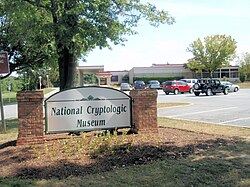
The National Museum of Cryptography ( eng. National Cryptologic Museum , NCM) is a museum of the USA created by the NSA , the exposition of which is devoted to the history of cryptography .
| National Museum of Cryptography | |
|---|---|
| National Cryptologic Museum | |
 | |
| Founding date | 1993 |
| opening date | Monday-Friday 9.00 -16.00, 1st and 3rd Saturday of the month - 10.00 -14.00 |
| Address | 8290 Colony Seven Road, Annapolis , Howard County, Maryland , USA |
| Visitors per year | more than 50 thousand per year |
| Director | Patrick Whedon (curator) |
| Site | National Cryptologic Museum |
Content
Exposure
The museum’s collection contains thousands of exhibits displaying the history of American cryptography from the War of Independence to the present, including the current copies of the Enigma German coder of the Second World War (two of them are available for use by visitors), Bombe , a United States Navy Cipher other.
In addition to the equipment used to encrypt, decrypt, and secure information, the exhibit features people who contributed to the development of cryptography in America — including George Washington (who used coded messages during the Revolutionary War), American Indians who protected US communications during world wars, using their native language to encode messages; female US military units of the US Navy WAVES , who deciphered German coded messages during World War II, and many others.
The museum exposition includes four main sections:
- The initial stage of the development of cryptography - covers the period from the XVI century (the book "Polygraphiae" of the Renaissance) to the 1950s. Here are the exhibits of the times of the founding fathers of the United States, the American Civil War , the Navajo ciphers , the First World War , the Second World War and the Korean War .
- The period of the “Cold War” - represents the period of the development of cryptography during the “ Cold War ”, from the first years of the NSA activities to the present, including using supercomputers .
- Information security - here are technologies using satellites, secure voice communications , unauthorized access systems and protection against them, including using biometric data .
- The memorial hall , part of which is the NSA Hall of Fame , also includes a memorial near the museum building - Vigilens National Park , which commemorates NSA employees who died while performing their duties [1] .
In addition, the museum features special expositions reflecting the role of women and African Americans in the history of cryptography, as well as the variety of languages used in the world (including a copy of the Rosetta Stone and hobo jargon used in the late XIX - early XX centuries). [2]
The museum has an extensive library of classified materials on the history of cryptography and cryptography itself. The library is open on museum days. Library materials are not given to readers, but photographing and photocopying are allowed.
Library funds almost doubled thanks to historian and writer David Kahn , who donated an extensive collection of articles, books, and other materials on the history of cryptography to the library. A solemn ceremony on this occasion took place on October 26, 2010. [3]
Activity
The museum organizes guided tours organized by retired NSA staff. Groups of six people or more should contact the museum in advance and decide on the provision of a guide. The museum also conducts educational tours, interactive programs, training for students aged 9 years, as well as programs for boy scouts and girls scouts of all ages.
In 2010, the museum held a ceremony of dedication of the personnel of the Marine Corps of the US Cyber Command , which was attended by the former commander of the Marine Corps, General A. Gray . [four]
NSA Hall of Fame
The Hall of Fame was created in the museum in 1999 to perpetuate the memory of NSA employees who made an outstanding contribution to the development of cryptography in the United States.
Each year the museum fund presents regular candidates for placement in the exposition of the Hall of Fame.
Gallery
Bombe decryption machine, by which the codes of the German Enigma were cracked
STU-I secret communications equipment
KY-3 secure phone
Navajo I secure phone
STU-II secure telephone (electronics located in a separate room)
STU-II secure communication equipment
STU-III secure phone
See also
- Hall of Fame US military intelligence
Notes
- ↑ National Cryptologic Memorial - NSA / CSS (May 28, 2010). The appeal date is October 26, 2010. Archived on September 12, 2012.
- ↑ National Cryptological Museum - Virtual Tour . The date of circulation is October 5, 2010. Archived September 12, 2012.
- ↑ Dr. David Kahn to be honored by NSA (October 19, 2010). Circulation date is October 23, 2010. Archived September 12, 2012.
- ↑ McCombs, Alan J. Fort Meade News: USMC Cyber Command (not available link) (January 28, 2010). The date of circulation is October 5, 2010. Archived February 21, 2010.