The Nguyen Dynasty ( Vietnamese. Nhà Nguyễn ; 1802-1945) - the last imperial dynasty in Vietnam .
| monarchy, protectorate | |||||
| Nguyen Dynasty | |||||
|---|---|---|---|---|---|
| Nhà nguyễn | |||||
| |||||
Anthem : | |||||
 → → → →- | |||||
| Capital | Hue | ||||
| Languages) | Vietnamese | ||||
| Religion | Confucianism , Buddhism , Catholicism | ||||
| Currency unit | |||||
| Form of government | absolute monarchy | ||||
| Story | |||||
| • June 1, 1802 | The coronation of Nguyen Thee | ||||
| • September 1, 1858 | First Franco-Vietnamese War | ||||
| • September 22, 1940 | Japanese occupation | ||||
| • August 30, 1945 | The Renunciation of Bao Dai | ||||

| History of vietnam | 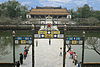 | ||||||||||||||||||||||||||||||||||||||||||||||||||||||||||||||||||||||||||||||||||||||||||||||||
|---|---|---|---|---|---|---|---|---|---|---|---|---|---|---|---|---|---|---|---|---|---|---|---|---|---|---|---|---|---|---|---|---|---|---|---|---|---|---|---|---|---|---|---|---|---|---|---|---|---|---|---|---|---|---|---|---|---|---|---|---|---|---|---|---|---|---|---|---|---|---|---|---|---|---|---|---|---|---|---|---|---|---|---|---|---|---|---|---|---|---|---|---|---|---|---|---|---|
| |||||||||||||||||||||||||||||||||||||||||||||||||||||||||||||||||||||||||||||||||||||||||||||||||
Thirteen emperors of the Nguyen dynasty sat in Hue for 143 years. After French colonization in 1884, Annamus ruled as a protectorate of the French Republic .
Content
History
Princes of Nguyen
During the reign of the Le Dynasty, the three feudal houses of Maki , Nguyen and Chini were part of the elite of Vietnamese society [1] . In the sixteenth and seventeenth centuries, they fought among themselves for real power in a country that was increasingly leaving the hands of Le. In fact, the country was divided into the northern part, where Chini ruled, and the south, where Nguyens ruled [2] .
In 1771, the Taishon revolt began, which began as a popular one. By 1773, the Taishons managed to capture a significant part of the Nguyen land, to establish themselves in the city of Quignon . Cheney, seeing that the Nguyen’s position had weakened, captured their capital Fusuan . In 1775, the Cini entered into an agreement with the Taisons and intended to fight the Nguyens with the hands of the rebels. In turn, one of the leaders of the uprising, Nguyen Hue, showed the strength of his army, capturing the city of Fuyen . The Taishon fleet landed in the Mekong Delta in 1776, and by the next year the rebels managed to capture the entire territory of Namka . In 1778, Nguyen Nyak proclaimed himself emperor, and the brothers as princes, having founded the state of the Teyshons. At this point, only the Nguyen Phuc Anya survived from the Nguyen clan, who managed to escape first to Phu Quoc , and then to Siam with the help of the French missionary Pinho de Bein [2] .
In 1784, with the support of the Siam army, Nguyen Fuc Anyu managed to return the western part of Zyadin . The son of Nguyen An, Prince , through the mediation of Pinho de Bein, went to France to ask for military assistance. But in 1785, the Taishons drove the Siamese from the occupied lands along with Nguyen Anem. In parallel, they made a trip to Chinei, and on July 21, 1786, Thanglong was taken. Formally, the rebels regained Le’s power from Zadin to Bakh [2] .
Founding of a Dynasty
On November 28, 1787, the Treaty of was signed in France, according to which the French promised to restore the power of the ruler Nguyen An, and in return received the port of Hoi An and some other privileges. However, the agreement was not implemented due to the revolution that broke out in France [2] .
Thanks to the support of the population in the south, the army of Siam and French spies, Nguyen Anyu managed to gain a foothold in Zyadin again. The Taishons fought a war with the Manchu, and by 1792 the Nguyen army numbered about 140 thousand people, 20 artillery groups, 200 fighting elephants, units of sapper troops (which included carpenters, locksmiths, gunsmiths, etc.) and well-established intelligence. The first landing in the Binh Thuan area ended unsuccessfully, a detachment of Nguyen Anya of 6,000 people was rejected. Several attempts were made to capture Kunyong, and the third time in 1799 the city surrendered. In the conquered territories, Nguyen An pursued a wise policy of "appeasement", not plundering local peasants, but delivering provisions from Zyadin. The decisive battle in the Gulf of Thinay took place in early 1801, there were heavy losses on both sides, Europeans participated on the Nguyen Anya side. Then the cities of Quangnam , Quang Ngai and Fusuan were taken. In 1802, the coronation ceremony of Nguyen Anya was held in Fusuan, who became the first emperor of the Nguyen dynasty, under the name Nguyen The-that and the motto of Zia Long . On July 20 of the same year, he captured Thanglong, brutally cracked down on the participants in the uprising, and the Taishon state ceased to exist [2] .
New State Structure
In the first years of his power, the emperor strengthened the state apparatus, and since almost all his relatives were destroyed, he relied on army generals who spent time in exile with him or showed themselves in the struggle with the Taisons, including those who switched to his side from the camp of the enemy. The largest officials were the commanders Nguyen Van Nyan, Nguyen Van Chyong, Le Van Zuet, Le Tyat, Nguyen Van Thanh [2] .
Immediately after seizing power in China, an embassy was equipped with a tribute to establish traditional relations with its northern neighbor. In 1804, the ruling Qing dynasty in China recognized Thee and gave him management investment . The new ruler demanded that the country cease to be called Annam ( pacified south ), and began to bear the name Namviet , as a symbol of the unification of the north and south. The Manchu emperor saw in this title claims on its territory and proposed a compromise name Vietnam [2] .
Six metropolitan departments were established [2] :
- personnel and appointments of ranks ( boi ),
- ceremonies ( bo le ),
- finance ( bo ho ), with its own mint and a monopoly on the issue of money,
- military affairs ( Bo Binh ),
- justice (punishment) ( bo hin ),
- community service ( bo kong ).
Gradually, by 1832, this structure was introduced on the ground in the provinces [2] .
Self-Management Period
Theo died in 1820, three years before his death in a difficult political struggle, his fourth son Nguyen Than-too became his successor [2] . During his reign, Thanh then tried to strengthen the central government by placing state control over the extraction of minerals, the production and sale of rice. Replaced his father's military officials with civilians. He changed the tax system in the direction of increasing taxes, clashing the interests of officials and landowners. Rebuilt the entire financial system. Thanh then paid attention to agriculture and oppressed trade. During his reign, 234 peasant uprisings took place, the largest of which was the , which lasted three years (1833-1836) [2] .
The uprising was supported by the army of Siam, and since then this state has become perceived as an enemy. Relations with other neighbors were also tense. Vietnam annexed the land of Changnin , Cambodia and Luang Prabang recognized themselves as vassals and sent tribute to Hue. And Vientiane , supported by Vietnam, was captured by Siam. Than still paid tribute to the Qing, but these relations became increasingly formal, and when the Manchu army, pursuing their criminals, entered the territory of northern Vietnam, he sent troops there and stood up to defend the borders. With Europeans, he kept himself independent, did not accept gifts from the British and French, and persecuted Catholic missionaries [2] .
At the beginning of 1841, Thanh then died, leaving the country in an atmosphere of relative stability [2] .
French protectorate
World War I and World
Dynasty Sunset
Dynasty Emperor Scheme
| one Tae 1802-1819 | |||||||||||||
| 2 Than something 1820-1840 | |||||||||||||
| 3 Hien something 1841-1847 | |||||||||||||
| four Zuk Tong 1847-1883 | Thoy Thai Wong | Kien Thai-wong | 6 Fe de 1883 | ||||||||||
| five Kung tong 1883 | 9 Kany Tong 1885-1889 | eight Ham ngi de 1884-1885 | 7 Ziang Tong 1883-1884 | ||||||||||
| ten Thanh thai fe de 1889-1907 | 12 Hoang tong 1916-1925 | ||||||||||||
| eleven Zooey Tan Fe 1907-1916 | 13 Bao dai de 1925-1945 | ||||||||||||
Notes
- ↑ Cheshkov M. A. Essays on the history of feudal Vietnam: (based on materials from the Vietnam chronicles of the 18th – 19th centuries). - M .: Nauka, 1967 .-- 251 p.
- ↑ 1 2 3 4 5 6 7 8 9 10 11 12 13 Mkhitaryan S. A. The New History of Vietnam. - M .: Nauka, 1980 .-- 720 p.
See also
- Flags of the administrative units of the Nguyen Dynasty