The April Revolution ( Dari انقلاب ثور - Saurian Revolution) is a military coup in Afghanistan on April 27, 1978, which resulted in the establishment of a socialist pro-Soviet government in the country.
| April revolution | |
|---|---|
| dari انقلاب ثور | |
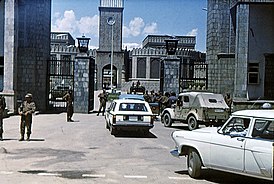 The streets of Kabul the day after the revolution. April 28, 1978 | |
| A country | Kabul , Afghanistan |
| date | April 27, 1978 |
| Cause | The arrest of the leaders of the PDPA - Taraki , Karmal and Amin |
| the main goal | The overthrow of the regime of Muhammad Daoud |
| Total | The victory of the pro-communist forces and the armed change of government. Proclamation of the Democratic Republic of Afghanistan (DRA) , the beginning of the war with the opposition |
| Organizers | PDPA |
| driving forces | PDPA Supporters The rebellious parts of the Afghan army |
| Opponents | Supporters of Muhammad Daoud |
Reasons and background
In 1979, in the January issue of “ Problems of Peace and Socialism ”, one of the PDPA members, Zerey, described the pre-revolutionary situation [1] :
| The masses were ready to revolt. The standard of living fell sharply. More than 1 million Afghans emigrated to Iran. The legitimacy of the government was greatly shaken in the eyes of the people; orders were not executed. A very important fact was that we worked among the people of 13-14 years, we led a popular movement. Before the revolution, our party was an impressive force with 50 thousand members and supporters, and this frightened the regime. |
In his book “The Tragedy and Valor of Afghanistan” A. A. Lyakhovsky notes [2] :
| For the Soviet representatives in Kabul, as well as for our special services, the military coup on April 27, 1978 appeared as “a bolt from the blue”, they simply “overslept” it. The leaders of the People’s Democratic Party of Afghanistan hid from the Soviet side their plans to overthrow Daud and all the more did not consult on these issues, as they were sure that Moscow would have reacted negatively to their intentions. |
Professor S. M. Menshikov also noted the same thing: “in April 1978, when local communists came to power in Afghanistan as a result of a military coup, this was a great surprise to the Soviet leadership. Our relations with the ousted regime were not bad, and perhaps for this reason the Afghan communists did not coordinate their actions with Moscow ” [3] .
April Revolution
On April 17, 1978, a prominent PDPA activist, member of the Parcham faction Mir Akbar Khaibar , a former editor-in-chief of the opposition authorities of the Parchamist newspaper , was shot dead. On April 19, his funeral turned out to be a demonstration against the regime of President Mohammed Daoud (according to some reports, about 20 thousand people took part in it), because there were rumors of involvement in the murder of the Daoud secret police, and led to a clash of demonstrators with the police.
Daud ordered the arrest of the PDPA leaders. On the night of April 26, Nur Mohammed Taraki and Babrak Karmal were arrested. Four hours later, Hafizullah Amin, already under house arrest, was sent to prison. On the morning of April 26, all four Kabul newspapers issued a government message stating: “Having examined the statements, speeches, slogans, appeals, actions and arbitrariness that took place during the funeral of Mir Akbar Khaibar, the government regarded them as provocative and unconstitutional ... by persons accused the criminal offenses and the arrested security agencies are Nur Mohammed Taraki, Babrak Karmal, Dr. Shah Wali, Dastagir Panjshiri, Abdul Hakim Sharayi, Hafizullah Amin, Dr. Zamir Safi. Upon the arrest of these persons, documents of interest were seized in their apartments. An active search for a number of other individuals continues. ”
However, Amin with the help of his son handed over to the faithful PDPA military units the order prepared in March for the start of an armed uprising. After that, PDPA supporters in the midst of the armed forces held an armed action to change the government [4] .
On April 27, 1978, at about 10 a.m. tanks appeared on the streets of Kabul. Tanks surrounded the presidential palace Arg [5] . In his book, General A. A. Lyakhovsky writes [6] :
| The first column of the 4th Tank Brigade, led by the tank company commander, senior captain Umar, appeared in front of the main entrance of the presidential palace at about noon on April 27. At this time, a meeting of the cabinet of ministers was held in the palace, chaired by M. Daud. The latter was immediately informed of the appearance of tanks. Dowd ordered Defense Minister Rasuli and Chief of Presidential Guard Major Zia to find out what was happening. When asked Zia why tanks arrived, Umar replied that they were sent by the brigade commander to strengthen the protection of the presidential palace. Umar was ordered to return to the brigade location. However, having left the position at the main entrance to the palace, he drove the tanks into a side street and waited. Soon the other units of the 4th Tank Brigade arrived. The presidential palace was surrounded by tanks. Officers M. A. Watanjar, S. D. Tarun, Nazar Muhammad, Sh. Mazdurjar and Ahmed Jan directed their actions. |
Tank units under the command of Aslam Watanjar fired at the royal palace of Arg, where Daud was with his whole family, the main ministries, and the building of law enforcement agencies. According to Afghan publicist Razak Mamun, in the middle of the day the first shell fired from a tank gun hit the building of the country's Ministry of Defense. This shot destroyed the connection between the Ministry of War and the presidential palace of Arg [7] .
Aircraft , one of which was piloted by a prominent political figure, then senior sergeant S. Gulyabzoy , dealt an “acrobatic” blow to the main building of the palace. The 7th division, faithful to Daoudu, tried to break through to the capital with battle, but was scattered by air attacks of the rebels [8] . The siege of Arg went on all night. The palace, bombarded and bombarded, fell the next morning. A group of soldiers led by Imamuddin burst into the building in which the head of state was located, the president and his whole family were killed; at about the same time the resistance of the troops loyal to the government was suppressed. A. Kadir and M. Watanjar announced on the radio on the “Saur revolution” in the evening of April 27 (“saur” is the name given in the language of the second month of the Persian calendar [9] ). The leaders of the PDPA Taraki and Karmal and others were released from prison. Afghanistan was declared the Democratic Republic of Afghanistan ( DRA ). Nur Mohammad Taraki became the head of state and prime minister, Babrak Karmal became his deputy, and Hafizullah Amin became first deputy prime minister and foreign minister.
Summary and characteristics
The April Revolution was communist (anti-clerical, anti-feudal, anti-capitalist and anti-moderate). Formally, socialism was established as a political system in Afghanistan, but attempts by the new leadership, ignoring the local specifics, to forcefully implement the strategy copied from the USSR, led to the emergence of an opposition to the government, to combat which the contingent of Soviet troops was subsequently introduced.
General Lev Gorelov , the chief military adviser to the Armed Forces of Afghanistan, who was in 1975-1979, subsequently evaluated it as follows: “In general, this was not a revolution, but rather a coup, a coup made by the officers, the army” [10] .
According to the Minister of Culture and Information of Afghanistan, Said Mahdum Rakhin (2010), the coup of 1978 stopped the process of development of democracy in the country for several decades [11] .
It is not customary to celebrate the anniversary of the April Revolution in Afghanistan [12] - instead of it the next day is the Day of Victory of the Afghan People in Jihad (the anniversary of the overthrow of the pro-Soviet government in 1992) [13] .
Notes
- ↑ Review of the history of the revolution and counter-revolution in Afghanistan
- ↑ Russian intelligence, Arab sheikhs, Afghanistan ... (inaccessible link) . Date of treatment April 27, 2008. Archived October 14, 2007.
- ↑ ON THE OLD AREA (inaccessible link) . Date of treatment March 26, 2013. Archived April 4, 2013.
- ↑ Soviet revisionism and the April (1978) revolution in Afghanistan (Inaccessible link) . Date of treatment April 27, 2008. Archived December 23, 2008.
- ↑ The Saurian Revolution
- ↑ Alexander Antonovich Lyakhovsky . The tragedy and valor of Afghanistan (1995)
- ↑ April Revolution 30 years
- ↑ Afghanistan: a history of wars from Alexander the Great to the fall of the Taliban. - M.: Publisher Eksmo, 2004.
- ↑ D.E. Eremeev. Islam: lifestyle and way of thinking. Chapter VIII. Pagan beliefs and holidays in Islam
- ↑ Lev Gorelov: How it was. Art Of War - Military Historical Literary Portal
- ↑ Rakhin: The April coup stopped the democratization of Afghanistan (Retrieved April 26, 2010)
- ↑ Exactly 30 years ago, the April Revolution took place in Afghanistan (inaccessible link)
- ↑ 30 years ago, the April Revolution took place in Afghanistan. (Retrieved April 26, 2010)