Galaxy Science Fiction is an American science fiction magazine published from 1950 to 1980 .
| Galaxy Science Fiction | |
|---|---|
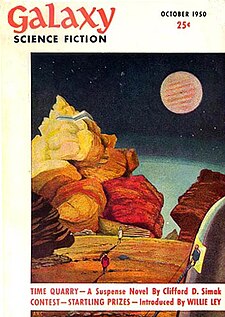 Galaxy First Release Cover | |
| Specialization | science fiction |
| Periodicity | monthly |
| Tongue | English |
| Chief Editor | G. L. Gold (first editor) |
| Founders | |
| A country |  USA USA |
| Publisher | World Editions, Inc., New York (October 1950 - September 1951); Galaxy Publishing Corp., New York (October 1951 - May 1969); UPD Corp., New York (July 1969 - October 1979); Galaxy Magazine, Inc., New York (1980) |
| Edition History | from 1950 to 1980 |
| Established | 1950 |
| Awards | [d] ( 1953 ) |
Content
History
The magazine was founded by the Italian company World Editions , which was planning to break into the American market. The company hired Leonard Gold as editor of Horace, who quickly made Galaxy the leading science fiction magazine of his time, focusing on social stories instead of technology.
Gold has published many famous works during his tenure as an editor, including Fireman Ray Bradbury (who served as the basis for 451 degrees Fahrenheit ), Puppeteers by Robert Heinlein and Alfred Bester 's Man Without a Face . In 1952, the magazine was acquired by Robert Guinn, his typographer. By the end of the 1950s, Frederick Paul helped Gold with most aspects of preparing the magazine. When Gold's health deteriorated, Paul finally assumed the duties of editor, which officially happened at the end of 1961.
Edited by Paul, Galaxy continued its success by regularly publishing renowned science fiction writers such as Jack Vance , Harlan Ellison , Robert Silverberg, and Cordweiner Smith . However, Paul never won the Galaxy Hugo Award, but instead got Hugo with his sister for If magazine. In 1969, Guinn sold the Galaxy Universal Publishing and Distribution Corporation and Paul resigned and was due to be replaced by Edgler Jacobson. However, edited by Jacobson, the quality of the magazine deteriorated. It was restored to its previous level under Jim Bane, who took control in mid-1974, but when he left at the end of 1977, the quality fell again and financial problems arose: the authors did not receive the fee on time and the publication schedule became irregular. By the late 1970s, the magazine was last sold to Vincent McCaffrey, who published only one issue in 1980 . The brief revival as a semi-professional magazine occurred in 1994 under the editorship of Gold's son; eight issues were released with a two-month break between releases.
Editors
- G.L. Gold (October 1950 - October 1961)
- Frederick Paul (December 1961 - May 1969)
- Edgler Jacobson (July 1969 - May 1974)
- Jim Bane (June 1974 - October 1977)
- John Jeremy Pearce (November 1977 - March-April 1979)
- Hank Stein (June-July 1979 - September-October 1979)
- Floyd Kemske (summer 1980)
Value
At its peak, Galaxy had a great influence in science fiction. He was considered one of the leading journals of the NF almost from the very beginning and his influence did not diminish until Paul left in 1969. Gold brought "complex intellectual subtleties" to the science fiction magazine, Frederick Paul then said that "after the appearance of Galaxy it was impossible to continue to be naive" [1] . Historian NF David Kyle agrees, noting that of “all the post-war editors, the most influential, without a doubt, was G. L. Gold” [2] . Kyle comes to the conclusion that Gold’s new direction inevitably led to the advent of the experimental “ New Wave, ” which defines the science fiction literary movement of the 1960s.
Notes
- ↑ Frederick Paul, “Introduction,” in Pohl, Greenberg & Olander, Galaxy: Thirty Years of Innovative Science Fiction, p. XII
- ↑ David Kyle, “A Pictorial History of Science Fiction,” pp. 119-120.