Hafsa-Sultan (1478/1479 - March 19, 1534) is the concubine of the Ottoman Sultan Selim I , the mother of Sultan Suleiman I and several other children. In the reign of her son she wore the title of Valide Sultan .
| Hafsa Sultan | |||||||
|---|---|---|---|---|---|---|---|
| tour. Hafsa sultan osman. عایشه حفصه سلطان | |||||||
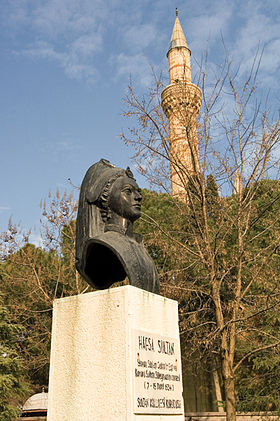 Bust of Hafsa Sultan in Manisa , Turkey | |||||||
| |||||||
| Monarch | Suleiman I | ||||||
| Predecessor | (?) [5] | ||||||
| Successor | Nurbanu Sultan | ||||||
| Birth | 1478/1479 is unknown | ||||||
| Death | March 19, 1534 Istanbul , Ottoman Empire | ||||||
| Burial place | |||||||
| Kind | Ottomans | ||||||
| Father | unknown | ||||||
| Spouse | Selim I | ||||||
| Children | Suleiman I Hatice Sultan Fatma Sultan Beihan Sultan | ||||||
| Religion | Sunni Islam | ||||||
Content
Name, Origin and Title
In historical documents and studies, the mother of Sultan Suleiman I is called Hafs [6] [5] [7] [8] [9] , Hafize [6] , Aisha Hafsa [3] [6] [4] and Aisha [6] [ 9] . Some sources considered the mother of Suleiman I the daughter of the Crimean Khan Mengli I Geray , who was named Aisha [10] [11] , but she could not be the mother of the Sultan, since she married Selim I only in 1511 [10] [12] , then how Suleiman was born in 1494 [2] . Probably, due to the incorrect opinion that Aisha was the mother of Suleiman I, a confusion with the names arose [10] .
There is no documentary evidence that the Crimean woman was the mother of Suleiman I; some sources call the mother of Suleiman I the representative of the dynasty of rulers of Dulkadirogullara , but there is also no evidence of this [6] [9] . Most likely, the Hafsa Sultan was a European [6] , a Turkish or a Circassian [5] . Hafsa’s father Alderson and Sakaoglu are called a certain Abdyulmuin [13] [6] , however this name (or the names Abdyulkhay, Abdurrahman and other derivatives from Abdullah) was recorded in the harem books as the father’s name for all concubines [9] [14] when they accepted Islam [6] .
Prior to the introduction of the title of Valide-Sultan, the mothers of the Sultans were called Khatuns [4] , and although numerous sources name the mother of Suleiman Hafs-Sultan , most likely, during her lifetime she was called Hafsa-Khatun . Necdet Sakaoglu writes that Hafsa was the last mother of the sultan who wore the title of Khatun [6] , and Caroline Finkel notes that the first woman who officially wore the title of Sultan was Nurbanu Sultan , mother of Sultan Murad III [15] .
Life in a Harem
Little is known about the life of the Hafsa Sultan. It is reliably known that she died at the age of 56 years [9] , on the basis of which the approximate date of birth of the future valid-sultan should be considered 1478 [6] or 1479 [9] . Contemporaries describe Hafsu as a very beautiful woman [6] [16] . Her youth passed in Trabzon, where Selim I , then shekhzade , was a sanjakbey - the governor of the province, preparing to rule the country. On November 6, 1494, the supposedly only son of Hafsa was born in Trabzon - the future Sultan Suleiman I [9] [6] .
In 1508-1509, Hafsa accompanied her son when he consistently held the posts of Sanjakbey Shebinkarahisara and Bolu [6] . In 1509, Suleiman was sent by his grandfather, Sultan Bayezid II , to the Crimea to the post of Beyerbey Kef , and Hafsa also went with him [9] [14] . In early 1512, Bayazid II abdicated in favor of Selim I; Hafsa, now one of the Sultan’s concubines, briefly arrived in Istanbul [6] , after which she and her son were sent to Manisa , where Suleiman became a sanjakbei [9] [14] . When Selim I died in 1520 and Suleiman I became a sultan, Hafsa was in the capital of the Ottoman Empire; in Istanbul, Hafsa settled in the Old Palace, located in the Beyazit district [6] , where she headed her son’s harem as a Valide Sultan (she also had the title of Mehd-i Hive [9] - “the cradle of the great Sultan” [17] ) [9] .
Evliya ебelebi in her book Seyyahatnam (The Book of Travels) reports without specifying the reason that in 1520 Sultan Suleiman I sent his mother to Trabzon. If there is no mistake in the records of Evliya ошибкиelebi, and he writes specifically about Suleiman I, and not about Selim I, then Hafsa was sent to Trabzon with a state mission: she was entrusted with organizing a new administrative unit - . Evlia also reports that from here Hafsa sent several letters to her son [10] . At the same time, Turkish and foreign sources report that Hafsa, although having a great influence on the son of the Sultan, did not abuse him and performed only an administrative function in the palace, trying to prevent the Alexandra Anastasia Lisowska from gaining sole influence over Suleiman I for the rest of his life [18 ] and suppress the rivalry between Alexandra Anastasia Lisowska and the mother of the eldest son of the Sultan, shekhzade Mustafa , Mahidevran Sultan [19] .
In the archives of the Sultan's Palace [20] , several letters were sent by Hafsa to the Sultans Selim I and Suleiman I [21] . One of the letters, signed by "Valide-i Sultan Suleiman Shah" ("mother of the Sultan Suleiman Shah"), was addressed to Selim when he was still a shekhzade; in a letter to Hafs, she expressed the hope that Selim would take the throne, and his expectation would not be in vain. In addition, this letter shows that during the time of Selim's stay in Trabzon, Hafsa was not with him, but with her son in a sanjak. In 1522, Hafsa wrote a letter to her son, and also attached to it a letter from the widow of the Egyptian governor Khayrbey, asking her to help him leave Egypt; Hafsa was also ready to bear the cost of transporting the widow of Hayirbey from Egypt and take her under her protection in Istanbul. In another letter, Hafsa asks his son to take care of his cousins Aisha and Fatma, the daughters of , who became orphans after the death of their mother. Historians who studied the letters of Hafsa, came to the conclusion that she was compassionate and benevolent [20] .
Hafs stayed valid for thirteen years, five months and twenty-seven days. [9] She died in Istanbul on March 19, 1534 [13] [9] ; historian Mehmed Sureya-Bey indicates the year of Hafsa’s death in 1539 [3] , however, this date is probably erroneous. The mother of Sultan Suleiman I was buried in the garden of the in Fatih , Istanbul [9] ; later, by order of Suleiman I, a mausoleum was erected over the grave of his mother [20] , in which, after 1536, one of Khafsa’s daughters, Khatija Sultan , was buried [14] . Also, according to records in Hadikatyu'l Jevah , three young sons of Suleiman I — Murad, Mahmud and Abdullah — and one of the harem women [10] were buried in the Hafsa mausoleum.
Offspring
The number and names of the children of Sultan Selim I from Hafsa are not known for certain. In addition to Suleiman I, Hafsa is considered the mother of Hatice Sultan (d. After 1536), Fatma Sultan (d. After 1553) and Beihan Sultan (d. Before 1559) [6] [22] .
Charity
Like many mothers of the Sultans, Hafsa was engaged in charity work. Vacufs of the Hafsa-Sultan operated in Manisa , Bursa and Mentesh [14] . She also built a hotel on the way from Istanbul to Edirne, near which the city of Havsa later flourished, a mosque in Perkan , a mosque and hammam in Marmaris , a madrasah and imaret in Trabzon [20] .
Her greatest contribution remained in Manisa [21] : here in 1522 [14] or 1523 she built a complex consisting of a three-domed mosque, madrasah , mekteba , the monastery of dervishes and imaret , and after the death of Hafsa, hammams were built on the orders of Suleiman I (1538) and the hospital (1539) [21] [14] [20] . The complex occupied an important social and economic place in the life of the city [23] and is a classic example of Ottoman architecture . According to the wakuf records, the complex was built by Timurtashoglu Ali-bey in the area of Manisa Gardens so that the city could expand towards the outskirts. 20 houses were built to the west of the mosque, the owners of which were exempted from any monopoly taxes. Over time, a district was formed that determined the direction of development of the city. In June-July 1523, a waqf was established by Hafsoy-Sultan, its managers and sources of income were appointed. By 1531, there were 117 employees in the fund. There were two imams in the mosque, a preacher, four muezzins and other servants. The food in imaret, in which 20 people worked, was served regularly: according to the data of the waqf books, the annual consumption of meat from the Imaret cuisine was 16,627 kilograms, and the consumption of wheat was 91,500 kilograms. Nine people lived permanently in the dervishes. In the madrasah taught up to ten people who received a salary of 2 acres per day. In the vacuum books for 1575, the appointment of the responsible for the work of buildings in the western part of the complex was reported: the main doctor, the second doctor, the head of the hospital, the eye doctor, the surgeon and the assistant manager were listed here. In 1559, some buildings of the complex were repaired and reconstructed. By the 1960s, under the influence of natural causes, most of the complex was destroyed; in 1969, the General Directorate of Funds restored part of the destroyed buildings, except for the imaret and the monastery of dervishes, which could not be restored [23] .
Manisa Festival
The annual festival Manisa Mesir Majunu is associated with the name of Hafsa Sultan. According to legend, when Hafsa was in Manisa, she fell ill. Musa bin Muslihiddin bin Kylych (d. 1552), the chief physician of the Sultan’s court, was called to the patient’s bed. He created healing paste from 41 varieties of herbs that healed Hafsa. Mother Suleiman I wished that the pasta was distributed to everyone everywhere. Later, the distribution of the ointment was turned into a festival that takes place on the Novruz holiday [10] .
In Culture
Television
- In the Ukrainian television series Roksolana (1997), the role of Suleiman's mother, Aisha Hafsa-Sultan, was played by Tatyana Nazarova [24] .
- In the Turkish historical and drama television series " Alexandra Anastasia Lisowska Sultan " (2003), the mother of the Sultan is not called by name, but only by title. The role was played by [25] .
- In the Turkish historical and drama television series The Magnificent Century (2011-2012), the mother of Sultan Suleiman I is named after Aisha Hafsa-Sultan and combines the biographies of Hafsa and Aisha-Khatun , daughter of the Crimean Khan Mengli I Giray . The role was played by Nebahat Chehre [26] .
Literature
Hafsa-Khatun is a minor character in a number of Turkish and foreign literary works describing the life of her sister-in-law Alexandra Anastasia Lisowska, Mahidevran and Gyulfem. In most of these works, the role of Hafsa has no historical basis [27] .
See also
- List of mothers of the Ottoman Sultans
Notes
- ↑ Alderson, 1956 , p. 83 (note).
- ↑ 1 2 Alderson, 1956 , table XXX.
- ↑ 1 2 3 Süreyya, 1 Cild, 1996 , s. 7.
- ↑ 1 2 3 Akyıldız, 2012 , s. 494.
- ↑ 1 2 3 Alderson, 1956 , p. 83.
- ↑ 1 2 3 4 5 6 7 8 9 10 11 12 13 14 15 16 Sakaoğlu, 2015 , s. 199.
- ↑ Bahadıroğlu, 2007 , p. 186.
- ↑ Peirce, 1993 , p. 52.
- ↑ 1 2 3 4 5 6 7 8 9 10 11 12 13 14 Bayat, 1997 , s. 122.
- ↑ 1 2 3 4 5 6 Sakaoğlu, 2015 , s. 201.
- ↑ Alderson, 1956 , table XXVIII.
- ↑ Alderson, 1956 , table XXIX (note 1).
- ↑ 1 2 Alderson, 1956 , table XXIX.
- ↑ 1 2 3 4 5 6 7 Uluçay, 2011 , s. 54.
- ↑ Finkel, 2012 , p. 231.
- ↑ Bayat, 1997 , s. 121.
- ↑ Alderson, 1956 , p. 117.
- ↑ Bayat, 1997 , s. 122-123.
- ↑ Somel, 2003 , p. 123.
- ↑ 1 2 3 4 5 Sakaoğlu, 2015 , s. 200.
- ↑ 1 2 3 Bayat, 1997 , s. 123.
- ↑ Öztuna, 2006 , p. 233.
- ↑ 1 2 Yavaş, 1997 , s. 123.
- ↑ Tatyana Nazarova . Cinema Search . Date of appeal April 9, 2018.
- ↑ “Hürrem Sultan” on the Internet Movie Database
- ↑ The Magnificent Century on the Internet Movie Database
- ↑ Sakaoğlu, 2015 , s. 199-200.
Literature
- Finkel, Caroline. History of the Ottoman Empire: A Vision of Ottoman. - M .: AST ; Astrel, 2012 .-- 829 p. - ISBN 978-5-17-043651-4 .
- Akyıldız, Ali. Valide Sultan // Islam Ansiklopedisi. - İslâm Araştırmaları Merkezi, 2012. - Vol. 42. - P. 494-499.
- Alderson, Anthony Dolphin. The Structure of the Ottoman Dynasty . - Oxf. : Clarendon Press, 1956.
- Bahadıroğlu, Yavuz. Resimli Osmanlı tarihi . - Nesil yayınları, 2007 .-- 541 p. - ISBN 9752692990 , 9789752692992.
- Bayat, Ali Haydar. Hafsa Sultan // Islam Ansiklopedisi. - İslâm Araştırmaları Merkezi, 1997. - Vol. 15. - P. 122-123.
- Sakaoğlu, Necdet. Bu mülkün kadın sultanları. - ALFA / Tarih, 2015 .-- S. 199—201. - ISBN 978-605-171-079-2 .
- Somel, Selçuk Akşin. Historical Dictionary of the Ottoman Empire . - Scarecrow Press, 2003 .-- 399 p. - ISBN 0810843323 , 9780810843325.
- Süreyya Mehmed Bey. Sicill-i Osmani / ed. Nuri Akbayar. - Istanbul: Tarih Vakfi Yurt Yayınlar, 1996. - T. 1. - P. 469. - ISBN 975-333-049-5 , 975-333-038-3.
- Öztuna, Yılmaz. Yavuz Sultan Selim / ed. Ömer Kul. - Istanbul: Babıali Kültür Yayıncılığı, 2006 .-- S. 233. - 260 p. - ISBN 9750098110 , 9789750098116.
- Peirce, Leslie P. The Imperial Harem: Women and Sovereignty in the Ottoman Empire . - Oxford: Oxford University Press, 1993 .-- 374 p. - ISBN 0195086775 , 9780195086775.
- Uluçay, M. Çağatay. Padişahların Kadınları ve Kızları. - Ötüken, 2011 .-- S. 53-54. - ISBN 978-975-437-840-5 .
- Yavaş, Doğan. Hafsa Sultan Külliyesi // Islam Ansiklopedisi. - İslâm Araştırmaları Merkezi, 1997. - Vol. 15. - P. 123-124.