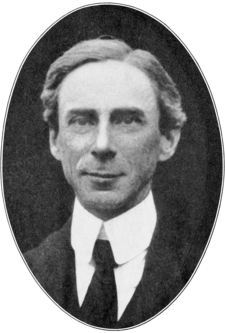
Bertrand Arthur William Russell, 3rd Earl Russell ( born Bertrand Arthur William Russell, 3rd Earl Russell ; May 18, 1872 , Treleck, Wales - February 2, 1970 , Wales) - British philosopher , logician , mathematician and public figure . Known for his work in defense of pacifism , atheism , as well as liberalism and left-wing political movements [5] [6] [7] , he made an invaluable contribution to mathematical logic , the history of philosophy and the theory of knowledge . Less well known are his works on aesthetics , pedagogy, and sociology . Russell is considered one of the founders of English neorealism , as well as neopositivism .
| Bertrand Russell | ||
|---|---|---|
| English Bertrand russell | ||
 | ||
| Birth name | ||
| Date of Birth | ||
| Place of Birth | , county of Monmouthshire , Wales | |
| Date of death | ||
| Place of death | , county of Guineth , Wales | |
| A country | ||
| Alma mater | ||
| Language (s) of works | English | |
| School / tradition | Analytic philosophy | |
| Direction | Western philosophy | |
| Period | 20th century philosophy | |
| Core interests | Epistemology , Logic , Mathematics , Philosophy of Language , Philosophy of Science , Ethics , Religion | |
| Significant ideas | Logical atomism , description theory , Russell's paradox | |
| Influenced | Leibniz , Hume , Moore , Frege , Whitehead , Ludwig Wittgenstein , Mill | |
| Influenced | Richard Dawkins , Ludwig Wittgenstein , Ayer , Carnap , Gödel , Popper , Quine , Chomsky | |
| Awards |  Nobel Prize in Literature (1950) Nobel Prize in Literature (1950)Kalinga Prize (1957) International Peace Prize (1957) Sonning Award (1960) Jerusalem Prize (1963) | |
| Awards |
Sylvester Medal (1934) | |
| Signature |  | |

In 1950 he received the Nobel Prize in Literature .
executive secretary of the Swedish Academy, described Russell as "one of the most brilliant representatives of rationalism and humanism, a fearless fighter for freedom of speech and freedom of thought in the West."
The American philosopher highly appreciated the works of Russell, even compared him to Voltaire , emphasizing that he, like his famous compatriots, philosophers of the old time, is a master of English prose.
Russell is considered one of the most influential logicians of the 20th century [8] .
In editorial comments on the memorial collection “Bertrand Russell - The Philosopher of the Century” (1967), it was noted that Russell's contribution to mathematical logic is the most significant and fundamental since the days of Aristotle .
Biography
Belonged to an old aristocratic family [9] of politicians, scientists and intellectuals, who was famous for his activities in the political life of the country since the 16th century; after Bertrand Russell himself, the most famous representative of the family was his grandfather, Lord John Russell , who twice headed the Queen Victoria’s government in the 1840s and 1860s [10] .
Bertrand Russell was born into the family of John Russell, Viscount Amberley, and Catherine (Stanley) Russell. By his fourth birthday, he had become a complete orphan. After the death of his parents, he and his elder brother Frank and sister Rachel were taken under the care of their grandmother, Countess Russell, who adheres to Puritan views . From an early age, Bertrand showed interest in the most diverse fields of natural sciences , he liked to spend his free time reading books from the extensive library collected by his grandfather at the Pembroke Lodge estate.
Youth and gaining fame. Socialism
In December 1889, Bertrand Russell entered Trinity College Cambridge . In the second year of study, at the proposal of A. Whitehead, Russell was elected to the Apostles discussion society. This society included both students and teachers, including J. Moore , J. McTaggart , with whom in the future Russell will fruitfully cooperate.
Russell, the son of a lord of one of the most influential clans, was appointed British diplomatic representative , first in Paris , then in Berlin . In Germany, Russell studied almost the entire range of German philosophy , among other things, the economic works of Marx . There, he was fluent in German, talked with famous socialists of that time: Wilhelm Liebknecht , August Bebel and others. Russell was inspired by the ideas of left-wing reformism , that is, the gradual reconstruction of the whole world on the principles of democratic socialism . In 1896, Russell published his first significant work, German Social Democracy, where he examined the problems and developmental paths of leftist ideas, surprisingly deeply for a relatively young philosopher.
This and some other works made Russell a famous scientist. Upon arrival at home in 1896, he received an invitation to lecture at the London School of Economics, which he did with constant success. Russell also lectured at US universities. In 1900, he participated in the World Philosophical Congress in Paris , met a number of famous scientists. Co-authored with Whitehead, the book Principia Mathematica (1910–13) earned him international recognition.
In 1908, the philosopher became a member of the Royal Society . In the same year he became a member of the Fabian society .
The Fabians considered socialism the inevitable result of economic development , but recognized only the evolutionary path , opposed the revolution . Russell, however, does not fully share the views of the Fabians [11] [12] , since he was an opponent of state control of social production [13] [14] .
At the same time, he proclaimed that the existence of the capitalist system is doomed, believed that industries should be controlled by working people, not entrepreneurs and the state , trying to prove the autonomy and independence of political institutions from the economic basis of society [15] . He sympathized with anarchism , and considered the power of the state the main cause of misfortune in the modern world.
World War I. Pacifism
During the First World War, Bertrand Russell was involved in a circle of complex socio-political problems of war and peace, the structure of the state and its management. While England was preparing for war, Russell was imbued with the ideas of pacifism , the basis of which served as Russell's socialist beliefs [16] . Russell becomes a member of the organization "Counteraction to military service", which was a very bold act at a time when in England they only talked about "protecting the fatherland." For opposing the authorities, Russell is deprived of a place at Trinity College [17] , but Russell is most upset by quarrels with many friends for whom pacifism was unacceptable in the face of a military threat to Britain.
In 1916, Russell anonymously published a leaflet, “Two Years of Hard Work for Refusing to Obey a Conscience,” in which he defended the human right to refuse military service for political or religious reasons. After several people were convicted of its distribution, Russell, not fearing to lose his authority, revealed authorship through the Times and suggested that political freedom in England was becoming a farce . For this, the authorities bring him to court. Russell said that not only he, but all the traditional British freedom was in the dock. As a result of litigation, Russell was fined £ 100 , the library was confiscated, and he was not allowed to travel to the United States to give lectures.
In the book “Political Ideals” (1917), Russell argues that the only worthy political goal is to ensure the maximum development of the natural creative capabilities of each person in society, which ultimately comes down to radical liberal reforms and the destruction of the system that divides people into classes and other conservative groups (including religious). This allows him to be ranked among the Social Democrats. True democracy, according to Russell, should strive for socialism.
Attempts to curb the convinced pacifist do not give results, and in the article “The German Peace Offer” (January 3, 1918), Russell sharply speaks out against the wave of slander and falsification of the policy of the Bolsheviks and Lenin , as well as the Entente’s unwillingness to join Russia's peace proposals, spread by the “patriotic press”. Russell also condemns US entry into the war, emphasizing that American soldiers who arrived in England can be hired by strikebreakers . In 1918, Russell was imprisoned in Brixton for a period of 6 months. There, prisoner no. 2917 read a lot (from Voltaire to Chekhov [18] ) and even wrote “Introduction to the Philosophy of Mathematics” (1919). At the same time, the famous Russian Bolshevik Maxim Litvinov was in the same prison.
R. P. Dutt , a leader of the English and international labor movement , at that time a member of the Independent Labor Party , who met Russell at a meeting convened by the "Organization of Socialist Students" in Oxford in the fall of 1919, wrote that the famous scientist’s speech for mass opposition to the war "put him in those days in the ranks of the socialists ” [19] .
Long before the actual start, and right up to the end of the hostilities, Russell was categorically against the war [20] [21] .
A trip to Soviet Russia. "Practice and Theory of Bolshevism"
After the proclamation of Soviet power in Russia, Russell in 1918 wrote that this event gives hope for future prosperity around the world, and even admitted that the Bolsheviks admire him [22] . On May 19, 1920, Russell, as a member of the Labor delegation, went to the Soviet Republic and stayed there until June 17, 1920. Russell visits the Kremlin , where he meets with V.I. Lenin and talks with him for more than an hour. During this trip, he also met Trotsky , Gorky and Blok , gave a lecture in the Petrograd Mathematical Society . Russell managed to meet with representatives of the opposition, as well as ordinary people [23] .
Russell recognized the Soviet model of development as inconsistent with true communist ideas [24] [25] and was largely disappointed with the Bolsheviks. In the book of memoirs about this trip, “The Practice and Theory of Bolshevism” (1920), Russell wrote:
If Bolshevism turns out to be the only strong and active competitor of capitalism, then I am convinced that no socialism will be created, and only chaos and destruction will reign.
Anyone who, like me, considers free intelligence to be the main engine of human progress, cannot but resist Bolshevism as fundamentally as the Roman Catholic Church .
Bolshevism is not just a political doctrine, it is also a religion with its own dogmas and scriptures. When Lenin wants to prove some point, he quotes Marx and Engels whenever possible.
Despite criticism of Bolshevism, Russell was not disappointed in the leftist ideas themselves, and continued to call himself a socialist [26] and even a communist [23] . In the same book, Russell wrote:
I believe that communism is necessary for the world.
I came to Russia as a communist, but communication with those who have no doubts strengthened my own doubts a thousandfold - not in communism itself, but in the rationality of such a reckless adherence to the symbol of faith that for its sake people are ready to multiply adversity, suffering, poverty.
Even under existing conditions in Russia, one can still feel the influence of the life-giving spirit of communism, the spirit of creating hope, the search for means to eradicate injustice, tyranny, greed - all that impedes the growth of the human spirit, the desire to replace personal competition with joint actions, the relations of master and slave with free cooperation . This hope helps the best part of the Communists to withstand the trials of the harsh years that Russia is going through, the same hope inspires the whole world. This hope is not a chimera, not a fantasy, but it can come true only through hard work, a more objective study of facts and, moreover, persistent propaganda, which should make the need for a transition to communism obvious to the vast majority of workers. It is possible that Russian communism will fail and perish, but communism as such will not die.
The existing capitalist system is doomed. Her injustice is so striking that only ignorance and tradition make wage laborers tolerate it. When ignorance recedes, tradition weakens; war destroyed the power of tradition over the human mind. Perhaps, under the influence of America, the capitalist system will last fifty years, but it will gradually weaken and will never return to the positions held in the 19th century. Trying to support her is a waste of energy that can be used to build something new.
Another book based on impressions of the trip was the book "Bolshevism and the West" (1924).
One of those who expressed doubts about the truthfulness of Russell's words was Aaron Steinberg . Steinberg admits that Russell did not deny his own statement about the hostility of the Soviet regime to freedom of thought, however, he notes in his memoirs that “Bertrand Russell conducted propaganda among us for the government of Lenin and Trotsky” . According to Steinberg, what Russell said at the secret meeting was very different from what Russell said later, so Steinberg concluded: “... Russell’s books are very necessary to read, but his assessment of political events, since it is based on his personal judgments about people, is very doubtful " .
Trip to China
At the invitation of the Society for New Doctrines, organized by the leader of the reform movement Liang Qichao , October 12, 1920, Russell leaves for China , where he stayed until June 10, 1921. In China, as a professor at Peking University, Russell taught special courses in mathematics, logic, morality, religion, the theory of knowledge, and discussed the development of socialism in this country [27] [28] . In his lectures, the thinker advocated communism, but opposed the dictatorship of the proletariat , arguing that only "enlightenment will help increase the awareness of the propertied classes , avoid wars and revolutions" [29] .
Russell's lectures, which reflected his ideas of free-thinking and criticism of religion , gave impetus to a new direction of the atheistic movement in China. They were published by the Shaonyan Zhongguo publishing house in a special collection, Problems of Religion (1921). The most noticeable influence on the Chinese intelligentsia was Russell’s thoughts on the democratic version of socialism [30] .
Both before and after his arrival in China, quite a lot of works of the English thinker are translated on mathematics, logic, socio-political development of society, which are becoming very popular among Chinese reformers and progressive figures who are looking for the future state structure of the country.
As Wang Singong noted, the philosophy of the English thinker “does not aim to achieve any wealth or happiness, it is designed to help people understand this simple and at the same time complex world surrounding us” [31] .
In 1920, the Bertrand Russell Society was created at Peking University and the Russell Monthly was published (January 1921). The philosophy of Losa, as Russell was called in China, had a strong impact on the progressive youth during the anti-imperialist May 4th Movement .
Bacon Hill School. Pedagogy
In 1921, Russell married for the second time to Dora Winifred Black, who was his secretary during a trip to Russia. It was she who wrote the chapter “Art and Education” for his book “The Practice and Theory of Bolshevism”. Russell has two children (first marriage to Alice (sometimes Alice), Whitall Piersall Smith was childless).
Russell begins to intensively study pedagogy, including innovative methods of education. His views on education form a single whole with his socio-political liberal views. Russell seeks to protect the free mind from obsolete conservative views (to which Russell ranks any religion). Children, Russell believes, should be brought up in kindness, in understanding the usefulness of the moral standards of society, without coercion. Russell considers it a terrible thing to separate children by their economic background, gender, race and nationality. The purpose of education for Russell is to protect a person’s creative abilities from the influence of chauvinism, bureaucracy, and class stereotypes. Russell sharply criticizes the system of English upbringing and education, offers its democratization.
The most important result of his work in this area were the books On Education (1926), Marriage and Morality (1929), Education and Social System (1932). Together with his wife, Russell opens the Bacon Hill School, which was aimed mainly at troubled young children. The school lasted until the outbreak of war.
A peculiar refrain of his ideas in pedagogy was the thesis that if love, backed up by knowledge, became the real basis of education, the world would be transformed [32] . Russell repeated this idea in later works.
His ideas on pedagogy, according to experts, were not as progressive as the views of outstanding English teachers of the time G. Lane and A. S. Neil or Americans G. Brady and J. Dewey , but this school allowed and encouraged greater freedom of expression for students . Russell wrote that “children must be citizens of the universe, ” brought up without coercion, not knowing a sense of fear. His pedagogical views in many ways resembled the ideas of the Utopian socialists Owen and Fourier , who opposed religious education .
Although many scholars often neglect Russell's contribution to pedagogy, more than twenty years later, Russell will be awarded the Nobel Prize in Literature for his book Marriage and Morality (1929).
1920s - 1930s
In the Daedalus brochure, the English biologist John Haldane , using the image of a mythological hero, argued that development can only be for the good of humanity. In 1924, Russell published the Icarus brochure, in which, resorting to another image of the same myth, Icaru , on the contrary, warned of the dangers lurking in the unbridled growth of knowledge and the development of technology, which could cause great human misfortune if the fruits of scientific activity are in limited use of individual structures, and also used with malicious intent. More than 30 years later, it will become clear that Russell’s worst fears became a reality in connection with the invention and use of nuclear weapons against people.
Summing up his life in his autobiography, Russell writes that he devoted his whole life to reconciling people with each other, Russell always sought to unite and harmonize the desires of human beings, to save humanity from extinction and the threat of death. During this period, he wrote books: “Prospects for Industrial Civilization” (1923), “Education and Welfare” (1926), “The Conquest of Happiness” (1930).
During the development of the totalitarian regimes of the 1930s, Russell struggled to prevent an impending military catastrophe . Among the many books written during this period were “Freedom and Organization, 1814-1914” (1934), “The Origin of Fascism” (1935), “Which Path Leads to the World?” (1936), “Power: A New Social Analysis” (1938). Russell actively fought against fascism and Bolshevism (The Origin of Fascism (1935), Scylla and Charybdis, or Communism and Fascism (1939)).
In the late 1930s, Russell travels to the United States and teaches at the Universities of Chicago and California.
In 1931, after the death of his older brother, he inherited the peer title and became the third Earl Russell.
In 1935, Russell divorced a second time and married his secretary Patricia Helen Spence. From this marriage he has a second son, Conrad .
Based on his pacifist beliefs, Russell welcomed the 1938 Munich Agreement .
The Second World War. Refusal of pacifism
The approach of World War II gives rise to strong doubts about Russell's expediency. After Hitler captured Poland, Russell rejected pacifism. Now Russell advocates the joint military efforts of England and the United States, which causes disapproval of the American isolationists who hoped to keep the country from entering into a military conflict. In an autobiography, recalling this time, Russell writes:
Although reluctantly, I admitted the possibility of the rule of Kaiser Germany; It seemed to me that this, of course, was evil, but nevertheless less than the world war and its consequences, while Nazi Germany was a completely different matter. The Nazis were disgusting to me both from a moral and rational point of view - cruel, fanatical and stupid. Although I adhered to pacifist convictions, it was all given to me with great difficulty. When the danger of occupation began to threaten England in 1940, I realized that throughout the First World War I had never seriously admitted the thought of defeat. The thought of him was unbearable, and after serious thought, I decided that I should support everything that is done for the sake of victory, no matter how hard this victory was given and whatever its consequences.
This was the last stage in the long process of abandoning the beliefs that matured with me in 1901
From 1938 to 1944, Russell lectured at the University of Chicago , California , Harvard , the Barnes Foundation , published two fundamental works: The Study of Meaning and Truth (1940) and The History of Western Philosophy (1945) , the last of which several times in the United States on the bestseller lists and still enjoys attention from both experts and ordinary readers.
In 1940, Russell became a professor of philosophy at City College , which provoked strong attacks by the clergy , against which Russell actively fought, spreading anti-clericalism and atheism .
1945-1954
In 1944, Russell returned from the United States to England, and began teaching at the same Trinity College at Cambridge University, where he was fired for his anti-militant speeches during the First World War. Despite his advanced age (he turned 70 in 1942), thanks to social activities, Russell becomes one of the most famous British. Among the great number of books published by him: “Philosophy and Politics” (1947), “Springs of Human Activities” (1952) and “Human Cognition. Its scope and boundaries ”(1948). Russell gives a series of lectures on the radio, later collected in the book "Power and Personality" (1949).
Until 1954, Russell supported the policy of the Cold War , convinced that it could prevent World War III . Russell very sharply criticizes the USSR, advocates world domination of the United States of America, and even considers it necessary to force the USSR to submit to the US dictates under the threat of atomic strikes [33] .
In 1948, Russell in his speech stated that if the USSR continued its aggression in Eastern Europe, it would be morally worse to start a war when the USSR gets an atomic bomb than before, because in a war against the USSR that does not yet have an atomic bomb , the victory of the West will be faster and bloodless [34] . This caused various interpretations and debates whether Russell approves of the first strike on the USSR or just indicates the need to use the US nuclear arsenal to intimidate the Soviet Union [35] . However, immediately after the atomic bombing of Hiroshima and Nagasaki from 1945 to 1948, Russell wrote letters and published articles in newspapers, unequivocally arguing that it is morally justified and correct to start a war against the USSR using atomic weapons while the USSR does not have an atomic bomb, but the United States has.
Only when the USSR tested the atomic bomb did Russell change his position and began to advocate a complete ban on nuclear weapons [36] .
In a short article, “Why am I not a Communist?”, Directed against countries declaring their commitment to communism, Russell wrote:
In Russia in 1917, however, the proletariat accounted for a small percentage of the population - the vast majority were peasants . Then the Bolshevik party announced that it bears the class consciousness of the entire proletariat, and a small committee of its leaders possesses the class consciousness of the entire Bolshevik party. The dictatorship of the proletariat, thus, became the dictatorship of this committee, and, ultimately, one person - Stalin . As the only proletarian with class consciousness, Stalin sentenced millions of peasants to starvation , and millions others to forced labor in concentration camps . He even got to the abolition of the generally accepted laws of heredity and replacing them with new ones , so that the rudimentary plasma obeyed the orders of the Soviet government, and not this reactionary priest Mendel . Я совершенно не могу понять, как получилось, что некоторые гуманисты и интеллектуалы находят чем восхищаться в этом огромном лагере рабов, созданном Сталиным.
Original textIn the Russia of 1917, however, the proletariat was a small percentage of the population, the great majority being peasants. It was decreed that the Bolshevik party was the class-conscious part of the proletariat, and that a small committee of its leaders was the class-conscious part of the Bolshevik party. The dictatorship of the proletariat thus came to be the dictatorship of a small committee, and ultimately of one man - Stalin. As the sole class-conscious proletarian, Stalin condemned millions of peasants to death by starvation and millions of others to forced labour in concentration camps. He even went so far as to decree that the laws of heredity are henceforth to be different from what they used to be, and that the germ-plasm is to obey Soviet decrees but not that reactionary priest Mendel. I am completely at a loss to understand how it came about that some people who are both humane and intelligent could find something to admire in the vast slave camp produced by Stalin.
При этом Бертран Рассел считал себя сторонником социал-демократии . Критика коммунизма , проводимая им в это время, сводится к критике марксизма . Фактически за содействие официальному режиму и пропаганде взглядов Великобритании относительно холодной войны 9 июня 1949 года Рассел был награждён орденом Заслуг . В 1950 году 78-летнему Расселу была присуждена Нобелевская премия по литературе за книгу «Брак и мораль» (1929) и публицистическую деятельность:
В знак признания его разнообразных и значимых произведений, в которых он защищает гуманитарные идеалы и свободу мысли.
Original textIn recognition of his varied and significant writings in which he champions humanitarian ideals and freedom of thought.
В одной из книг, в которых он критикует оптимистический взгляд на развитие цивилизации - «Воздействие науки на общество» (1951, рус. изд. 1952), Рассел предупреждает, что средствами науки можно создавать не только благо. В частности он пишет, что «власть имущие» теоретически могут попробовать евгенистическим методом создать нацию рабов , после чего критика власти «станет психологически просто невозможна» и, заключает Рассел, восстание «расы рабов» будет настолько же невероятным, как «восстание овец против производителя баранины» [37] .
В 1952 году 80-летний Рассел женится в четвёртый раз на Эдит Финч, своей давней знакомой, писательнице из США. Они переезжают в северный Уэльс .
1954—1970 годы. Активная борьба за мир
После испытания водородной бомбы и переписки с Фредериком Жолио-Кюри Рассел, используя свой публицистический талант и огромный авторитет, начинает решительно выступать против ядерного оружия , обращается по радио (24 декабря 1954 года) ко всем жителям Англии и земного шара с «Манифестом борьбы за мир против ядерной войны», в котором утверждал, что в будущей войне не может быть победителя. Вопрос о путях к прочному миру с большой остротой был поставлен также в известном заявлении, подготовленном Расселом и подписанном Эйнштейном за два дня до смерти последнего, а затем и другими крупнейшими деятелями науки. Этот документ был оглашен в Лондоне на пресс-конференции учёных всего мира против угрозы атомной войны (1955) как «Декларация Рассела — Эйнштейна» . Среди прочего в ней сказано:
Мы хотим, чтобы это было понято как на Востоке, так и на Западе. Мы требуем от правительств всего мира признать и заявить публично, что они не будут стремиться достичь своих целей при помощи войны. И мы призываем их, в соответствии с этим, искать мирных способов урегулирования разногласий, существующих между ними…
В 1957 году после обсуждения на первой конференции учёных в канадской деревушке Пагуош был принят как «Манифест борьбы за мир» всех учёных планеты, что ознаменовало начало деятельности пагуошского движения .
В 1950—1960-е годы, когда больше, чем когда-либо мир стоял перед перспективой третьей мировой войны с использованием ядерного оружия, деятельность Рассела, одного из самых влиятельных борцов за мир, трудно переоценить. Рассел был членом движения за ядерное разоружение (1958) и «Комитета ста» (1960) . Рассел переписывался, общался, встречался и дискутировал с лидерами крупнейших стран мира, международный авторитет огромен.
C 1961 года Рассел отстаивает концепцию международного авторитетного форума, сходного с ООН .
В 1961 году за участие в одной из антивоенных акций 89-летнего Нобелевского лауреата приговаривают к семидневному тюремному заключению. Магистрат предложил заменить его на «обещание хорошего поведения», но Рассел отказался [38] [39] .
В 1962 году во время обострения Карибского кризиса Рассел напрямую обращается к Кеннеди и Хрущёву с призывом немедленно вступить в переговоры.
С лета 1963 года началась работа по созданию , который должен был взять на себя решение всего круга вопросов, до этого времени составлявших деятельность Рассела и его сподвижников. Особую роль в создании организации сыграл Ральф Шенманн .
Учредители фонда решили, что он должен носить имя Бертрана Рассела, несмотря на его собственные возражения. Генеральный секретарь ООН У Тан писал по этому поводу:
Отрадно узнать, что предполагается основать фонд, носящий имя лорда Рассела… Лорд Рассел был одним из первых, кто осознал безумие и опасность неограниченного накопления ядерных вооружений.
Сооснователь Фонда Кристофер Фарли писал о Расселе:
Во многих странах, в которых отсутствовали гражданские свободы или которые находились под патронажем могущественных соседей, Рассел почитался национальным героем.
Рассел приветствовал демократические реформы в Чехословакии и осуждал ввод войск в Чехословакию .
С 1963 года Рассел начал протестовать против американского участия в войне во Вьетнаме . Вместе с Жаном Полем Сартром создал Международный трибунал по расследованию военных преступлений во Вьетнаме .
С этого времени Запад [ кто? ] , пытаясь уменьшить уважение простого народа к знаменитому антимилитаристу, санкционировал резкие выпады против Рассела . До конца своих дней Рассел терпел всяческие намеки и прямые утверждения, что «старик выжил из ума». Солидная газета «Нью-Йорк таймс» даже напечатала оскорбительную статью «Труп на лошади» . Хотя уровень его общественной деятельности в последние годы жизни не менее, если не более, высокий, чем в молодости, полностью опровергает эти слухи. Например, отметив 80-летие (1952), он успел выпустить более двух десятков книг, среди которых «Портреты по памяти» (1956), «Факт и вымысел» (1962). За год до смерти Рассел успел издать последний, третий том «Автобиографии» (1967—1969), которая поныне считается одной из самый известных его работ, так как помимо биографических данных о жизни имеет элементы всей сложной эволюции взглядов. Прожив почти столетие, поначалу благодаря происхождению, Рассел с ранней молодости жил в эпицентре всех мировых событий, благодаря чему «Автобиография» стала поистине великим произведением.
Умер Рассел от гриппа , близ города Пенриндайдрайта ( Уэльс ) 2 февраля 1970 года.
Философская составляющая мировоззрения
Философия, по мнению Рассела, занимает «ничейную» область между наукой и теологией, пытаясь дать соответствующие требованиям научности ответы на вопросы, в которых бессильна теология. И хотя философия не является наукой, она все же представляет определённую духовную силу, оказывающую значительное влияние на жизнь общества и его историю. Рассел признаёт взаимную связь философии с политическими и социальными условиями развития общества. История философии, по Расселу, это история оригинальных концепций выдающихся творческих личностей, оказывающих своими системами существенное воздействие на общественную жизнь. Наиболее плодотворными традициями в истории философии Рассел считает антиклерикализм и стремление поставить теоретико-познавательные исследования на почву логики. Книги Рассела «Проблемы философии» (1912) и «История западной философии» (1945) до сих пор считаются в англосаксонских странах лучшим введением в философию.
Ранние взгляды
Рассел прошёл сложную эволюцию взглядов, которую сам он определил как переход от платоновской интерпретации пифагореизма к юмизму . После кратковременного увлечения гегельянством в его английской версии Рассел перешёл к платоновскому варианту абсолютного идеализма [40] , а затем под влиянием Мура , Мейнонга , Уайтхеда — к неореализму [41] . Рассел был одним из создателей концепции логического атомизма , которая объясняет необходимость передачи логической структуры языка на реальность и для создания соответствующей этой структуре онтологической доктрины. Как указывал сам Рассел: «Я постараюсь сформулировать… определённый вид логической доктрины и на основе этого… определённый вид метафизики» [42] . Логический атомизм сформулирован в работах «Наше познание внешнего мира» (1914), «Философия логического атомизма» (1918), «Мистицизм и логика» (1918). Позже эта концепция была развита Витгенштейном
В этот период Рассел внёс огромный вклад в создание математической логики, написав (совместно с Уайтхедом) фундаментальный трёхтомный труд « Principia Mathematica » (1910—1913), где Рассел доказывает соответствие принципов математики принципам логики и возможность определения основных понятий математики в терминах логики .
Проблему существования Рассел решал при помощи разработанного им учения о дескриптивных определениях (близко номинализму ). При этом Рассел попытался снять противопоставление объективного и субъективного существования в понятии «существование вообще»: «Существует только один „реальный“ мир, воображение Шекспира — его часть; аналогично реальны мысли, которые он имел, когда писал „Гамлета“. Точно также реальны мысли, которые мы имеем, читая эту трагедию» [43] . В 1910—1920-е годы Рассел сформулировал концепцию логического атомизма, но не принял конвенционализма и физикализма , в их крайней, ведущей к солипсизму форме.
Дальнейшая эволюция взглядов Рассела состояла во всё большем ограничении областей реальности, которым приписывается онтологически самостоятельное существование: если вначале Рассел учил об особом бытии (subsisting) как бы «априорных» логических отношений, то в 1920—1930-х годах, сближаясь с неопозитивизмом , Рассел‚ после колебаний, признал реальность лишь за чувственными данными (sense-data, particulars), входящими в состав так называемых «нейтральных» фактов (events). Близость философии Рассела неопозитивизму выразилась в том, что для него важнейшей философской проблемой было обоснование научного знания в чувственном опыте субъекта. Это проявилось в пристальном внимании к исследованию содержания и структуры опыта. На раннем этапе Рассел считал, что в структуре опыта наряду с чувственными данными присутствуют универсалии . В дальнейшем главным предметом внимания стала для него проблема перехода от непосредственного опыта, имеющего индивидуальный, «личный» характер, к общезначимому естественно научному знанию. Поэтому в поздний период Рассел выдвигал и отстаивал взгляды, согласно которым для понимания естественнонаучного знания важны такие его скрытые элементы, как «принципы недемонстративного вывода» или «постулаты научного вывода».
В целом Рассел сыграл значительную роль в формировании британской разновидности неопозитивизма (логического позитивизма), с одной стороны, позитивистски истолковывая результаты своих логико-математических исследований, с другой стороны, исправляя своей критикой «чересчур» субъективистские выводы Венского кружка . В частности, он выступил против огульной характеристики проблем традиционно философии, как псевдопроблем.
Сложившаяся в его книгах «The analysis of mind» ( N. Y. — L. , 1924), «The analysis of matter» ( N. Y. — L. , 1927), «An outline of philosophy» (L., 1927) концепция нейтрального монизма усматривала в понятиях «дух» и «материя» лишь логические конструкции из чувственных данных и была близка к прагматизму Джемса и махизму . Она отличалась от последнего главным образом своеобразной терминологией: «Я верю, — писал Рассел, — что материя менее материальна, а дух — менее духовен, чем полагают…» [44] . При этом Рассел призывал отказаться от материализма, который он считал несовместимым с научными открытиями, сделанными в релятивистской и квантовой физике [45] [46] . Идеализм он также отвергал, но уже с позиции другой науки — психологии [47] . Рассел стал одним из самых известных натуралистов XX столетия, при этом его версия натурализма носила нематериалистический характер [48] [49] .
Развитие взглядов
В 1940—1950-х годах Рассел обращается к идеям Юмa . Рассел допускает существование «фактов», которые, в отличие от «опыта», объективны, но объективность их основана лишь на «вере» в бытие внешнего мира [50] .
В работе «Человеческое познание. Его сфера и границы» ( L. , 1948; рус. пер.: М. , 1957) Рассел формулирует пять постулатов научного метода познания «физического мира», которые, по его мнению, образуют предварительные условия правдоподобности индуктивных обобщений, в форме которых познание осуществляется ( Рассел Б. Человеческое познание. — М. , 1957. — С. 453—540.). Философская эволюция Рассела соответствовала изменениям в содержании настойчиво проводившейся им широкой программы приложения средств математической логики к теоретико-познавательным исследованиям. На неореалистском и позитивистском этапах его эволюции эта программа вела к растворению теории познания в логическом анализе (наравне с Муром , Рассел был основоположником логического анализа философии). В основном оформляется философия зрелого Рассела.
Теория познания Рассела в значительной мере является попыткой соединить два различных принципа — принцип эмпиризма , согласно которому все наше знание происходит из опыта, и убеждение, традиционно считающееся рационалистическим , что логика составляет сущность философии. Одним из первых результатов применения логического аппарата к решению философских проблем стала теория дескрипций (описаний).
Важнейшим элементом теории познания Рассела была концепция знания-знакомства — учение о непосредственном познании в опыте определённых объектов: чувственных данных и универсалий. Объекты, непосредственно познаваемые в опыте, сначала рассматривались Расселом также и в качестве онтологических единиц. Простые элементы опыта мыслились Расселом как своеобразные строительные блоки, из которых состоит весь корпус естественнонаучного знания. В поздних работах он частично отказался от учения о непосредственном познании в опыте таких объектов, как универсалии, считая подлинными объектами познания лишь «полные комплексы сосуществования», которые рассматривались как определённые совокупности качеств.
Свою позднюю философскую позицию Рассел определял как реализм и логический атомизм (отчасти под влиянием Витгенштейна), поскольку «картина мира» есть совокупность логических высказываний. Рассел принимает теорию внешних отношений, следствием которой было утверждение существования субстанциально-нейтральных элементов мира, при котором имеется функциональное различение субъективного и объективного. Сама теория была взаимосвязана с разделением бытия на «существующее» (физические вещи и содержание сознания) и «идеально существующее» (математические и логические объекты, отношения, прошлые и будущие события, заблуждения, иллюзии, кентавры, круглые квадраты) [51] .
Этика
В области этики Рассел стоял на позициях эмотивизма . В поздний период своей общественно-политической деятельности получил известность как критик западной цивилизации, видел её основной порок в гипертрофированном развитии науки производства при отсутствии подлинно гуманистических ценностей и идеалов. Выступил против противопоставления сферы разума и чувств, фактов и ценностей, а также за более тесную связь этики и политики. Призывал к отказу от принципа силы как средства решения международных политических проблем.
Рассел был убеждён, что предложения, в которых утверждается желательность чего-либо как этической цели или внутренне значимого или конечного блага, суть выражения эмоций и поэтому не могут быть истинными либо ложными. Однако это не означает, что следует стремиться к преодолению этических чувств. Мотивом собственной деятельности Рассел считал стремление по возможности объединить и гармонизировать желания человеческих существ.
Антиклерикализм. Атеизм
Большое место в творчестве Рассела занимала критика религии и христианской церкви, в которых он видел средство подавления человеческой личности. В атеистических кругах Рассел почитается как один из самых влиятельных атеистов. Рассел — автор множества книг, посвящённых защите атеизма. Одна из его известнейших работ — « Почему я не христианин ». Также известен юмористический антирелигиозный рассказ «Кошмар богослова» (1961).
Психология масс и инженерия согласия
В своих лекциях, прочитанных с 1938 по 1944 годы, Бертран Рассел выделил важность психологии масс в политическом контексте, а «образование» отнёс к одному из современных методов пропаганды. В своих прогнозах на будущее он точно подметил возрастающую роль прессы, кинематографа и радио:
Думаю, что политически чрезвычайную важность приобретёт психология масс… Её важность чрезвычайно возросла с развитием современных методов пропаганды. Среди них самым важным является то, что называется «образованием». Религия всё ещё играет определённую роль, но всё меньшую, а вот роль прессы, кино и радио возрастает…
Рассел отметил, что в будущем общественная система будет полностью подконтрольна и управляема, а институт семьи в этом плане будет создавать помехи. Особую роль в инженерии согласия он выделил музыке:
Социальные психологи будущего будут вести различные классы школьников, на которых они будут отрабатывать различные методы выработки уверенности, что снег чёрный. Очень быстро будут получены различные результаты. Во-первых, будет доказано, что семья мешает. Второе – обработка не даст существенных результатов, если она начнётся после десятилетнего возраста. Третье – стихи, положенные на музыку с повторами, очень эффективны. Четвёртое – мнение, что снег белый, нужно считать проявлением болезненной склонности к эксцентричности. Но я забежал вперёд…
Учёным будущего предстоит отточить эти максимы и точно подсчитать, во что обойдётся убеждение одного школьника в том, что снег чёрный, и насколько дешевле будет убедить его в том, что снег тёмно-серый… [52]
Произведения Бертрана Рассела
До 1940-х годов его фамилия в русских изданиях передавалась как Рёссель.
- Германская социал-демократия .
- Изъ исторіи соціалъ-демократіи въ Германіи. Составлено по книгѣ Рёсселя: "Германская соціалъ-демократія" , Москва: Книгоиздательство Е.Д. Мягкова «Колоколъ», 1905. (46 стр. - сокращённый пересказ).
- Очерки изъ исторіи германской соціалъ-демократической рабочей партіи. Шесть лекцій / Перев. съ англійскаго В. Фигнеръ ; редакція и предисловіе В. Канеля . Спб, 1906. - XXIV+137 c. (В 1910 году этот перевод был переиздан без изменений в составе сборника "Очерки по истории Германии".)
- Германская соціалъ-демократія : [6 лекцій, чит. в 1896 г. в Лондон. школѣ экон. и полит. наукъ]/ Перев. и предисловie А. Каменскаго. - Спб, 1906. - 2, XII, 147 с.
- Новѣйшія работы о началахъ математики . /Перев. A.V. [= А.В. Васильев ]// Новыя идеи въ математикѣ. Сборникъ первый: Математика. Методъ, проблемы и значеніе ея . - Спб: Книгоиздательство «Образованіе», 1913. - С. 84-105.
- Проблемы философіи . /Перев. S.I. Штейнъ [= Семён Ильич Штейн ]. Спб, 1914. [У этого произведения помимо данного издания имеется два современных перевода: А.Ф. Грязнова (2000) и В.В. Целищева (2001)]
- Икар или будущее науки . //Д.Б. Холден [= Дж.Б.С. Холдейн ] и Бертран Рёссель. Дедал и Икар (будущее науки) . /Перевод с английского М.С. Горевой. Ленинград-Москва: Издательство "Петроград", 1926. - С. 63-95.
- Воздействие науки на общество / Редакция, примечания и предисл. Э.А. Араб-Оглы . Per. from English V.A. Онышко. — М. : Изд-во иностранной литературы, 1952. - 59 c. [Сокращённое издание с грифом "Рассылается по особому списку"; титул оригинала: Impact of Science on Society. ]
- Человеческое познание. Его сфера и границы [Human Knowledge. Its scope and limits]:
- Человеческое познание . Его сфера и границы / Ред. Э. Кольман , пер. from English N.V. Воробьёв. — М. : Изд-во иностранной литературы, 1957. — 555 с. [Издание с грифом "для научных библиотек".]
- Человеческое познание: его сфера и границы / Ред. А.Ф. Грязнов, пер. from English N.V. Воробьёв. — М. : ТЕРРА — Кн. клуб: Республика, 2000. — 463 с. Указ. имен: с. 461-462.
- Человеческое познание: его сфера и границы . — К.: Ника-Центр, 2001. — 555 с. Предм.- имен. указ.: с. 543- 553.
- Почему я не христианин [Why I am not a Christian]
- Почему я не христианин / Пер. from English И.З. Романова. — М. : Изд-во иностранной литературы, 1958. - 30 с.
- Почему я не христианин : Избранные атеистические произведения / Пер. from English И.З. Романова; сост., авт. foreword and note. А. А. Яковлев. — М. : Политиздат, 1987. - 333 с.
- Почему я не христианин . - Москва : Опустошитель, 2016. - 290 с.; 500 экз; ISBN 978-5-87399-132-7 .
- История западной философии [History of Western Philosophy]:
- История западной философии . / Ed. В.Ф. Асмус , пер. A.N. Чанышев , Н.А. Клейнман, В.М. Закладная, И.З. Романов, Т.А. Бурова, В.С. Швырёв , В.К. Финн .- М: Изд. иностр. лит., 1959. - 935 с. [Издание с грифом "для научных библиотек".]
- История западной философии . / Ed. В. Чалидзе . Нью-Йорк: Chalidze Publications, 1981. — 855 с.
- История западной философии . Ростов-на-Дону: Миф, 1998
- История западной философии и её связи с политическими и социальными условиями от античности до наших дней . В 3 кн. / Науч. ed. В. В. Целищев. — Новосибирск: Изд-во Новосиб. университета, 2001.
- История западной философии . / Ed. Смоленков, В. Е., сопровод. Art. Светлов, Р. В. - Санкт-Петербург: Азбука, 2001 — 956 с.
- Здравый смысл и ядерная война / Пер. from English В. М. Карзинкина [53] . — М. : Изд-во иностранной литературы (ИЛ), 1959. - 77 с. [Сокращённое издание с грифом "Рассылается по особому списку"; титул оригинала: Common sense and nuclear warfare , объём английского издания - 109 с.]
- Практика и теория большевизма / Авт. послесл. В. С. Марков; АН СССР, Науч. совет «История революций и социал. движений», пер. from English И. Ю. Воробьёвой, И. Е. Задорожнюк, Ю. Г. Казанцева. — М. : Наука, 1991.
- Словарь разума, материи и морали . / Общая редакция и послесловие А. А. Васильченко. — К. : Port-Royal 1996. - 363 с., Библиогр. with. 351-355., Указ. в конце кн.
- Практика и теория большевизма : Избр. страницы / Пер. from English И. Ю. Воробьёвой, И. Е. Задорожнюк, Ю. Г. Казанцева. Предисл., послесл. and note. Б. Гиленсона . — М. : Панорама, 1998.
- Мудрость Запада: Ист. researched app. философии в связи с обществ. и полит. обстоятельствами / Ред. П. Фулкес; [Entry. Art. В. А. Малинина , пер. HE. Орнатской]. — М. : Республика, 1998. - 476 с. ISBN 5-250-02648-6
- Философия логического атомизма . / Пер., коммент. и послесл. V.A. Суровцева . — Томск: Водолей, 1999. — 191 с. ISBN 5-7137-0127-1
- Искусство мыслить / Общ. ред., сост. and foreword. О. А. Назаровой; per. from English Козловой Е. Н., Назаровой О.А., Сычёвой С.Г., рисунки Дениски [sic!] Назарова, 2-е испр. изд.. — М. : Идея-Пресс: Дом интеллектуальной книги, 1999. - 240 с. — ISBN 5-733-0007-8. [Название оригинала: The Art of Philosophizing and other Essays.]
- Исследование значения и истины / Общ. scientific ed. and note. Е. Е. Ледникова. — М. : Идея-Пресс: Дом интеллектуальной книги, 1999. — 399 с. Предмет. указ.: с. 395- 399.
- Автобиография (в сокращении) // «Иностранная литература», 2000, № 12. С. 97 - 240. [Содержит менее одной пятой текста оригинала. Перевод отрывков из 1-го т. — Т.Я.Казавчинской, из 2-3 тт. — Н.А.Цыркун.]
- Проблемы философии [The Problems of Philosophy, см. также выше сведения о дореволюционном издании]
- Проблемы философии . / Ed. А.Ф. Грязнов. — М.: 2000.
- Проблемы философии . / Ed. V.V. Целищев. — Новосибирск: Наука, 2001. — 109 c.
- Брак и мораль / Пер. Ю. В. Дубровина. — М. : Крафт +, 2004. - 272 с. [= Marriage and morals]
- Основания математики : в 3 т. / Альфред Н. Уайтхед, Бертран Рассел ; per. from English Ю. Н. Радаева, И. С. Фролова; under the editorship of Г. П. Ярового, Ю. Н. Радаева. - Самара : Сам. ун-т, 2005-2006. - 721+737+459 c. [=Principia Mathematica]
- Введение в математическую философию. Избранные работы . / Вступ ст. V.A. Суровцева. — Сибирское университетское издательство, 2007. - 262 с. ISBN 978-5-379-00306-7
- Овладение счастьем [The Conquest of Happiness]
- Завоевание счастья . (2013) сетевой перевод Е. Кузьминой.
- Завоевание счастья. Под ред.. А. С. Василенко и В. М. Никитина. М: «Российский писатель» , 2015. – 160 с.
See also
- Логицизм
- Логический атомизм
- Парадокс Рассела
- Чайник Рассела
- Теория типов
- История западной философии
- Новые левые
Notes
- ↑ Немецкая национальная библиотека , Берлинская государственная библиотека , Баварская государственная библиотека и др. Record #118604287 // Общий нормативный контроль (GND) — 2012—2016.
- ↑ 1 2 BNF identifier : Open Data Platform 2011.
- ↑ 1 2 Archive for the history of mathematics MacTyutor
- ↑ Рассел Бертран // Большая советская энциклопедия : [в 30 т.] / под ред. A. M. Prokhorov - 3rd ed. - M .: Soviet Encyclopedia , 1969.
- ↑ Практика и теория большевизма . — Издательство «Наука», 1991. — С. 5.
- ↑ Интервью с Вудро Уайэттом. 1959 год .
- ↑ The Case for Socialism
- ↑ He co-authored, with AN Whitehead , Principia Mathematica , an attempt to ground mathematics on logic. His philosophical essay « On Denoting » has been considered a «paradigm of philosophy». Ludlow, Peter, «Descriptions», The Stanford Encyclopedia of Philosophy (Fall 2008 Edition), Edward N. Zalta (ed.), URL: http://plato.stanford.edu/archives/fall2008/entries/descriptions/
- ↑ Sidney Hook . Lord Russell and the War Crimes Trial. // Bertrand Russell: critical assessments , Volume 1, edited by AD Irvine. — N. Y. , 1999. — P. 178.
- ↑ Bloy, Marjie, Ph.D. Lord John Russell (1792–1878) . Дата обращения 28 октября 2007. Архивировано 22 июня 2012 года.
- ↑ Мочалов Л. В. Марксистско-ленинская оценка фабианского социализма. — М. ‚ 1976. — С. 24—40, 47.
- ↑ Russell B. Wisdom of the West. Western philosophy in its Social and Political Setting / Ed. by P. Foulkes. — L. , 1959. — P. 75.
- ↑ Делюсин Л. П. Спор о социализме в Китае: Из истории общественно-политической мысли в Китае в начале 20-х годов. — М. , 1970. — С. 32—35.
- ↑ Рассел Б. Ловушки в социализме. — 1916.
- ↑ Рассел Б. Принципы социального переустройства. — 1916.
- ↑ Russell B. The Basic Writing of Bertrand Russell. 1903—1959 /Ed. by RE Egner and LE Dennon. — L. , 1961. — P. 47.
- ↑ Его избирают президентом Аристотелевского общества в Англии (1911). Уже тогда он становится поборник — Smerchw.ru
- ↑ Russell B. Wisdom of the West. — P. 112.
- ↑ Dutt RP Bertrand Russell (1872—1970) // Labour Monthly. — 1970. — Vol. 52. — № 3.
- ↑ «Война и справедливость» (1916)
- ↑ Бертран Рассел . Автобиография
- ↑ Russell B. Wisdom of the West. — P. I26.
- ↑ 1 2 Бертран Рассел . Практика и теория большевизма. — 1920.
- ↑ Dutt RP Bertrand Russell (1872—1970). — P. 105.
- ↑ Russell B. The Autobiography of Bertrand Russell. — L. , 1975. — P. 326—335.
- ↑ Bertrand Russell . The Case for Socialism. // Praise of Idleness. — 1935.
- ↑ Russell B. The Autobiography of Bertrand Russell. — P. 357—368.
- ↑ Делюсин Л. П. Спор о социализме в Китае. — С. 31—35.
- ↑ Дин Шоухэ, Инь Сюйн, Чжан Бочжао . Влияние Октябрьской революции на Китай. — М. , 1959. — С. 108.
- ↑ Колесников А. С. Философия Бертрана Рассела / Науч. ed. Я. А. Слинин. — Л. : Изд-во ЛГУ, 1991.
- ↑ Ван Сингун . Анализ логики и мировоззрения Рассела // Синь Циннянь. 1920. — T. 8. — М. : З. — С. 6.
- ↑ Russell B. On Education. Especially in Early Childhood. — Шаблон:L, , 1926. — P. 1.
- ↑ Перегудов С. П. Антивоенное движение в Англии и лейбористская партия (1957—1968). — М. , 1969. — С. 71.
- ↑ A philosopher's letters – Love, Bertie , The Economist (21 July 2001).
- ↑ Griffin, Nicholas (ed.). The Selected Letters of Bertrand Russell. — Routledge, 2002. — P. 660. — ISBN 0-415-26012-4 .
- ↑ The life of Bertrand Russell: Ronald William Clark: 9780394490595: Amazon.com: Books . amazon.com .
- ↑ Рассел Б. Влияние науки на общество. — 1953. — С. 49—50.
- ↑ Bertrand Russell Peace Foundation, Bertrand Russell, 1872—1970 [1970], p. 12
- ↑ Russell, Bertrand. The Autobiography of Bertrand Russell, Vol. 3. — Little, Brown, 1967. — P. 157.
- ↑ Russell B. A critical exposition of the philosophy of Leibniz. — Cambr. , 1900.
- ↑ Russell B. The problems of philosophy. — N. Y. , 1911.
- ↑ Russell В. Logic and Knowledge, Essays 1901—1905. L., 1956
- ↑ Russell B. Introduction to mathematical philosophy. — L. — N. Y. , 1924. — P. 169.
- ↑ The analysis of matter. — L. , [1954]. — P. 7.
- ↑ Прист, Стивен. Глава 6. Двухаспектная теория: Спиноза, Рассел и Стросон // Теории сознания / Перевод с английского и предисловие: А. Ф. Грязнов. — Москва: Идея-Пресс, Дом интеллектуальной книги, 2000. — 288 с. — ISBN 5-7333-0022-1 .
- ↑ Bertrand Russell. The Nature of our Knowledge of Physics // An Outline of Philosophy . — Routledge, 2009. — P. 173. — 338 p. — ISBN 978-0-415-47345-3 .
'Matter' is a convenient formula for describing what happens where it isn't. I am talking physics, not metaphysics; when we come to metaphysics, we may be able, tentatively, to add something to this statement, but science alone can hardly add to it. Materialism as a philosophy becomes hardly tenable in view of this evaporation of matter. But those who would formerly have been materialists can still adopt a philosophy which comes to much the same thing in many respects. They can say that the type of causation dealt with in physics is fundamental, and that all events are subject to physical laws. I do not wish, as yet, to consider how far such a view should be adopted; I am only suggesting that it must replace materialism as a view to be seriously examined.
- ↑ Dustin Z. Olson. Bertrand Russell On Perception and Knowledge (1927 – 59) . — Hamilton, Ontario, Canada: McMaster University, 2011. — P. 17. — 154 p.
- ↑ James D. Madden. Chapter 1. Naturalism and the Philosophy of Mind // Mind, Matter, and Nature: A Thomistic Proposal for the Philosophy of Mind . — The Catholic University of America Press, 2013. — P. 6. — 336 p. — ISBN 978-0813221410 .
- ↑ Bertrand Russell. 47 Non-Materialistic Naturalism [1942] // Volumes of The Collected Papers of Bertrand Russell. Volume 10: A Fresh Look at Empiricism, 1927–42 / Edited by John G. Slater with the assistance of Peter Kollner. — L. & N. Y. : Routledge, 1996. — P. 371-375. — xxxvii, 886 p. — ISBN 978-0-415-09408-5 .
- ↑ Russel B. An inquiry into meaning and truth. — L. , 1940.
- ↑ Философия сознания Б.Рассела и аналитическая философия
- ↑ Бертран Рассел. Психология масс и инженерия согласия . Проект «Мнение» .
- ↑ Вадим Михайлович Карзинкин (1907—1972) из известного купеческого рода .
Literature
- In Russian
- Быховский Б. Э. , Мееровский Б. В. Атеизм Бертрана Рассела // От Эразма Роттердамского до Бертрана Рассела: (Проблемы современного буржуазного гуманизма и свободомыслия): [Сборник статей] / Редколл.: И. М. Кичанова , А. Л. Субботин , Т. М. Ярошевский ; Acad. societies. наук при ЦК КПСС. Institute of Science атеизма. — М.: Мысль , 1969. — С. 268—302. — 303 с.
- Велембовская Ю. А. Учёный в борьбе против ядерной угрозы // Новая и новейшая история . — 1999. — № 6.
- Колесников А. С . Философия Бертрана Рассела / Науч. ed. Я. А. Слинин . — Л. : Изд-во ЛГУ, 1991.
- Кольман Э. Бертран Рассел — оруженосец империализма.// Вопросы философии . 1953. № 2.
- Крысова Ю. А. Становление либеральных идей в философии Бертрана Рассела // Компаративное видение истории философии. - SPb. , 2008. — С. 119—125. — ISBN 978-5-93682-457-9
- Нарский И. С. Философия Бертрана Рассела. — М. , 1962.
- Розанова М. С. Современная философия и литература. Творчество Бертрана Рассела / Под ред. Б. Г. Соколова. - SPb. : Изд. дом С.-Петерб. state университета , 2004. — 160 с.
- Цверианишвили А. Г . Лян Шумин и Бертран Рассел о китайской и западной культурах // Развивающиеся страны. Политика и идеология. - M. , 1985.
- Юань Вэйши Рассел в Китае // Философские науки . — 1990. — № 12.
- На английском языке
- Краткая библиография основных работ на зеркале сайта "Общества Бертрана Рассела" .
- Martin, Werner. 1981. Bertrand Russell A bibliography of his writings/Eine Bibliographie seine Schriften; 1895-1976 . — Библиография Рассела, содержащая среди прочего выходные данные переводных изданий.
- Blackwell, Kenneth, Harry Ruja, and Sheila Turcon. 1994. A bibliography of Bertrand Russell . 3 vol. London: Routledge. — Наиболее полная библиография английских изданий Рассела, позволяет с помощью буквенно-цифровых кодов легко идентифицировать работы, выходившие под разными заголовками (например, редакторы американских изданий нередко изменяли расселовские заголовки на более понятные для своей аудитории, как в случае с книгой "Принципы переустройства общества", которая в США называлась "Почему люди воюют").
- Collected Papers of Bertrand Russell — научное собрание сочинений Рассела.
- Russell — индексированный журнал исследований, посвящённых Расселу, выпускаемый канадским Университетом Макмастера . Издаётся с 1971 года, часть материалов доступна онлайн.
- BRACERS — публичный каталог Архива Рассела.
- . Bertrand Russell and his world . London: 1981. — биография Рассела в фотографиях (более 100 снимков).
- . My Father Bertrand Russell . Bristol: Thoemmes, 1996. [Воспоминания дочери Рассела]
- Russell, Dora. The tamarisk tree . L.: Virago, 1981. [Воспоминания второй жены Рассела]
- Crawshay-Williams, Rupert. Russell Remembered . London: Oxford UP, 1970. [Воспоминания соседа Рассела]
- Chao, Yuen Ren. With Bertrand Russell in China. 1972. [Воспоминания китайского переводчика Рассела]
- Willis, Kirk . 1996. "Russell and His Biographers". Russell: the Journal of Bertrand Russell Studies. 16, no. 2. [Критический обзор важнейших биографий Рассела]
- Ayer, Alfred Jules . 1972. Bertrand Russell . New York: The Viking Press. — XII, 168 p.
- Consciousness in the Physical World. Perspectives on Russellian Monism / Edited by Torin Alter and Yujin Nagasawa. — Oxford University Press , 2015. — 472 p. — (Philosophy of Mind Series). — ISBN 978-0-19-992735-7 .
Links
- Сайт «Общества Бертрана Рассела» (англ.)
- Сайт Центра Исследований Бертрана Рассела (англ.)
- Сайты, посвящённые Бертрану Расселу, в каталоге ссылок Open Directory Project (dmoz) (англ.)