The Selfish Gene ( The Selfish Gene ) is a popular science book on evolution written by British biologist Richard Dawkins and first published in 1976 . The main idea of the book is to substantiate the genocentric view of evolution .
| Selfish gene | |
|---|---|
| The selfish gene | |
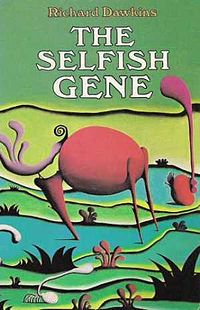 Cover of the first edition of the book | |
| Genre | popular science literature |
| Author | Richard Dawkins |
| Original language | English |
| Date of first publication | |
| Publisher | Oxford University Press |
| Following | |
Content
Key ideas
The phrase "selfish gene", introduced in the title of the book, was chosen by Dawkins as a convenient metaphor for expressing a genocentric view of evolution in which evolution is considered primarily as an evolution of genes and it is believed that natural selection at the level of individuals or populations almost never prevails over natural selection at the level of genes. In addition, for the English-speaking reader, this title is consonant with the title of the tale of Oscar Wilde “ The Selfish Giant ”.
According to this view, biological evolution is based on the evolution of genes (not individuals, not species, etc.), which is moving towards increasing their ability to replicate (exerting a particular impact on the environment and forcing it to replicate itself). Those gene alleles that are best able to replicate, win in natural selection and displace less successful competing alleles. At the same time, for any gene, the organism in which it is located, all other organisms, as well as all other genes that are in the same organism and in other organisms, are only part of the environment to which it influences and to which it adapts. Due to natural selection at the level of genes, the development of populations tends to evolutionarily stable strategies that are not always the most optimal for organisms and the population as a whole.
For reproduction (i.e., increasing the number of copies) of a gene, it is beneficial that its carriers contribute not only to their own reproduction, but also to reproduction of other carriers of the same gene. As a result, the phylogenetic line of evolution of individuals moves towards increasing their total fitness ( eng. Inclusive fitness ), which takes into account not only the direct descendants of a particular individual, but also other individuals in which the same genes, as well as their descendants, are created which this individual also makes an indirect contribution (for example, in the form of care, feeding, protection from enemies, etc.), wasting its resources on this. Under certain conditions, it may be beneficial for a gene that a carrier of one of its copies sacrifice its own reproduction for the sake of survival or reproduction of other carriers of the same gene ( biological altruism ). If Hamilton’s rule is fulfilled, that is, if the number of copies of the gene produced at the same time exceeds the number of donated copies, then the genes that form such behavior in their carriers will be supported by natural selection and will be distributed in the population. The probability of finding the same copies of a gene in close relatives of an individual is greatest (the closer the relationship is, the higher the probability), therefore, in the course of evolution, individuals of some species develop altruism in relation to relatives. This is the so-called Kin-selection theory, the presentation of which is devoted to an essential part of the book. The most striking example of such altruism are sterile working individuals of social insects who are not at all capable of their own reproduction and instead have taken on the whole function of caring for the offspring of their reproductive relatives, which contain the same genes as themselves.
Chapter 11 of the book also introduces the term “ meme ” for an element of cultural evolution, similar to a gene , with the assumption that such “selfish” replication can also be attributed to cultural elements: ideas, technological methods, religions, fashion styles, etc. , culture not only human: the example of the songbirds of New Zealand is considered the transfer from generation to generation of song motives. After the publication of the book on the basis of this idea, a new discipline emerged - memetica , which became the subject of numerous studies and disputes (although, independently of Dawkins, other authors put forward similar ideas).
To date, the book has been published four times: in 1976, 1989, 2006 and 2016. In the second edition, notes were added and two chapters were added - 12 and 13. They are based on the books “Evolution of Cooperation” ( R. Axelrod ) and “ Extended Phenotype ” by R. Dawkins himself, respectively [1] .
Table of Contents
- Chapter 1. Why do we live?
- Chapter 2. Replicators
- Chapter 3. Immortal spirals
- Chapter 4. Gene Machine
- Chapter 5. Aggression: Stability and Selfish Machine
- Chapter 6. Gene fraternity
- Chapter 7. Family Planning
- Chapter 8. The Battle of Generations
- Chapter 9. Battle of the Sexes
- Chapter 10. Scratch My Back, And I'll Saddle You
- Chapter 11. Memes - New Replicators
- Chapter 12. The Good Guys Finish First
- Chapter 13. "The Long Arm of the Gene"
Reviews
The book received mixed reviews, causing acute controversy both among scholars and among society as a whole. Here are some of these reviews:
- "... highly scientific, witty and very well written ... intoxicatingly great ." Sir Peter Medavar . "Spectator"
- "... a popular science work of this kind allows the reader to feel almost like a genius ." New York Times Newspaper
The author of the book in his preface to the second edition wrote:
“In the twelve years that have passed since the publication of the“ Selfish Gene ”, the main idea of the book became generally accepted and entered into textbooks. This is paradoxical, although paradoxical and not striking. The book does not belong to those who at first tolerated only reproach, and then gradually gained more and more supporters, until ultimately they were so orthodox that now we only wonder what, in fact, caused a stir. It was just the opposite. At first, the reviews delighted with their benevolence and the book was not considered controversial. Reputation ridiculous ripened over the years, and only now the book began to be treated as a work of extreme extremism. However, it was in those years when the book was increasingly entrenched as an extremist reputation, its actual content less and less seemed so, approaching generally accepted views. ”
Famous biologists such as William Hamilton , George Williams , John Maynard Smith and Robert Trivers praised Daukins’s book The Selfish Gene and concluded that he did more than explain their ideas. George Williams said in an interview that Dawkins, in his book, advanced some questions much further than himself. According to William Hamilton, in his book The Selfish Gene, Dawkins “succeeded in the seemingly impossible task of presenting in simple language difficult to understand the themes of last thought in evolutionary biology” in a way that “surprised and revived even many biologists-researchers” . According to the philosopher Daniel Dennett , Dawkins' book is "not only science, but also philosophy at its best . " [2] The ideas about “selfish DNA” touched upon in this book prompted some scientists, including well-known chemist Leslie Orgel and Nobel laureate Francis Crick , to undertake a more detailed study of this issue [3] [4] [2] . Dawkins' ideas were thoroughly confirmed after it was discovered that a substantial part of "selfish DNA" consists of transposons . Thus, Dawkins ideas helped explain what is happening inside the genomes , long before DNA sequencing became common. [2]
According to the zoologist, journalist and popularizer of science Matt Ridley , genocentric view on evolution , defended and crystallized by Dawkins, currently plays a central role in theoretical evolutionary biology, and “no other explanation is meaningless,” although there are alternative views. Also, according to him, the book "The Selfish Gene", "gave rise to the" gold rush "among the writers of popular science literature, because publishers began to make great efforts in the hope of finding a new" Selfish gene "" [2] .
The Russian biologist A.V. Markov characterizes Dawkins' ideas as “based on invincible logic”, firmly included in scientific use [5] and defining the image of the modern biological picture of the world [6] . He also gives the following assessment of the ideas of Dawkins, reflected in the books "Selfish Gene" and "Advanced Phenotype" :
This is a genocentric approach to evolution, which did not manage to take root among Russian biologists, although it has become widespread in the west, and most evolutionists work on the basis of this model. <...> This is a very curious and useful model for understanding the many biological phenomena that are difficult to understand within the framework of traditional ideas focused on group selection. And from this position it is easier to understand them. But the ideas of Dawkins and his teachers meet with sharp rejection, especially among some Russian biologists, by virtue of their apparent reductionism, and many simply cannot understand how everything can be reduced to genes. It seems to them that we split all living things into too small parts and destroy their integral essence. This, in my opinion, is an illusion, because we do not destroy anything: having understood how evolution works at the level of genes, we again go to the level of the whole organism and see that even here much has become clearer. [7]
The famous American geneticist Richard Levontin criticized Dawkins for the reductionism and vulgarization of Darwin's theory. In his review of The Selfish Gene, published in the journal Nature , he called this work "a caricature of Darwinism." In particular, Levontin saw the ideas of genetic determinism in the statements often repeated in the book that “We are just survival machines, self-propelled vehicles blindly programmed to preserve selfish molecules known as genes . ” In addition, Levontin criticizes total selectionism, which consists in the desire to explain any sign of the structure or behavior of organisms as a result of natural selection and does not take into account the fact that some signs may be just a side effect of other processes. [8] .
To criticism about genetic determinism, Dawkins responded in detail in his next book, Advanced Phenotype (Chapter 2, Genetic Determinism and Gene Selectionism). In this case, Dawkins’s views were oversimplified and distorted (see Scarecrow (logical trick) ). Dawkins explains that the influence of genes is only statistical in nature, not fatal, and the effects of gene influence can easily be changed by environmental influences, education, education, etc. [9] And even in the Egoistic Gene itself, Dawkins wrote: “We are the only creatures on the planet capable of rebelling against the tyranny of selfish replicators” [10] . In Chapter 4, “The Gene Machine,” Dawkins explained that genes cannot directly control all animal movements, “pulling strings,” if only because of a time delay. Genes can only control protein synthesis in the cell. Consequently, in the course of the evolution of genes, a developed brain should have arisen, capable of modeling the surrounding reality and independent decision-making, to which genes ask only general instructions for behavior (avoid pain, avoid danger, etc.). Further development in this direction could lead to the fact that some “survival machines” could completely get out of the control of genes. In the same book, in the chapter “Memes - New Replicators” he introduced the notion of meme, challenging the opinion of some of his fellow biologists that any trait of human behavior is due to genes and must necessarily have some sort of biological advantage, that is, to serve for more successful reproduction of individual genes. Dawkins emphasized that certain behavioral traits may exist because they contribute to the success of replicators of a different nature, for example, those memes. Dawkins notes that with the emergence of culture, non-genetic methods of transmitting information appeared (primarily in humans, although not only in them), and he does not deny that much is due to culture and education in man, and not genetics. In this case, the idea of memes is not mandatory here [11] .
Rewards and recognition
In 2006, the book “The Selfish Gene” entered the top ten of the most popular science books of all times according to the American popular science magazine “ Discover ”, ranking 9th in the list of the 25 best science popular works published by this edition [12] . In April 2016, the Selfish Gene was included in the list of the 100 best popular science books of the British newspaper The Guardian at number 10 [13] . In July 2017, as a result of a survey devoted to the 30th anniversary of the award for scientific books of the Royal Society of London , the Selfish Gene was included in the list of the most influential scientific books of all time, ahead of Charles Darwin ’s Origin of Species and Natural Mathematical Principles . Isaac Newton [14] .
See also
- Kin selection theory
- Evolution theory
- Meme
- Memetics
- Books by Richard Dawkins:
- Extended phenotype
- Blind Watchmaker
- Ancestor story
- Spreading a rainbow
- The greatest show on Earth: Evidence of evolution
- God as illusion
- Essay by Richard Dawkins:
- Brain viruses
- Books by other authors:
- Masters of illusions. How ideas turn us into slaves
Notes
- ↑ . Richard Dawkins. Selfish gene / lane. from English N. Fomina. - Moscow: AST: CORPUS, 2013. - 512 p. - 5000 copies - ISBN 978-5-17-077772-3 .
- ↑ 1 2 3 4 Ridley Matt . In retrospect: The selfish gene. // Nature, 529, 462-463. (28 January 2016)
- ↑ Doolittle W. Ford & Sapienza Carmen . Selfish genes, the phenotype paradigm and genome evolution. // Nature, 284, 601-603. (17 April 1980)
- Gel Orgel LE & Crick FHC Selfish DNA: the ultimate parasite. // Nature, 284, 604-607. (17 April 1980)
- ↑ Dawkins, Richard . Advanced phenotype. M .: Astrel: CORPUS, 2011. Preface of the scientific editor. Page 9-10.
- ↑ Evidence of evolution. Part 10. Answers to some typical "arguments" of anti-evolutionists.
- ↑ A.V. Markov. 5 books on evolutionary biology.
- ↑ Lewontin RC Caricature of Darwinism (English) // Nature. - 1977-03. - Vol. 266 iss. 5599 . - P. 283–284 . - ISSN 1476-4687 . - DOI : 10.1038 / 266283a0 .
- ↑ Dawkins, Richard . Advanced phenotype. M .: Astrel: CORPUS, 2011.
- ↑ Dawkins, Richard . Selfish gene. - Per. from English M .: AST: CORPUS, 2013. Pp. 306.
- ↑ "A person has a trait inherent in him alone, the development of which could occur through memes or without communication with them: his ability for conscious foreseeing." ( Dawkins, Richard . Egoistic gen. - Trans. From English. M .: AST: CORPUS, 2013. P. 305.)
- ↑ By the editors of DISCOVER magazine. 25 Greatest Science Books of All Time . DISCOVER: science for the curious (12/08/2006). The appeal date is November 23, 2018.
- ↑ McCrum, Robert . The 100 best nonfiction books: No 10 - The Selfish Gene by Richard Dawkins , The Guardian (4 April 2016). The appeal date is April 5, 2016.
- Aw Dawkins sees off in the most influential science book .