Hatamoto taikutsu otoko ( 旗 旗 退 屈 男 Hatamoto taikutsu otoko ) or Bored Hatamoto ( Bored Hatamoto ) is a Japanese media franchise based on a series from the Mitsuzo Sasaki novel series and which included, in 2001, more than 30 films (starting from the silent film of 1930) and 6 television series.
| Saotome Mondonosuke | |
|---|---|
| jap. 早 乙 女 主 水 之 介 | |
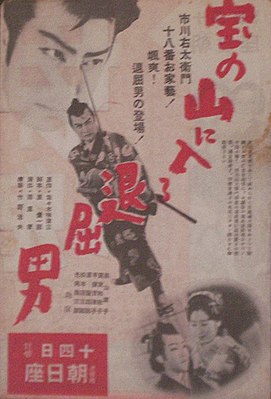 Poster of one of the film adaptations (1938) | |
| Creator | Mitsuzo Sasaki |
| Artworks | A series of 11 novels by Hatamoto Taikutsu Otoko , Japanese 旗 旗 退 屈 男 , since 1929 ( political detective - jizaygeki ) |
| Floor | male |
| Age | 33 (in the first story) |
| Date of Birth | 2nd half of the 17th century |
| Nickname | "Bored Hatamoto" Japanese 旗 本 退 屈 男 (Hatamoto Taikutsu Otoko) , "His Missing Grace" jap. 退 屈 の 殿 様 (Taikutsu no Tonosama) |
| Rank | hatamoto |
| Occupation | the fight against boredom, the protection of justice and the interests of the Tokugawa Shogunate |
| The role is performed | Films 1930-1963 years
TV serials
|
Content
- 1 Literary basis
- 2 Movies
- 3 TV series
- 4 The influence of the image on the culture
- 5 notes
- 6 References
- 7 See also
Literary basis
The franchise is based on the following 11 stories by Mitsuzo Sasaki, first published in the literary magazine Literary Club ( Jap. 文 芸 倶 楽 部 Bungei kurabu ) . The first of the stories was released in April 1929.
- “Bored Hatamoto” ( Japanese 旗 本 退 屈 男 Hatamoto Taikutsu Otoko )
- “Bored Hatamoto. Continuation " ( Jap. 続 旗 本 退 屈 男 Dzoku Taikutsu Otoko )
- "The Next Bored Hatamoto" ( 後 の 旗 本 退 屈 男 Notino Taikutsu Otoko )
- “A bored Hatamoto leaves for Kyoto ” ( 京 へ 上 っ た 退 屈 男 Kyo: e notta Taikutsu Otoko )
- ( Japanese 三河 に 現 れ た 退 屈 男 )
- ( Japanese 身 延 に 現 れ た 退 屈 男 )
- ( Japanese 仙台 に 現 れ た 退 屈 男 )
- ( Japanese 日光 に 現 れ た 退 屈 男 )
- “Bored Hatamoto is back in Edo” ( п 戸 に 帰 っ た 退 屈 男 Edo-no kaetta Taikutsu Otoko )
- “A bored Hatamoto buys a ghost” ( 幽 霊 を 買 っ た 退 屈 男 Yu: ray-o kautta Taikutsu Otoko )
- "Bored Hatamoto Goes to Chiyoda Castle "
( 千代 田 城 へ 乗 り 込 ん だ 退 屈 男 Chiyoda-jo: e norikonda Taikutsu Otoko )
The genre of stories can be attributed to the political detective story in the setting and style of the Japanese historical drama specific to the country and era.
The protagonist of the cycle is the Samurai and Hatamoto of the Genroku era (circa 1690s) Saotome Mondonosuke ( Japanese 早 乙 女 主 水 之 介 ) , known by the nickname "Missing Hatamoto" ( Japanese 旗 旗 退 退 屈 男 Hatamoto Taikutsu otodu otoku otoku otoko ) (in the first story), with an enviable physique for his time (height 5 syaku 6 suns , that is, about 170 cm), a dandy and a lover of painted silk kimonos.
He is quite prosperous (1,200 koku of annual income), lives in his own estate with a younger sister and seven servants. Single.
The master of the “two-sided” style of fencing Morokh-ryu seigan-kudzi ( 諸 羽 流 正 眼 崩 し ) and a number of other styles, however, he believes that life in the Genroku era (known as the “Japanese Renaissance”) is too calm for the applicability of his talents, from which is what happens “ boredom from which there is no salvation” ( п 屈 で 仕 方 な い taykutsu de sikatanai ) .
Incorruptible, loyal to the shogunate, merciless to conspirators and corrupt officials of any level; at the same time merciful and affable to people of low position. He is respected by residents of the capital who jokingly call him “His Missing Grace” ( я 屈 の 殿 様 Taikutsu-no- tono-sama ) .
A special sign of it is a wide sickle-shaped scar on the forehead, called in the original letters. “A scar on the forehead (as a sign) of the highest resolution” ( 下 下 下 免 の 向 こ う 傷 Tenkagomen-no muko: kizu ) , and the shogun’s official is a sign of Saotome’s “above the law”, a kind of “ license to kill ”. The wound on the forehead was received by Mondonosuke while protecting the shogun from seven samurai from Choshu ; the history and meaning of granting him such a “license” is for the first time summarized in the 4th novel of the literary series [1] . The story of the scar was not covered in the film adaptations, however, an episode of the series with Kinya Kitaoji in the title role was dedicated to it.
Movies
A screen adaptation of Mitsuzo Sasaki’s novels about Missing Hatamoto began shortly after the first of them was published by the actor and producer Utaemon Ichikawa in the previously created film company Ichikawa Utaemon Productions . From 1930 to 1935, the film company made 7 silent films about this hero. Later film adaptations were continued by sound technology at the Shochiku (2), Shinkō Kinema film studios (1) Toyoko (2) and Toei (18 films), created with the participation of Ichikawa.
In total, 30 films about Bored Hatamoto were shot; in all of them, the title role was played by Utaemon Ichikawa. The last time he embodied his "corporate" character for the big screen shortly before his resignation from the cinema and from the post of director of production Toei , in 1963.
In the films of 1957-1960, the second-order role of the page Hatamoto was played by the actor’s son Kinya Kitaoji , who had made his debut shortly before the movie, who later inherited the main role from his father and played her in the TV series 1988-1994 and 2001.
| Year | Japanese name [2] | Transliteration | English name [3] | Russian name [4] |
|---|---|---|---|---|
| 1930 | 旗 本 退 屈 男 | Hatamoto taikutsu otoko | Bored hatamoto | |
| 1930 | 京 へ 上 が っ た 退 屈 男 | |||
| 1931 | 仙台 に 現 は れ た 退 屈 男 | |||
| 1931 | 江 戸 へ 帰 っ た 退 屈 男 | |||
| 1933 | 爆走 す る 退 屈 男 | Bakusō suru taikutsu otoko | ||
| 1935 | 中 仙道 を 行 く 退 屈 男 | Nakasendō o yuku taikutsu otoko | ||
| 1935 | 中 仙道 を 行 く 退 屈 男 後 篇 十万 石 を 裁 く 退 屈 男 | Nakasendō o yuku Taikutsu Otoko 2: Jūmangoku o sabaku Taikutsu Otoko | ||
| 1937 | 富士 に 立 つ 退 屈 男 | |||
| 1938 | 宝 の 山 に 入 る 退 屈 男 | Takara no san ni iru Taikutsu Otoko | Bored Hatamoto and Treasure Mountain | |
| 1950 | 旗 本 退 屈 男 捕 物 控 七 人 の 花嫁 | Hatamoto Taikutsu Otoko torimonokō: Shichinin no Hanayome | Matters of the Bored Hatamoto: Bride of Seven | |
| 1950 | 旗 本 退 屈 男 捕 物 控 毒殺 魔 殿 | Hatamoto Taikutsu Otoko torimonokō: Dokusatsu Maden | Matters of Bored Hatamoto: Poisoning in the Devil's Castle | |
| 1951 | 旗 本 退 屈 男 唐人街 の 鬼 | Hatamoto Taikutsu Otoko: Tōjingai no Oni | ||
| 1952 | 旗 本 退 屈 男 江 戸 城 罷 り 通 る | Hatamoto Taikutsu Otoko Edo-jō makaritōru | Bored Hatamoto Goes to Edo Castle | |
| 1953 | 旗 本 退 屈 男 八百 八 町 罷 り 通 る | Hatamoto Taikutsu Otoko Happyakuyachō makaritōru | Bored Hatamoto walks all over Big Edo | |
| 1954 | 旗 本 退 屈 男 ど く ろ 屋 敷 | Hatamoto Taikutsu Otoko: Dokuro Yashiki | ||
| 1954 | 旗 本 退 屈 男 謎 の 百万 両 | Hatamoto Taikutsu Otoko: Nazo no Hyakumanryō | Bored Hatamoto: The Mystery of a Million Gold | |
| 1954 | 旗 本 退 屈 男 謎 の 怪人 屋 敷 | Hatamoto Taikutsu Otoko: Nazo no Kaijin Yashiki | ||
| 1955 | 旗 本 退 屈 男 謎 の 伏魔 殿 | Hatamoto Taikutsu Otoko: Nazo no Fukumaden | ||
| 1955 | 旗 本 退 屈 男 謎 の 決 闘 状 | Hatamoto Taikutsu Otoko: Nazo no Kettōjō | Bored Hatamoto: The Mysterious Challenge | |
| 1956 | 旗 本 退 屈 男 謎 の 幽 霊 船 | Hatamoto Taikutsu Otoko: Nazo no Yūreisen | Bored Hatamoto: The Mysterious Ghost Ship | |
| 1957 | 旗 本 退 屈 男 謎 の 紅蓮 搭 | Hatamoto Taikutsu Otoko: Nazo no Gurentō | Bored Hatamoto: The Riddle of the Crimson Cargo | |
| 1957 | 旗 本 退 屈 男 謎 の 蛇 姫 屋 敷 | Hatamoto Taikutsuotoko: Nazo no Hebihime-Yashiki | The Idle Vassal: House of the Snake Princess / Bored Hatamoto: Riddle of the Snake Princess' Mansion | Bored Hatamoto: Riddle of the Snake Princess Manor |
| 1958 | 旗 本 退 屈 男 | Hatamoto taikutsu otoko | Bored Hatamoto Samurai / Bored Samurai | Bored hatamoto |
| 1959 | 旗 本 退 屈 男 謎 の 南蛮 太 鼓 | Hatamoto Taikutsu Otoko: Nazo no Nanbandaiko | Bored Hatamoto: The Acrobats of Death / A Sword Against Intrigue | Bored Hatamoto: The Riddle of Chinese Clowns |
| 1959 | 旗 本 退 屈 男 謎 の 大 文字 | Hatamoto Taikutsu Otoko: Nazo no Oomoji | Bored Hatamoto: Letter of Death [5] | Bored Hatamoto: The Mysterious Symbol |
| 1960 | 旗 本 退 屈 男 謎 の 幽 霊 島 | Hatamoto Taikutsu Otoko: Nazo no Yūreijima | Bored Hatamoto: The Ghost Island Mystery | |
| 1960 | 旗 本 退 屈 男 謎 の 暗殺 隊 | Hatamoto Taikutsu Otoko: Nazo no ansatsutai | ||
| 1961 | 旗 本 退 屈 男 謎 の 七色 御 殿 | Hatamoto Taikutsu Otoko: Nazo no Shichishoku Goten | The Crescent Scarred Samurai / The Idle Vassal Tribute | Bored Hatamoto: The Mystery of the Rainbow Palace |
| 1962 | 旗 本 退 屈 男 謎 の 珊瑚 屋 敷 | Hatamoto Taikutsu Otoko: Nazo no Sango Yashiki | Bored Hatamoto: The Enigma of the Coral Manor | |
| 1963 | 旗 本 退 屈 男 謎 の 龍神 岬 | Hatamoto Taikutsu Otoko: Nazo no Ryujin Misaki | Bored Hatamoto: The Mysterious Cape | Bored Hatamoto: The Cape of the Dragon Enigma |
TV Series
- Hatatomo Taikutsu Otoko / “Bored Hatamoto” ( Japanese 旗 本 退 屈 男 ) (1959)
- Starring:
- Hatatomo Taikutsu Otoko / “Bored Hatamoto” ( Japanese 旗 本 退 屈 男 ) (1970)
- Starring:
- ( NET TV , 10.2.1973 - 03.26.1974, weekly evening 90-minute format.
The series was repeated on the Jidigeki channel of Japanese Satellite Broadcasting starting in August 2010)
- Starring: Utaemon Ichikawa
- mini-series ( Fuji TV , 02/25/1973 - 03/03/1983, 105-minute evening format)
- Starring:
- TV ( TV Asahi with Toei TV , 1988-1994; a total of 9 films were shot)
- Starring: Kinya Kitaoji , the son of Utaemon Ichikawa . In addition, the son of the first performer, musician and actor Masaaki Sakai also starred in the secondary role of the hatamoto servant embodied in all the films about him by the famous comedian Shunji Sakai .
- mini-series ( Toei , 07/31/2006, 10 episodes of 55 minutes each)
- Starring: Kinya Kitaoji
Cultural Impact
- The protagonist of a series of stories by Junji Yokota “Extraordinary murder cases” ( 奇想 天 外 殺人 事件 ) is based on images and the plot is a direct descendant of both Saotome Mondonosuke and James Bond [6] .
- The image of the Bored Hatamoto is used in modern creativity of the genre of Japanese engraving ukiyo-e [7] .
Notes
- ↑ The text (Japanese) of the story 京 へ 上 っ た 退 屈 男 (lit. “A bored Hatamoto leaves for Kyoto” ) in the Aozora Bunko library.
- ↑ Based on materials from the Japanese Movie Database (Japanese) .
- ↑ Based on materials from the Internet Movie Database , as well as Japanese movie store bases kurotokagi.com and samuraidvd.net.
- ↑ Films have never been translated into Russian; all Russian interpretations of names are unofficial. Separate names are taken from the sites Shinema-ru and the cinema club "Phoenix"; most, where it is not in doubt, are translated from Japanese.
- ↑ By the similarity of the meaning of the title and the English name of the episode of the series of the same franchise of 1993 with Kinya Kitaoji in the title role.
- ↑ 奇想 天 外 殺人 事件
- ↑ Japan Ukiyo-E Society. Ukiyo-E art . - 1991. - Vol. 102-109. - P. 14.
Links
- The page of the writer Mitsuzo Sasaki in the Aozora Bunko open electronic library with the texts of his works (all are in the public domain ). 11 tales of Missing Hatamoto - numbered 40-50.
- Re-release of Mitsuzo Sasaki . Bored Hatamoto = Japanese 旗 旗 退 屈 男 . - Tokyo : Bungeishunjū , 2011 .-- 558 p. - ISBN 9784167801502 .
See also
- Japanese literature
- Chambara