The Trieste Lira ( Slovenian. Lira Trst , Croatian. Lira Trst , Serbian. Lira Trst ), also known as “Yugolira” - the currency introduced by the head of the Yugoslav military administration in the Julian Krajina Colonel Vladimir Lenaz .
| Trieste lira | |||
|---|---|---|---|
Lira Trst, Lira Trst | |||
| |||
| Territory of circulation | |||
| Issuing country |  Yugoslavia Yugoslavia | ||
 Italy (territory occupied by Yugoslavia) Italy (territory occupied by Yugoslavia) Free territory of Trieste (zone B) Free territory of Trieste (zone B) | |||
| Coins and Banknotes | |||
| Coins | not issued | ||
| Banknotes | 1, 5, 10, 20, 50, 100, 500, 1000 lire | ||
| Story | |||
| Introduced | October 1945 | ||
| Predecessor currency | Italian lira | ||
| Seized | July 1949 | ||
| Successor currency | Yugoslav dinar | ||
| Issue and production of coins and banknotes | |||
| Emission Center (Regulator) | Commercial Bank of Istria, Rijeka and Slovenian Primorye | ||
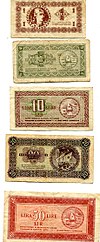
Despite the name, the currency was not related to the city of Trieste . Initially, it had treatment in the territory of Italy occupied by the Yugoslav army, and after Italy ratified the Paris Peace Treaty on September 16, 1947 - only in Zone B of the Free Territory of Trieste .
The unexpected introduction of this currency and the forced exchange of Italian lire to Trieste at the 1: 1 exchange rate caused panic among the local population and led to unrest suppressed by the Yugoslav troops. Replaced by the Yugoslav dinar in the ratio: 10 lira = 1 dinar [1] [2] [3] [4] .
Notes
- ↑ Promjene domaće valute u dvadesetom stoljeću , KUNALIPA (Croatian)
- ↑ Istra Peninsula, Rijeka and the Slovenian coast , fox-notes
- ↑ Istria, Fiume and Slovene Coastal Area , banknote.ws
- ↑ VUJA - ZONE B - 1945 - 1947 , freeterritorytrieste.com (Italian)