Karakoram ( Mong. Kharkhorin ?, ᠬᠠᠷᠠ ᠬᠣᠷᠢᠨ ? ), In the Middle Ages Kara Horum ( Mong. Har Horum ?, ᠬᠠᠷᠠ ᠬᠣᠷᠣᠮ ? ) - the capital of the Mongol Empire in 1220 - 1260 . Currently, it is a city, the center of the somon Kharkhorin aimak Uverhangay of Mongolia . The name goes back to the Mongolian toponym of the surrounding mountains "Karakorum" ( Mong. Har Hүremliterally "black stones of the volcano") [3] .
| Somone center | |
| Karakoram | |
|---|---|
| mong. Kharkhorin | |
| A country |  Mongolia Mongolia |
| Aimak | Overhead |
| Somone | Kharkhorin |
| History and Geography | |
| Based | 1220 |
| First mention | 1220 |
| Square | 20.72 [1] km² |
| Timezone | UTC + 7 |
| Population | |
| Population | 9439 [2] people ( 2015 ) |
| Density | 456 people / km² |
| Nationalities | mongols |
| Katoykonim | karakorumka, karakorumets, karakorumtsy, karakorumums. |
| Official language | Mongolian |


Content
Construction History
The date of foundation of the city is considered to be 1220, when the headquarters of Genghis Khan was moved to the banks of Orkhon . The residence of the khan was probably located near Mount Malahite, in the settlement of Tahai-balgas, where in the XII century the headquarters of the Kereit khan was located. The development of the territory began no earlier than the reign of Ugadei ( 1229 ), who was convinced by the advisers of the need for a stationary capital. It was under his rule that Karakorum is the center of the Mongolian state. Ogedei built a palace called the “Palace of Ten Thousand Years of Welfare” ( Mong. Tүmen amgalant ; Chinese Trad. 万年 пал , pall .: Wannyangong ). Younger Genghisides were also obliged to build here in the palace. In 1234, both the palaces and the quarters of the armourers outside Tahai-balgas were surrounded by a fortified wall. Karakorum was the main camp, where the khan left his family for the duration of his campaigns, and the center for the production of weapons and equipment for troops.
Political Importance
During the khans of Ugedey, Guyuk and Munke, the sovereigns of neighboring and distant countries, including Russian princes, came to Karakorum as a sign of humility and veneration; here the questions of succession were decided; here decisions were made about new conquests, setting in motion millions of people and turning over their fates; emissaries of Muslim, Buddhist, Christian and other faiths rushed here with hope for influence. Information about Karakorum is contained in Chinese chronicles and notes of 13th century European travelers: Plano Carpini , Marco Polo and de Rubruk .
Layout and population
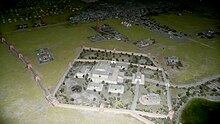
The city consisted of several quarters isolated from each other, in which artisans, traders and envoys from around the world lived. There lived people of different races and religions. Near the Christian ( Nestorian ) churches, travelers saw numerous Muslim mosques and Buddhist temples.
Decline
With the reign of Khubilai (1260), the capital of the empire was first transferred to the city of Kaiping ( Shandu ) founded by him, then to Beijing (1264), and in 1267 to the city built north of old Beijing, after the founding of the Yuan dynasty (1271), which was called Hanbalgasun ( Hanbalyk ), or Mong. Their nislell - ("The Great Capital"; Chinese. Dadu ). [four]
The northern capital of Yuan was Shandu (“Upper Capital”) in the territory of modern Inner Mongolia . Karakoram has become a provincial town. [5] After the Mongols were expelled from China (1368), the remnants of the Yuan leadership eventually settled in Karakorum, but in 1388 the Minsk forces ravaged the city.
Secondary settlement of the city in the 16th century.
According to Sagan-Setsen's “Precious Legend”, a decision was made to rebuild the capital on the Kurultai in 1415, but the implementation of this decision has not yet been confirmed by any archaeological data. The city was re-populated in the 16th century , when Batu-Munke Dayan Khan made it his residence and returned the city to its capital status. In subsequent years, the city several times passed from Genghisides to Oirats and, probably, would have been completely destroyed if the Khalkh khan Abatay had not paid attention to him. [6]
In 1585, Abatai began the construction of the first stationary Buddhist monastery in Northern Mongolia, Erdeni-Dzu , for which he had to not only restore old buildings, but also build new ones, using stone from the ruins of the old city for construction:
| ... Togon-Temur- khan, having arrived from Beijing to Mongolia, updated the [Buddha] statue in Kharahorin. After several centuries, temples fell into disrepair and desolation. They almost completely disappeared when Abatai - Tushetu Khan , following the command of the Dalai Lama III , brought the masters from Hohhot the year of the thirteenth cycle of fire, reconstructed the dilapidated temples of Erdeni-Dzu and built new ones [7] . |
The new monastery became one of the largest religious, political and economic centers of Khalkha , near which nomad camps were grouped. Thus, by the end of the XVI century the place of the city was again inhabited.
Current status
Currently, the city is the center of the somon Kharkhorin aimak Uverhangay . In 2003, its population was 8977 people, and the area - 20.5 km² [8] . In 80 kilometers southeast of Kharkhorin is the geographical center of Mongolia .
The main sources of municipal income are tourism and agriculture. Irrigation of fields to the east of the city is carried out from the Orkhon River. Kharkhorinsky airport with unpaved runway accepts regular flights from Ulaanbaatar and back.
The new urban development is directly adjacent to the ruins of the old city. In 2004, the Prime Minister of Mongolia, Elbegdorj, initiated the creation of a design committee that would draw up a plan for new development bypassing the ruins. According to his plan, the city was to restore its capital status by the time of its 800th anniversary (approx. In 2020) and become “a symbol of modern Mongolia” [9] . However, after his forced resignation in 2006 in favor of M. Enkhbold from the MPRP, they did not return to this project. This did not happen after the return of Elbegdorge to power in 2009, already as the country's president.
On September 2, 2009, at a government meeting, it was decided to create the Kharkhorum Museum, which will become a place for collecting unique memorabilia, research, storage and propaganda of history and culture associated with world heritage, as historical sites of the Orkhon River Valley and the ancient Mongolian capital. To support this museum project, Japan donated $ 5 million; construction work was performed by the Japanese company Konoike. The museum has been operating since the summer of 2011 .
In 2014, a memorandum was signed on the restoration of the ruins of the Buddhist monasteries of Karakoram, unique memorabilia and the arrangement of the exhibition hall. The project to create an open-air museum was fully completed on December 31, 2015 [10] .
History of Karakoram research
At the end of the 19th century, the Russian scientist N. M. Yadrintsev examined the ruins of the Karakoram. A.M. Pozdneev by analysis of historical sources confirmed the location of the ancient Mongolian capital in the vicinity of the Buddhist monastery Erdeni-Dzu , built in 1585 in the southern part of the capital.
In 1948 and 1949, the Soviet-Mongolian archaeological expedition worked here. In the southwestern part of the city are the remains of the Ogedei Palace, built on a granite basement; under the palace, the remains of a Buddhist idol of the late XII - early XIII centuries. with mural painting. For this work, the expedition leader S. V. Kiselev (1905-1962) was awarded the USSR State Prize and was elected a corresponding member of the USSR Academy of Sciences .
| UNESCO World Heritage Site , Object No. 1081 Russian • English • fr. |
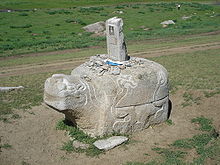
In 2004, Kharkhorin, together with a vast territory, called the Cultural landscape of the Orkhon River Valley , was declared a UNESCO World Heritage Site No. 1081rev . Archaeological finds on the territory of Somon Kharkhorin are now exhibited at the Kharkhorum Museum, which opened in 2011 [11] .
Notes
- ↑ Official site of aimak Uverhangay. Description somona Kharkhorin. (Mong.) (inaccessible link) . Date of treatment May 14, 2016. Archived June 3, 2016.
- ↑ Statistical Yearbook of Aimak Uverhangay, 2015 (Mong.)
- ↑ N. Navaan. "Kharkhorin." UB. 1959
- ↑ Dalai Ch. Mongolia in the XIII-XIV centuries / Ed. Editor B.P. Gurevich. - M .: Nauka, 1983 .-- S. 43.
- ↑ Tkachev V.N. Karakorum in the 13th century // Mongolica. - S. 227 .
- ↑ Hans-Georg Hüttel, Der Palast des Ögedei Khan - Die Ausgrabungen des Deutschen Archäologischen Instituts im Palastbezirk von Karakorum, in: Dschingis Khan und seine Erben, p. 140-146
- ↑ Erdenipel G. The ultimate cause of religions in Mongolia // History in the works of learned lamas. M .: KMK, 2004 .-- p. 226
- ↑ ア ー カ イ ブ さ れ た コ ピ ー . Date of treatment January 14, 2013. Archived April 21, 2012. Official statistics of the Uver-Khangai aimak
- ↑ Holbert J. Genghis Khan is the livingest of all living // The Wall Street Journal 02/11/2007
- ↑ A MUSEUM WILL BE CREATED UNDER AN OPEN SKY NEOPR MUSEUM WILL BE CREATED AT THE PLACE OF THE RUDDLES OF THE BUDDHIAN TEMPLES G. KHARKHORUM . Date of treatment July 22, 2014. (unavailable link)
- ↑ A. Zul “Kharkhorum” museum neelte hiylee
Literature
- Atlas of Antiquities of Mongolia, c. 1, St. Petersburg, 1899;
- Ancient Mongolian cities. M., 1965;
- Pozdneev A., Mongolia and the Mongols, vols. 1-2, St. Petersburg. 1896-98;
- Tkachev V.N. Karakoram in the 13th century // Mongolica: In memory of Academician B. Ya. Vladimirtsov (1884-1931). - M .: GRVL publishing house "Science" ,, 1986. - S. 219-231 .
- Yadrintsev N. M. A trip to the upper reaches of Orkhon to the ruins of the Karakoram // News of the Russian Geographical Society, 1890, v. 26, v. four;
- Extracts from the “Tarih-i-Jehangush” by Ala-ad-din Ata-Melik Juvani // Materials on the History of Turkmens and Turkmenistan / Transl. under the editorship of A.A. Romaskevich. - M .: Institute of Oriental Studies, 1939. - T. 1 . - S. 485 .
- Rashid ad-Din. Collection of annals / Translation from Persian O. I. Smirnova, edited by Professor A. A. Semenov. - M., L .: Publishing house of the Academy of Sciences of the USSR, 1952. - T. 1, book. 2 .-- S. 200.
- Ata Melik Juvaini. Genghis Khan. History of the World Conqueror = Genghis Khan: the history of the world conqueror / Translation from the text of Mirza Muhammad Kazvini into English by J.E. Boyle, with a preface and bibliography of D.O. Morgan. Translation of the text from English into Russian by E. E. Kharitonova. - M .: "MAGISTR-PRESS Publishing House", 2004. - S. 260. - 690 p. - 2000 copies. - ISBN 5-89317-201-9 .
- Ata Melik Juvaini. Genghis Khan. Conqueror of the World. - S. 558.
- Dmitriev S. V. On the Question of the Karakorum // Society and State in China, vol. 39, 2009, p.
- The Journey of William of Rubruck to the Eastern Parts of the World, 1253-55 . - Hayklut Society, 1900.
Links
- Karakoram - article from the Great Soviet Encyclopedia (3rd edition)
- Shilovsky M. V. On the Question of the Opening of the Karakoram . Electronic journal "Siberian Zaimka" No. 3, 2000