Saint Bernard ( FR. Saint-bernard , German: Bernhardiner ) is a breed of dog . There are two varieties: short-haired and long-haired. It comes from Asian dog-shaped dogs ( Tibetan mastiffs), which were brought to Europe and bred with local dogs.
| Saint bernard | |||||
|---|---|---|---|---|---|
 | |||||
| Origin | |||||
| A place |  Switzerland Switzerland  Italy Italy | ||||
| Time | mid 17th century | ||||
| Characteristics | |||||
| Height |
| ||||
| The weight | not less than 70 kg | ||||
| Wool | Short or long | ||||
| Life span | 8-10 years | ||||
| IF classification | |||||
| Group | 2. Pinschers and schnauzers, Molossoid breeds, mountain and Swiss cattle dogs | ||||
| Section | 2. Molosses | ||||
| Subsection | 2.2. Mountain dogs | ||||
| room | 61 | ||||
| Year | 1954 | ||||
| Other Classifications | |||||
| COP Group | Working | ||||
| AKC Group | Working | ||||
Content
- 1 History
- 2 Description
- 3 Character dogs
- 4 notes
- 5 Literature
History
The name "St. Bernard" ( French Chien du Saint-Bernard - the dog of St. Bernard) - came from the monastery of St. Bernard in the Swiss Alps. In the XI century, the monk Bernard of Menton [1] founded a shelter for travelers, which, like the trail, was named after him. The same name was given to the local dog breed. The site was located on the Great St. Bernard Pass at an altitude of about 2472 m - in one of the highest populated areas of Europe at that time. It was difficult and dangerous for travelers because of avalanches, strong winds, steep mountain passes and robbers.
In the 17th century, monks decided to use dogs to rescue people affected by avalanches . Thick skin reliably protected dogs from ice and snow, and their unusual scent allowed finding victims buried under avalanches and covered with snowstorms . Dogs accompanied the monks into the valley, and their ability to feel the approach of avalanches often saved the life of travelers.
At that time, St. Bernards in appearance differed from today's. They were less massive and therefore characterized by great mobility. The most famous St. Bernard was Barry (originally the breed was called "barry" - distorted from the German Bären, "bears"), which saved the lives of forty people from 1800 to 1812. Once Barry rescued a little boy and carried him to his monastery for five kilometers, in deep snow.
Breeding of pure breed began at the end of the XIX century. Now used as guard and accompanying dogs.
Description
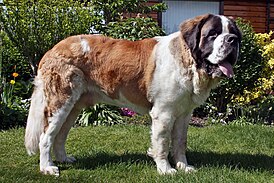
Saint Bernard is a very strong, large dog, the height at the withers, in accordance with the breed standard, in dogs is not less than 70 cm, and bitches - not less than 65.
The head of the St. Bernards is large and wide. The forehead is convex, slightly covered with wrinkles. The transition from the forehead to the muzzle is pronounced. Upper lips sag. Strong teeth, complete set. Eyes are dark brown, not very large, slightly sunken, located quite close to the bridge of the nose. Ears of medium size, hanging down on the sides of the head. The neck is strong, with a large collar.
The coat is medium-long, shiny, with a dense undercoat. Color: red with white marks or white with red marks, moreover, any shade of red is allowed [2] .
The average life expectancy of Saint Bernards is 8-10 years [3] .
Dog Character
Saint Bernards are faithful and very obedient dogs. They love people, and they treat children very carefully and carefully. There is one drawback that is quite difficult to cope with - Bernards do not really like small dogs. But if the puppies are raised together, then in the future there is a hope that they will live together.
Previously, St. Bernards were used to save people who fell into avalanches (before the St. Bernards began to work as rescuers, they were actively used by monks from St. Bernard's Shelter on the Great Pass in the Alps - a mountain route connecting Switzerland and Italy. provisions - large sizes and flexible disposition made them beautiful pack animals). And now they can be seen working on the snowy slopes [2] . Best of all, these dogs live in private houses, where you can provide them with free walking, in urban apartments, these dogs feel much worse, in this case they need to provide enough time for walking.
In hot times, there is a plentiful release of saliva.
The coat of long-haired St. Bernard must be regularly combed and brushed with a special brush [2] .
The rapid increase in height and weight of St. Bernards can lead to a serious deterioration in their bones if they do not receive adequate nutrition and training.
Notes
- ↑ Dog Owner's Guide Profile: The St. Bernard
- ↑ 1 2 3 Long-haired St. Bernard
- ↑ Saint Bernard . American Kennel Club . Date of treatment July 29, 2019.
Literature
- Inshakov A., Tsigelnitsky E. Saint Bernard // Friend: Journal. - 2001. - No. 4 (88) . - S. 6-11 .
- Potekhina N. Yu. Saint Bernard. - Tomsk, 2009