Herodotus Crater ( lat. Herodotus ) is an ancient impact crater located in the northeastern part of the Ocean of Storms on the visible side of the Moon. The name was given in honor of the ancient Greek historian Herodotus of Halicarnassus (484 BC - 425 BC) and approved by the International Astronomical Union in 1935. The formation of the crater dates back to the Late Umbrian period [1] .
| Herodotus | |
|---|---|
| lat Herodotus | |
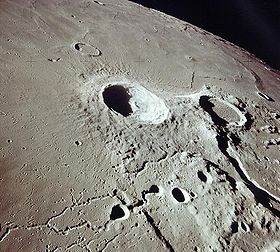 Craters Herodotus (pictured right) and Aristarchus . A picture from the side of Apollo 15 . | |
| Characteristics | |
| Diameter | 35.9 km |
| Deepest | 1300 m |
| Title | |
| Eponym | Herodotus of Halicarnassus (484 BC - 425 BC), ancient Greek historian |
| Location | |
| Heavenly body | Moon |


Content
- 1 Crater Description
- 2 Satellite Craters
- 3 See also
- 4 notes
- 5 Links
Crater Description
To the east of the crater is Aristarchus Crater; in the west, the Schiaparelli crater; in the south - the lonely standing dome of Mount Herodotus Omega (ω). Between the craters Herodotus and Aristarchus there is a small plateau [2] . The area around the crater is interesting for a large number of ridges and furrows. Selenographic coordinates of the center of the crater , diameter 35.87 km [3] , depth 1.3 km [4] . The top picture was taken from the Apollo 15 in the south, that is, the picture is rotated 180 degrees. The bottom image has a normal orientation to the north.
The crater has a slightly irregular shape and a relatively thin shaft, the bottom of the crater is even, filled with basalt lava. As a result of this, the albedo of the crater is significantly lower than that of the neighboring, much more noticeable, Aristarchus crater. The crater shaft is very well preserved, in the north-western part of the shaft there is a small satellite crater, Herodotus N. In the north-eastern part of the shaft there is a hole in the direction of the Schroeter valley (see below). The maximum height of the crater shaft above the bottom is about 1200 m - in the eastern part of the shaft. There is no central peak, no ray system. The volume of the crater is approximately 820 km³ [1] .
25 km north of the crater rampart an interesting formation begins - the Schroeter Valley, with a length of about 160 km and a depth of 1 km. The valley is probably cut through by a rapid lava flow or formed during the collapse of the lava tunnel . The valley begins with a small crater, which has received an unofficial name - “Cobra's Head”.
Satellite Craters
| Herodotus | Coordinates | Diameter, km |
|---|---|---|
| A | 10.0 | |
| B | 5,6 | |
| C | 4.7 | |
| E | 36.5 | |
| G | 3,5 | |
| H | 6.2 | |
| K | 4.7 | |
| L | 3.9 | |
| N | 4.3 | |
| R | 3.9 | |
| S | 4.1 | |
| T | 5,0 |
- The following craters are renamed the International Astronomical Union :
- Herodotus D - Raman .
- Satellite craters Herodotus A, B and C are included in the list of craters with a bright ray system of the Association of Lunar and Planetary Astronomy (ALPO) [5] .
See also
- List of Craters on the Moon
- Lunar crater
- Morphological catalog of Moon Craters
- Planetary nomenclature
- Selenography
- Mineralogy of the Moon
- Geology of the moon
- Late heavy bombardment
Notes
- ↑ 1 2 Lunar Impact Crater Database . Losiak A., Kohout T., O'Sulllivan K., Thaisen K., Weider S. (Lunar and Planetary Institute, Lunar Exploration Intern Program, 2009); updated by Öhman T. in 2011. Archived page .
- ↑ Herodotus Crater on the map LAC38
- ↑ Handbook of the International Astronomical Union
- ↑ John E. Westfall's Atlas of the Lunar Terminator, Cambridge Univ. Press (2000)
- ↑ List of craters with a bright ray system of the Association of Lunar and Planetary Astronomy (ALPO) Archived on March 4, 2016.
Links
- Digital Photographic Atlas of the Moon
- Photos of the crater from the side of Apollo 15
- Photos of the crater and its environs on the Lunar Picture of the Day website
- Description of the crater on The Moon-Wiki
- Selenological map of the vicinity of the crater
- Herodotus Crater on the LM39 map
- Andersson, LE, and EA Whitaker, NASA Catalog of Lunar Nomenclature, NASA Reference Publication 1097, October 1982.