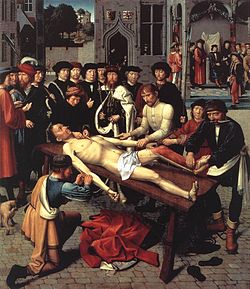
Skinning ( freshening ) is one of the historical types of the death penalty and torture (depending on the amount of skin to be peeled off and the method of doing this), which consists in peeling the skin from a living person or his corpse.
Description
In the case when it comes to the death penalty in this way, as a rule, they try to save the skin after stripping for demonstration in order to intimidate. Most often, the skin was already stripped from a person who was killed in a different way — a criminal, an enemy, in some cases a blasphemer who denied the afterlife (in medieval Europe). Removing part of the skin can be part of a magical ritual, as is the case with scalping .
Skinning is an ancient, but, nevertheless, non-widespread practice, which was considered one of the most terrible and painful forms of execution. In the chronicles of the ancient Assyrians, there are references to the flaying of captured enemies or rebellious rulers, whose whole skin was torn off and nailed to the walls of their cities as a warning to all who challenge their authority. There are also references to the Assyrian practice of “indirect” punishment of a person by flashing his young child before his eyes. The Aztecs in Mexico skinned the victims during ritual human sacrifices , but, as a rule, after the death of the victim. Skinning was sometimes used as part of the public execution of traitors in medieval Europe. A similar method of execution was still used at the beginning of the 18th century in France; one such episode is clearly described in the first chapter of Michel Foucault 's book “To oversee and punish ” (1979). In some chapels in France and England, large flaps of human skin nailed to the doors were discovered. In Chinese history, execution was more widespread than in European: it executed the corrupt officials and rebels, and, in addition to execution, there was a separate punishment - stripping the skin from the face. Emperor Zhu Yuanzhang was especially “successful” in this execution, who massively used it to punish bribe-takers and rebels. In 1396, he ordered 5,000 women accused of treason to be executed in this way.
The practice of skinning disappeared in Europe at the beginning of the XVIII century, in China it was officially banned after the Xinhai revolution and the establishment of the republic. Nevertheless, in the 19th and 20th centuries, separate cases of skinning took place in different parts of the world: the execution of Net Turner in the USA in 1831 (then the skin was torn from an already dead body), executions in Manzhou-Guo in the 1930s, executions in Afghanistan.