Zhamanshin ( Kaz. Zhaman Shyң - Zhaman - bad, evil, scary; Shyң - peak, glassy fragile rock) - impact crater in the Irgiz district of the Aktobe region of the Republic of Kazakhstan . The size of the inner ring of the crater is about 7 × 7 km, there is also a less pronounced outer ring.
| Zhamanshin | |
|---|---|
 Impact glass from Zhamanshin crater | |
| Location | |
| A country |
|

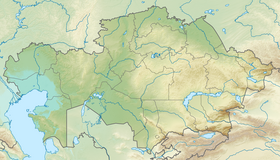

According to the results of radioisotope analysis, the crater is about 1 million years old (according to other estimates, up to 53 million years). According to the most widely accepted hypothesis, it was formed as a result of the fall of a meteorite to Earth (possibly an asteroid or cometary nucleus) with a diameter of 200 to 400 meters, evaporated during an explosion. At the time of the explosion, the ambient temperature in the area of the fall reached 1700 ° C. Immediately after the explosion, the depth of the crater was not less than 500 meters (perhaps even 1000 meters). At present, the maximum elevation difference is 250–300 meters.
Zhamanshin was first studied by scientists A. Yanshin and V. Vakhrameev in 1937-1939. Geologists studied and eventually found particles of the Paleozoic era on the surface of the earth. For a number of years - in 1946, 1957, 1961 and 1963, they studied the crater. After many years of research, the Moscow professor Florensky Pavel Vasilievich , to whom soil samples were sent, came to the conclusion in 1975–1976 that a meteorite fell and disappeared in Zhamanshyn, and the rocks formed during a powerful collision gave the name “irgizite” and “zhamanshinit”.
For many years, the scientist of the Institute of Geology and Geophysics of the Siberian Branch of the Russian Academy of Sciences, Dr. E. Geoscience and Mineralogical Sciences, has developed a hypothesis of the origin of tektites, according to which the crater is about 10 thousand years old. This hypothesis allows us to eliminate the contradiction between the radiogenic age of crater tektites and the age of geological rocks around the crater, in which there is an impact layer associated with the formation of a crater [1] .
This is one of the few deposits of tektites ( irgizits ) on earth and the only crater in which tektites and impactites are simultaneously found. Foamed leschelerite (quartz glass) and minerals containing trivalent titanium are also found in the crater.
The crater is a natural reserve of the Irgiz region. As a tourist attraction, it is popular with tourists.
Notes
- ↑ Izokh.. P. Kashkarov L. L. Geneaeva L.I. Age of the glass of the impact crater Zhamanshin according to the track research data // Traces of cosmic influences on the Earth: Coll. scientific works. - Novosibirsk: Science, 1990. - p. 188-193
Links
- Florensky P.V., Dabija A.I. Meteorite Crater Zhamanshin. - M .: Science , 1980. - 127 p.
- Expedition to the crater Zhamanshin, Kazakhstan
- Maria Saplinova - Roadside Picnic: Omsk astronomers expanded the meteorite crater by a third.
- In the wake of past disasters and scientific publications
- Zhamanshin (English) . Earth Impact Database. Circulation date October 18, 2012. Archived October 23, 2012.