Sarcodes ( lat. Sarcodina ) - protozoa that, when moving, produce paw-like processes (pseudopods). The speed of movement is about 1 cm / h. Sarkodovy include more than 11,000 species, among which there are three large groups: sunstrokes, rootpods, radiolarians. The most famous of the amoeba rootworms is Proteus. This is one of the largest amoeba, which in diameter reaches 0.5 mm, so it can be seen with the naked eye. You can find this amoeba in ponds and ditches with a muddy bottom.
| Polyphyletic group of protists | |
|---|---|
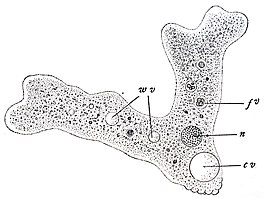 Amoeba proteus Amoeba proteus | |
| Title | |
| Sarcode | |
| Title Status | |
| Deprecated Taxonomic | |
| Scientific name | |
| Sarcodina | |
| Parent taxon | |
| The Kingdom of Protista - Protists | |
| Representatives | |
| |
You can find amoeba in the human body, there are five species, four of which are harmless. But one of them is dysenteric amoeba, which is able to penetrate the walls of the intestines, devouring their tissues and red blood cells. Then a person has a serious illness, amoebic dysentery. According to research, every tenth healthy person carries dysenteric amoebas and can infect other people with them.
In fresh water reservoirs you can find a large number of close relatives of the amoeba-conch root roots. And in seawater, at the bottom of the foraminifera. Shells of marine rhizomes cover about 1/3 of the bottom of the oceans. Also in the sea you can observe and radiolarium. But, unlike foraminifera, they seem to soar in the thickness of sea water thanks to needles that increase the body area, thereby reducing the specific gravity.
See also
- Wildlife Taxonomy
- Flagellum
Links
- Sharova I.Kh. Subdomain Protozoa, or Unicellular // Subtype Sarcode. - M .: Humanitarian Publishing Center VLADOS, 2002. - P. 40. - 592 p. - ISBN 5-691-00332-1 .