The leaders of destroyers of the Jaguar type are the type of leaders of the French fleet of the Second World War . In total, six ships were built in the series, named after predatory animals : “Jaguar” ( French Jaguar ), “Panther” ( French Panthere ), “Lynx” ( French Lynx ), “Leopard” ( French Leopard ), "The Jackal" ( Fr. Chacal ), "Tiger" ( Fr. Tigre ) [1] . The Jaguar type is also known as the Jackal type.
| Leaders of destroyers of the Jaguar type | |
|---|---|
| Jaguar classe contre-torpilleurs | |
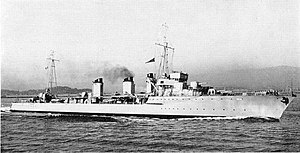 The leader of destroyers "Jackal" type "Jaguar" | |
| Project | |
| A country |
|
| Operators |
|
| Subsequent type | Cheetah |
| Years of construction | 1922-1927 |
| Years in the ranks | 1926-1954 |
| Built | 6 |
| Scrapped | one |
| Losses | five |
| Main characteristics | |
| Displacement | Normal 2700 t |
| Length | 126.78 m |
| Width | 11.32 m |
| Draft | 4.1 m |
| Engines | 2 TZA |
| Power | 50 000 liters with. |
| Speed | 35.5 knots |
| Sailing range | 2900 miles at 16 knots, 600 miles at 35 knots |
| Crew | 195 people |
| Armament | |
| Artillery | 5 × 1 - 130 mm / 40 |
| Flak | 2 × 1 - 75 mm / 50 |
| Mine torpedo armament | 2 × 3 - 550 mm torpedo tubes |

Officially called the counter-destroyers ( French contre-torpilleurs ) and actually were not the leaders of the destroyers in the traditional sense, as they were intended for operations in homogeneous formations and had to perform the functions of light cruisers . In fact, they could be called destroyer destroyers [2] . They had no direct analogues abroad. They became the first ships of this class in the French Navy after the First World War , sometimes called the "2100-ton counter-destroyers." They were evaluated by the fleet command as not quite successful combat units. They took an active part in World War II, five of the six ships of the series died during the hostilities. Further development of the class in the French Navy was the leader of the type " Cheetah ".
The standard displacement is 2126 tons, normal - 2700 tons, total - 2950-3050 tons. 2 TZA Rateau-Bretagne or Breguet, 5 Du Temple steam boilers, capacity 50,000 liters. sec., speed 35.5 knots. Cruising range 2900 miles at 16 knots, 1000 miles at 28 knots, 600 miles at 35 knots. [3] [4] [5]
French counter-destroyer class genesis
France's first counter-destroyers
The first ships classified as a class of destroyers appeared in the French fleet ( fr. La Marine Française ) at the end of the XIX century . Their construction was caused by changes in the views of the naval leadership of France . Over the past decade and a half, the French Maritime Ministry has adhered to the Doctrine of the Young School ( Fr. Jeune Ecole ). This theory claimed, in particular, the principle of "mobile defense", according to which the protection of the French coast should have been, above all, the numerous flotillas of small destroyers [6] . After Admiral Teofil Ob , the leader of the Young School, became the naval minister of France , mass construction of destroyers was launched, classified in the French fleet as torpilleurs [7] .
As a result, France came out on top in the world in the number of destroyers, of which more than 200 were built [8] [9] . However, the fighting qualities of most of these ships were low. In pursuit of quantity, the fleet demanded from designers cheap and small ships. Their seaworthiness was often unsatisfactory, moderate speed , cruising range insignificant, and armament extremely weak. Naval exercises have shown that in stormy weather, French destroyers are unable to operate effectively even near their bases .
The end of the French enthusiasm for the mass construction of small destroyers was marked by the appearance in 1893 - 1894 of the " British destroyers" (" torpedoboats destroyers" ) of the Hevok type , which were later referred to as "fighters" ( English destroyers ) and laid the foundation for a new class torpedo-artillery ships - destroyers . They were focused primarily on the fight against the French destroyers [10] [11] . After successful trials of the Havocs, the British began mass construction of destroyers that exceeded the French destroyers in all respects [12] .
In 1896, the first relatively large torpedo-artillery ships for the French fleet of the Durendal type were laid down, which received the classification of counter-destroyers ( French contre-torpilleurs ). These ships with a displacement of about 300 tons were built in four units. Over the next ten years, another 51 destroyers of the so-called "300-ton type" were laid down, which were actually divided into five subtypes. All of them had a displacement of just over 300 tons, a speed of 26-28 knots, carried weapons from one 65 mm gun and six 47 mm and two torpedo tubes of 381 mm caliber, and the last destroyers received 450 mm torpedoes [13] .
By the time the last 300-ton type destroyers were put into operation, they began to look too weakly armed in comparison with the latest British destroyers. They tried to correct their shortcomings by increasing the size. So there were counter-destroyers of the "450-ton" type, which included the subtypes of "Spagi" and "Voltiger" , only 13 units. Their displacement exceeded 500 tons, weapons now consisted of six 65-mm guns and three 450-mm torpedo tubes. Steam turbines were installed on the last 450-tonne destroyers instead of steam engines . These ships went into operation in 1909 - 1912 . Finally, in 1911 - 1914, the fleet was replenished with 18 counter-destroyers of the 800-ton type of two series: Buklie and Bisson . Their total displacement exceeded 800 tons, the speed reached 30 knots, and the armament included two 100-mm and four 65-mm guns, as well as four 450-mm torpedo tubes. On March 14, 1913, the fleet command changed the ship's classification and all counter-destroyers began to be considered destroyers ( fr. Torpilleurs d'escadre ). Thus, the development of the first generation of the French counter-destroyers was completed [14] .
Designing a new type of destroyer
March 30, 1912 in France, the Maritime Law was adopted, designed to reduce the backlog of the French fleet from the great sea powers. According to this document, it was supposed to have the following forces by 1920 :
- 28 battleships ;
- 10 scout cruisers ;
- 52 large destroyers;
- 94 submarines [14] .
The proposed program suffered from a clear imbalance . The number of light ships did not correspond at all to the number of battleships. However, the naval ministry leadership, constrained in funds, considered the construction of dreadnought battleships, which in those years were rated as the main force of the fleet, to be the most important. Therefore, the main appropriations were allocated for the construction of battleships of the Brittany , Normandy and Lyon types. The construction of other types of ships was provided for on a residual basis. In 1913, the fleet ordered only three destroyers, although previously they were laid down six to seven a year. In December 1913, the Chief of the Naval General Staff ( French Etat-Major General ), Vice Admiral Le Bree, presented a report inviting the construction of 58 destroyers of a new type and bringing the total number of destroyers in 1920 to 115. In particular, it was supposed lay in 1915 - 1918 32 destroyers of a new type, with a displacement of 1,500 tons [14] .
In 1913, the Technical Committee ( Fr. Comité Technique ) of the Ministry of the Sea published a report on the development of French destroyers since 1908, where he outlined further ways for the development of this class of ships. It was suggested that due to the instability of the destroyers as artillery platforms, their high speed and small size, as well as primitive fire control systems, the distance of effective firing in battles of torpedo-artillery ships would not exceed 3,000 m, and the number of hits would be insignificant. It was recommended that future destroyers be equipped with guns of the greatest possible caliber, even by reducing their number, in order to achieve maximum damage from each hit on the target. As possible options, weapons were featured six guns of 90 mm caliber, four 100 mm caliber and even two 138.6 mm caliber, the latter option was considered the most preferable. The number of torpedo tubes of 450 mm caliber was to be brought up to eight [14] .
On January 28, 1914, the Technical Department of the Ministry of the Sea ( Fr. Service Technique des Constructions et Armes Navales ) presented a preliminary design of the new destroyer, approved by the Naval General Staff on June 9, 1914. With a normal displacement of 1,530 tons, the destroyer had to accelerate to 33 knots. The armament included eight torpedo tubes in triple and single units and two 138.6-mm Schneider guns with a barrel length of 25 calibers. This system fired shells weighing 36 kg, and the effective range did not exceed 6000 m. But the shell contained 3.9 kg of melinite , which allowed us to expect great damage when hit by the target [14] .
| gun | Scheider 14cm / 25 [14] | |
|---|---|---|
| caliber mm | 138.6 | |
| barrel length, calibres | 25 | |
| installation weight, kg | 6.65 | |
| rate of fire, in / min | 15 | |
| projectile weight, kg | 36 | |
| initial speed, m / s | 550 | |
| effective range, m | 6500 | |
Two ships of this type, designated as M89 and M90 , were to be ordered in 1914 with a bookmark in 1915 and commissioning in 1917 . However, in the spring of 1914, the naval minister refused to include the M89 / 90 in the 1915 shipbuilding program, although the fleet had already ordered torpedoes for them. Design work was continued, but the outbreak of World War I led to their cessation [14] .
Design work on new destroyers for the French Navy was resumed only in 1917 . It was planned to build torpedo-artillery ships of two types: destroyers ( French torpilleur d'escadre ) with a displacement of 1,530 tons and larger leaders of the flotillas ( French conducteur d'escadrille ). The latter were to be armed with three short-barreled 138.6-mm Schneider guns. These suggestions were based on the experience of the British Navy. However, it was further recognized that the Schneider guns did not meet the requirements, since they did not provide reliable destruction of the target at a distance of more than 5000 m. Since there were no other guns of suitable caliber at that time, an option was proposed with five 100-mm guns [14] [ 15] .
On March 12, 1919, the Naval General Staff formulated its ideas about future torpedo-artillery ships and their tasks in a special note. According to her, the main task of the counter-destroyers was to be intelligence. The second most important task was the defense of their linear forces from attacks by light enemy ships. And only in third place were torpedo attacks on the enemy’s battle line. For this, the new ships had to have good seaworthiness, high speed and powerful weapons. It was recognized that the displacement of such a ship would be at least 2000 tons [14] .
| Projects of the counter-destroyers of France 1914-1920 [14] | |||||
|---|---|---|---|---|---|
| Main elements | M89 / 90 (1914) | 1918 project | 1920 project | ||
| Displacement, normal / total, t | 1530/1700 | 1650 / n / d | 1780/2063 | ||
| Power plant, hp | 38,000 | 40,000 | 38,000 | ||
| Maximum speed, knots | 33 | 35 | 35.5 | ||
| Cruising range, miles at speed, knots | n / a | 3600 (15) | 3000 (17) | ||
| Main caliber artillery | 2 × 1 - 138.6 mm / 25 | 3 × 1 - 138.6 mm / 25 | 5 × 1 - 100 mm / 45 | ||
| Flak | - | 1 × 1 - 75 mm / 50 | 2 × 1 - 75 mm / 50 | ||
| Torpedo weapons | 2 × 3 and 2 × 1 - 450 mm SLT | 2 × 3 - 550 mm TA | 2 × 3 - 550 mm TA | ||
| Crew | 155 | 176 | 178 | ||
Creation History
During the First World War, the command of the French Navy, when small French destroyers were often opposed by larger and more powerful armed destroyers of the German and Austro-Hungarian fleets, the need for a certain intermediate class of warships, which took place between the destroyers and cruisers, was realized [16] . During the war, French sailors were able to get acquainted with the characteristics of Italian scouts ( Italian. Esploratore Leggero ) type " Aquila " ( Italian. Aquila ) and appreciate their powerful weapons and high speed. The British experience with the use of Shakespeare ( Scottish ) and Scott ( Scott ) flotilla leaders, each carrying five 120-mm cannons, also had a significant impact on the design of new counter-destroyers. Finally, after the post-war reparations, the former German destroyer S-113 , armed with four 150-mm guns, entered the French fleet. Against this background, a project with five 100-mm guns looked frankly weak [14] .
Soon after the end of World War I, naval rivalry in the Mediterranean between France and Italy intensified. The Italian fleet in the early 1920s was seen as the main potential adversary. At this time, the Italian fleet was building large destroyers such as " Leone ", called by the Italian classification "scouts" ( Italian. Exploratori ). They carried eight 120 mm cannons in twin units. In his note of February 25, 1919, the chief of the Naval General Staff, Admiral De Beaune, noted that Italians were going to build at least 12 ships of this class [14] . Since the French fleet did not have modern cruisers at that time, and their new construction was limited by the Washington Treaty , it was decided to create an intermediate class of warships that would be stronger than Italian scouts and at the same time not subject to contractual restrictions [17] .
| Comparative performance characteristics of ships that influenced the development of the Jaguar project | |||||
|---|---|---|---|---|---|
| Main elements | Leone [18] | Scott [19] | type S-113 [20] | ||
| Years of construction | 1921-1924 | 1917-1919 | 1917-1918 | ||
| Displacement, standard / total, t | 2000 / | 1580/2050 | 2060/2475 | ||
| Power plant, hp | 42,000 | 40,000 | 45,000 | ||
| Maximum speed, knots | 34 | 36 | 36 | ||
| Main caliber artillery | 4 × 2 - 120 mm / 45 | 5 × 1 - 120 mm / 45 | 4 × 1 - 150 mm / 45 | ||
| Flak | 2 × 1 - 76 mm / 40 | 1 × 1 - 76 mm / 40 | - | ||
| Torpedo weapons | 2 × 3 - 450 mm TA | 2 × 3 - 533 mm TA | 2 × 2 - 600 mm SLT | ||
The Technical Committee of the Naval Ministry expressed the view that the 100-mm guns planned for the new counter-destroyers look too weak against the background of 120-mm artillery of Italian and British competitors. At the same time, it was suggested that the 138.6-mm guns would be too heavy and the best solution would be to equip the new ships with 130-mm guns under development. On January 14, 1921, the Naval General Staff considered new proposals for future counter-destroyers. Six weapons options were proposed, including four to six 138.6 mm cannons and five to eight 130 mm cannons. May 1, 1921 settled on a variant of six 130-mm guns placed in two twin and two single installations. The presence of powerful anti-submarine weapons was specifically stipulated [14] .
On March 28, 1922, the French parliament adopted a shipbuilding program, according to which it was planned to build three light cruisers (future type Duguet Truen ), six counter-destroyers (future type Jaguar), 12 destroyers (future type Burrask ) and nine submarines boats (future type "Roken" ) [14] . On March 18, 1922, together with destroyers of the Burrask type, six Jaguar-type destroyers were officially ordered, and at the insistence of MPs, only two ships were to be built by the naval arsenals, and the remaining orders were given to private companies. For the construction of all six units allocated 156 million francs [14] .
Design
Housing and architecture
General layout and plan of the hold |
The long, narrow body of the "jaguars" was designed to achieve high speeds, the ratio of its length to width was 10.8: 1. For the first time in French practice, ships of this type had a pronounced forecastle with an inclined bow . The hull of the ship was recruited according to the longitudinal pattern and consisted of 58 frames with a spacing of 2.1 m, and in the extremities the spacing was reduced. The frames were numbered from the stern to the bow. The casing was steel , with a thickness of 5 to 10 mm. 11 transverse bulkheads divided the casing into 12 watertight compartments. The double bottom stretched along almost the entire length. The bodies of the “jaguars” were assembled from steel with a tensile strength of 50 kg / mm² exclusively on rivets , electric welding began to be introduced into French shipbuilding after 1930 . The total mass of the hull was 813 tons, which amounted to 37.5% of the standard displacement [14] .
The ships had only one continuous deck - the main one. The lower deck was interrupted for five engine-boiler compartments, which rose to the main deck. In the bow there was a massive four-tier deckhouse of square section, where the main control posts for the ship and its weapons were located. Also in the bow were the cubicles of non-commissioned officers and sailors , officer cabins , including the commander’s apartments , were traditionally located in the stern [14] .
Despite the fleet’s desire to obtain completely the same type of ships, differences in the technologies used by contractors led to significant differences in design. As a result, it was necessary to divide the series into three subtypes: “Jaguar” and “Panther” were called Arsenaux type, “Jackal” and “Tigre” type Industrie A , “Leopard” and “Lynx” type Industrie B [14] ..
Power plant
About 50% of the ship’s length was occupied by a linear power plant. Its dry weight was 35% of the standard displacement. Steam for the turbines was supplied by five small Du Temple water - tube boilers , placed in a line in three compartments. Each boiler assembly weighed 74 tons. When choosing boilers, the emphasis was on endurance and reliability , so the characteristics were very conservative - pressure 18 kg / cm² and steam temperature 216 ° [14] .
Two turbo-gear units were located in two separate but adjacent compartments. Each set of turbines was independent of the other. The total mass of one unit was 193.2 tons. They rotated two bronze propellers with a diameter of 3.6 m. Four ships were equipped with Rateau-Bretagne turbines, which, after overcoming some problems, turned out to be quite reliable. The Breguet-Laval units were much worse. Their operation brought many problems and it took several years to resolve most of them. After that, the fleet refused to purchase Breguet-Laval turbines [14] .
In tests, all six ships showed good speed characteristics. With a power of 52,200 - 56,000 hp all showed an average speed of 34.5 knots and 35.3 - 35.6 knots when boosting turbines. The Tigre turned out to be the fastest, having developed 36.7 knots with a power of 57,200 hp. This achievement was widely advertised in the then naval press . In the service of the "jaguars" easily maintained a speed of 30 knots even in later years [14] .
The fuel supply included 530 tons of oil in four tanks . In addition, ships received 35 tons of lubricating oil and 100 tons of feed water for boilers. There were also 12 tons of water for sanitary purposes and four tons of drinking water for the crew in tanks in the bow and stern. According to the test results, we considered that the cruising range at a speed of 13 knots when operating only cruising turbines, with two boilers under steam, would be 3,300 miles, which was close to the calculated data. However, when the main turbines were connected, fuel consumption increased sharply. At a speed of 35 knots, the destroyers could only go 600 miles instead of the estimated 700 miles and 1000 miles at a speed of 28 knots [14] .
Electricity needs of the ships were provided by two Fives-Lille turbogenerators of 60 kW / 80 kW each, generating 115 volts of current . They were located on the upper platform in front of the engine room. There were also evaporators for the production of distilled water . In case of boiler failure, there was a backup diesel generator with a capacity of 30 kW / 36 kW. Theoretically, he was supposed to fully provide the ship with electricity . In 1926, another backup diesel generator with a capacity of 15 kW / 18 kW was installed on the "jaguars", but it could provide only lighting and some other functions [14] .
Armament
Main Caliber
Draft designs provided for the arming of the "jaguars" with six and even seven 130-mm guns. The first option included one twin artillery mount and four single, the second - two twin and three single. However, the trials of the Mle 1921 twin set at the Amiens memo were disappointing. It was found that when servicing a paired installation, the comendors interfere with each other and its rate of fire is noticeably lower than that of two single ones. On August 14, 1923, it was decided to equip the Jaguar type with only single installations [14] .
Thus, the main caliber of the Jaguar-type destroyers was represented by five 130-mm M1919 guns with a barrel length of 40 calibers in single installations. Four guns were placed in pairs in the bow and stern according to a linearly elevated pattern; another was installed behind the third chimney. The development of the gun began shortly after the end of World War I using pre-war technologies. It was a simple and reliable system. The gun fired very heavy shells - the half-armor-piercing weight was 32.05 kg, and the HE explosive was 34.85 kg. Semi-armor-piercing projectile contained 1.8 kg of melinite, high-explosive - 3.6 kg of melinite . From a distance of 10,000 m, a semi-armor-piercing projectile could penetrate 80 mm thick armor . At a distance of 18,000 m, this figure dropped to 45 mm. Charging was separate. Ballistic characteristics were also very good - at an elevation angle of 36 ° the firing range reached 18 900 m, but a significant range was achieved by increasing the height of the pins , which made loading difficult, since the shutter in this case was at the level of the shoulders of the loaders. However, the rate of fire was not high and did not exceed 4 - 5 rounds per minute, which was caused by the use of a piston shutter . Even with a very well trained crew, the rate of fire was never above 6 rounds per minute. This value was considered insufficient for a light ship [14] [21] .
Already during the construction of the ships it was clear that this artillery system was outdated, but in view of the unavailability of the guns of the new models, the jaguars installed what was available, with the prospect of re-arming the guns with new models in the future. Initially, the guns had light gun shields, but in 1926 Lorient's arsenal developed new box-shaped shields that provided much better protection, which were installed on all the ships of the series. Ammunition in peacetime included 660 shells and 745 charges . All of them were stored in the bow and stern cellars and delivered to the guns using chain electric lifts [14] .
The initial design included an advanced fire control system. The electromechanical computer Mle 1923B had to calculate all the data for firing, after which there was a remote guidance of the guns. However, the development of this system by the armaments department ( fr. Direction Central des Armes Navales ) was delayed and as a result, the destroyers received a very simple Mle 1919 system, which was used on the Amiens type of advice. She received data from a three-meter optical combining range finder Mle B.1926 from SOM ( French: Société d'Optique et de Mécanique de haute precision ), and orders for guiding guns were transmitted by telephone or using voice tubes [14] .
Anti-aircraft caliber
During the development of the anti -destroyers, air defense ships paid only limited attention. The air threat was considered insignificant due to the fact that torpedo bombers of that time flew very slowly and were a convenient target for anti-aircraft guns . The possibility of hitting maneuvering ships with aerial bombs was called into question, and dive bombers did not even exist in the projects. It was considered sufficient to have several medium-caliber anti-aircraft guns on the ship, which were supposed to drive away, and if successful, bring down slow-moving biplanes . French battleships and cruisers of the early 1920s carried four 75-mm anti-aircraft guns. Thus, two similar guns on relatively small counter-destroyers seemed to be sufficient weapons [14] .
The destroyers were initially armed with two Model 1924 75 mm anti-aircraft guns . These were ship cannons from the First World War, which were installed on the Mle 1922 anti-aircraft guns. They were installed on the sides on the upper deck, on special reinforcements closer to the stern, between the 130-mm gun number 3 and the stern torpedo tube. A well-trained crew could fire at a speed of up to 12 rounds per minute, provided that the elevation angle did not exceed 75 °. There was no centralized anti-aircraft fire control, the calculation commanders chose targets and fired using the sights of the guns themselves. Ammunition included 600 shells, high-explosive fragmentation and lighting.
As a short-range anti-aircraft weapon, coaxial 8-mm machine guns were used. These were the Hotchkiss Mle 1914 systems mounted on the twin Mle 1926 carriages, which were located on the forecastle, in front of the bridge. Ammunition was 20,500 rounds . Machine guns were usually stored in the below deck and mounted on carriages if necessary [14] .
| Jaguar-type anti-destroyer artillery | ||||||||||
|---|---|---|---|---|---|---|---|---|---|---|
| gun | 130 mm / 40 M1919 [22] | 75 mm M1922 [23] | 13.2 mm M1929 [24] | |||||||
| caliber mm | 130 | 75 | 13,2 | |||||||
| barrel length, calibres | 40 | 50 | 76 | |||||||
| gun mass, kg | 4050 | 1070 | 19.5 | |||||||
| rate of fire, in / min | 4-5 | 8-15 | 200 | |||||||
| projectile weight, kg | 32—34.85 | 5.93 | 0,052 | |||||||
| initial speed, m / s | 820 | 850 | 800 | |||||||
| maximum range, m | 18 900 | 14 100 | 7200 | |||||||
| maximum reach in height, m | - | 10,000 | 1500 | |||||||
Torpedo weapons
The torpedo armament of the French interwar period ships was excellent. Even during the First World War, fleet experts came to the conclusion that it was necessary to increase the caliber of torpedoes . As a result, the fleet received four types of 550-mm torpedoes before the start of the next war. In their characteristics, they significantly exceeded foreign torpedoes of the traditional 533 mm caliber and were comparable to Japanese 610 mm torpedoes [25] . Jaguar-type counter-destroyers, like Burrask-type destroyers, received two Schneider Mle 1920T torpedo tubes each , firing 550-mm Mle 1919D torpedoes [14] . These torpedoes had a kerosene engine and had the following characteristics:
- Caliber - 550 mm;
- Length - 8220 mm;
- Weight - 1900 kg;
- The mass of the warhead is 250 kg of melinite ;
- Range, m / at speed, knots - 6000/35, 14 000/25 [14] [25] .
The launch of torpedoes was carried out using compressed air from 60- liter tanks . A powder start was used as a backup. Initially, it was planned to equip torpedo tubes with remote control from the bridge and exclude manual operations. But it was not possible to bring the system to a suitable state, and the data necessary for pointing torpedoes was transmitted from the bridge and entered directly on the torpedo tubes. The same control system was used as for the main artillery caliber. Undoubtedly, the destroyers were too large and valuable ships to throw them into close combat with battleships, so the tactics of using torpedoes implied their massive launch from a distance of 10,000 - 12,000 m in the direction of the battle line of the enemy ships. There were no spare torpedoes on the destroyers. According to French experts, reloading torpedo tubes in the open sea was unrealistic [14] .
Anti-submarine weapons
According to the project, the Jaguar-type destroyers carried several types of anti-submarine weapons. Two gutters in the stern housed 12 Guiraud Model 1922 200 KG (2 × 6) depth charges . The actual weight of the bomb was 260 kg, the weight of explosives was 200 kg, the targets could be hit at a depth of up to 100 m. Four more such bombs were in reserve. The gutter system was original and well thought out, leaving a quarterdeck free, but much more complex than rail bombing on ships in other countries. In addition, the destroyers had four single-barrel 240-mm Thornycroft Mle 1918 , mounted in pairs along the sides, in the area of the front chimney. They were installed at a fixed elevation angle of 50 ° and could drop the Guiraud Model 1922 100 KG depth bomb at 60 m. The total ammunition of 100 kg bombs reached 30 pieces [14] .
However, having anti-submarine weapons on board, the counter-destroyers did not have instruments for detecting an underwater enemy, although the fleet and industry were working in this direction. According to the project, they were to be equipped with the so-called sound lenses of Walser ( FR. Walser ). On board it was supposed to install two such mechanical devices. In fact, Walser’s lenses were only installed on the Panther. Practical testing of this system yielded disappointing results. Get some information about the underwater enemy could only be at a complete stop of the ship. By 1931, the fleet abandoned the development of the Walser system [14] .
In the first post-war period, SIF ( French Société Indépendante de télégraphie sans Fil ) developed an active sonar and such devices had to be installed on destroyers of the Burrask type, and special bays were provided for the antenna of the locator and for the placement of operators. The installation of the system on the “burrasky” began in 1929, but already next year the fleet abandoned these locators due to their inefficiency and unreliability. As a result, counter-destroyers of the Jaguar type, like other ships of the pre-war French fleet, could only rely on the visual detection of a submarine or a trace of its torpedoes [14] .
Maneuverability and seaworthiness
On counter-destroyers of the Jaguar type, one balanced rudder was installed with an area of 14.13 m² to 14.44 m² on different ships of the series. This was not enough, especially given the weakness of the steering machine. At a speed of 30 knots, it took 25-3 seconds to turn the steering wheel to a maximum angle of 35 °. As a result, the Jaguars were not very maneuverable at high speeds. At the Tigre tests in 1925, it was revealed that the ship needed 525 m to turn at a speed of 20 knots and 570 m at a speed of 25 knots [14] . This flaw was especially evident during the battles in the English Channel in 1940 , where, in cramped conditions, the Jaguars found it very difficult to dodge the attacks of Luftwaffe bombers and torpedo boats [26] .
The high forecastle combined with the inclined stem made the “jaguars” good sea vessels. They could maintain high speed on rough seas without strong longitudinal pitching . However, lateral stability was not up to par. Excessive upper weight in combination with significant windage led to the fact that the ships had a roll in the stormy sea up to 25 ° with a period of 8-10 seconds . This made it difficult to use weapons and made the existence of the crew uncomfortable. Measures were taken to reduce lateral instability of the ships, including reducing the upper weight, but they did not give great results, allowing only not to aggravate the problem. I had to abandon plans for re-equipment with 138.6-mm guns due to their greater mass. In addition, the "jaguars" suffered from overload on the nose when fully refueling, so it was recommended to consume primarily fuel from the bow tanks or not even refuel completely [14] .
Crew and habitability
In the states of peacetime, the crew of the Jaguars consisted of 10 officers and 187 lower ranks . The ship was commanded by an officer with the rank of captain of the 2nd rank ( French Capitaine de frégate ), the senior officer was the captain of the 3rd rank ( French Capitaine de corvette ). Two captain-lieutenants ( fr. Lieutenant de vaisseau ) were responsible for the artillery and anti-submarine weapons of the ship. The officers also included two lieutenants ( Fr. Enseigne de vaisseau ), a chief mechanical engineer ( Fr. Ingénieur mécanicien de 1re classe ) and two junior mechanical engineers ( Fr. Ingénieurs mécani-ciens de 2e classe ). In addition, the ship had a medical officer ( Fr. Médecin de 1e / 2e classe ) or a procurement specialist ( Fr. Commissaire de 1e / 2e classe ). The junior command staff was represented by the chief foreman ( FR. Premier maître ) and 21 foremen of the first class ( FR. Maîtres ) and the second class ( FR. Seconds maîtres ). The crew also included 165 sailors . In wartime, it was supposed to have 12 officers, 33 foremen and 176 sailors [14] .
The commander had apartments in the aft of the ship , including a bedroom , an office , a bathroom and a pantry . The officers also lived in aft on the lower deck in single cabins and had their own private bathroom and wardroom . The chief foreman had a separate cabin in the bow of the ship. Nearby were cubicles for foremen. Sailors were accommodated in two small and two large cockpits in the nose, and in hanging buns , they were eating here. The Jaguar was the only ship in the series equipped as the leader of the flotilla, with rooms for Rear Admiral ( FR Contre-amiral ) of four officers of its headquarters [14] .
The destroyers of the Jaguar type had good thermal insulation of residential premises. However, air conditioning systems were not available. Like many other ships of the French fleet, they were convenient for serving in moderate latitudes, but during service in West and North Africa the crew suffered from heat and stuffiness, so crew members often slept right on the upper deck [14] .
Upgrades
Pre-war modernization
Initially, it was planned to replace the 130-mm artillery of the counter-destroyers with the more powerful 138.6-mm Model 1923 guns . In 1925 orders were even placed for thirty of these guns, but problems with the upper weight did not allow to realize this project. It only remained to improve the existing weapons. In the late 1920s, automatic loading trays were installed on the guns, which improved the working conditions of the loaders and allowed to slightly increase the rate of fire. Since 1927, the ships finally received the Mle 1923 Type B electromechanical fire control computer provided for by the initial design. In 1931, the three-meter alignment rangefinder was replaced by the stereoscopic rangefinder OPL25 E.1926 or E.1927 with the same base, and in 1937 they began to be replaced by the five-meter stereo rangefinder OPL (PC.1936). However, plans to establish a second rangefinder in the aft cabin had to be abandoned [14] .
In 1938, it was decided to replace the old 130 mm guns with 100 mm twin Model 1931 mounts. These guns would provide an opportunity to fire at air targets. However, production difficulties prevented re-equipment. In 1932, it was decided to replace the 75-mm anti-aircraft guns with eight 13.2-mm large - caliber Hotchkiss Mle 1929 anti - aircraft machine guns mounted on coaxial Mle 1931 machine guns . Machine guns were a good, reliable weapon, but their rate of fire was insufficient due to the need for a frequent change of 30-charge magazines , and the damaging effect and range did not meet the requirements of combating high-speed aircraft at the beginning of World War II [27] [14] .
Wartime Modernization
With the outbreak of war, the need emerged to strengthen the anti-submarine capabilities of counter-destroyers. The stock of depth bombs, reduced in the pre-war period, was again increased. But the main innovation was the placement on ships of the British Type 123 sonar . During the years 1939-1940 it was received by all the ships of the series, except for the Panthers. The escort operations of the French fleet at the beginning of the war showed the insufficient range of the "jaguars" and it was decided to equip them with equipment for refueling at sea. However, only the Panther managed to get it [14] .
Battles off the coast of Norway and in the English Channel revealed a clear lack of anti-aircraft means of the French ships. A draft was developed to strengthen anti-aircraft weapons, according to which the main mast was removed from the destroyers, and in its place a platform was installed with a paired 37 mm Model 1933 installation . This twin semiautomatic machine no longer met the requirements, but the French Navy did not have anything better then [27] . But only Panther managed to pass the re-equipment. After the armistice, the surviving ships of the Jaguar type were considered obsolete and put into reserve, and their weapons were used for more modern ships [14] .
Service
| laid | lowered | commissioned | fate | |
|---|---|---|---|---|
| "Jaguar" | August 22, 1922 | November 7, 1923 | July 24, 1926 | On May 23, 1940, it was hit by two torpedoes from German torpedo boats , ran aground and was finally destroyed by German aircraft |
| Panther | December 23, 1922 | October 27, 1924 | October 10, 1926 | Flooded in Toulon November 27, 1942 |
| Link | January 14, 1923 | February 25, 1924 | Flooded in Toulon November 27, 1942 | |
| "Leopard" | in August 1923 | September 29, 1924 | October 10, 1927 | May 27, 1943 sat on stones near Benghazi and June 19, 1943 destroyed by a storm |
| "Jackal" | August 16, 1923 | September 27, 1924 | June 12, 1926 | May 24, 1940 sunk by German diving bomber Ju-87 in the area of Boulogne |
| "Tiger" | September 15, 1923 | August 2, 1924 | February 1, 1926 | Decommissioned on January 4, 1954 and scrapped |
Jaguar
The ship was built at the shipyard of Arsenal Lorient ( fr. Arsenal de Lorient ) [21] . Immediately after entry into service, it became part of the 2nd division of the destroyers and was based on Brest . In 1928-1937 periodically acted as the flagship of the destroyer fleets. At the end of the summer of 1926 he participated in the campaign of a detachment of French ships in the Baltic Sea , in December 1926 he visited Dakar . In April 1927 he went to Seville , in May – June 1927, among other ships, he provided for an official visit of the President of France to Great Britain [14] .
In the spring of 1,939, they wanted to convert it into a destroyer destroyer and replace the main armament with 100-mm anti-aircraft guns. The outbreak of war thwarted these plans. Since the beginning of World War II, he acted in the English Channel as part of the 2nd division of leaders. January 17, 1940 collided with the British destroyer Keppel and received minor injuries. During the French campaign, he supported ground forces in the Dunkirk area with artillery fire. Around midnight, May 23, 1940 was attacked by German torpedo boats S 21 and S 23 . Having received two torpedoes, the Jaguar ran aground and was left by the crew. One officer and 20 sailors were killed. Then it was finally destroyed by German aircraft [26] .
Panther
The ship was built at the shipyard of Arsenal Lorient [21] . After entry into service, it became part of the 1st division of the destroyers of the 1st squadron and was based on Toulon [14] . At the beginning of World War II, he acted in the North Sea , the Atlantic Ocean and the Mediterranean Sea . After the surrender of France was withdrawn to the reserve and disarmed in September 1940. He stood in Toulon. Flooded there on November 27, 1942. Raised by Italian rescuers in March 1943 and included in the Italian fleet as FR 22 . Brought in tow to Italy and repaired in La Spezia . September 9, 1943 flooded due to the threat of capture by German troops .
Lynx
The ship was built at the Ateliers et Chantiers de la Loire shipyard in Saint-Nazaire [21] . Immediately after entry into service, it became part of the 2nd division of the destroyers and was based on Brest . In January – April 1930, together with the Cheetah counter-destroyer and the light cruisers Lamott Piquet and Primoge, he made a long voyage to the French West Indies and visited the Antilles [14] . Since the beginning of World War II, he acted on the Mediterranean Sea. He participated in the battle of Mers al-Kebir on July 3, 1940. In September 1940, he was disarmed and put into reserve in Toulon. Flooded in Toulon on November 27, 1942. January 22, 1944 raised by German rescuers and dismantled for metal [28] .
Leopard
The ship was built at the Ateliers et Chantiers de la Loire shipyard in Saint-Nazaire [21]. Immediately after entry into service, it became part of the 2nd division of the destroyers and was based on Brest . At the time of the surrender of France, he stood in Portsmouth , where he was captured by the British on July 3, 1940. July 31, 1940 transferred to the naval forces of Free France . Air defense systems were strengthened by the installation of British anti-aircraft guns and heavy machine guns. In the winter of 1940-1941, he was based at Clyde, participating in escort of convoys . In the spring of 1941, repairs were made during which the front boiler compartment was removed and fuel tanks were installed instead. Cruising range increased, the ship could reach a speed of 30 knots. Anti-aircraft weapons are further strengthened by the installation of 40-mm “pom-pom” and 20-mm “erlikon” . Also installed radar and sonar [28] .
July 11, 1942, together with the British sloops "Spey" and "Pelican" sank the German submarine U 136 . In November 1942 he took part in the operation of Free France against Reunion . On November 27, 1942, a small detachment of paratroopers landed on the Reunion. In 1943 he acted on the Mediterranean Sea, escorting convoys. On May 27, 1943, he jumped out on stones 30 miles northeast of Benghazi. The crew did not suffer losses and was removed from the ship. It was not possible to save the Leopard; on June 19, 1943 it was finally destroyed by a storm [29] .
The Jackal
The ship was built at the Ateliers et Chantiers de St Nazaire Penhoët shipyard in Saint-Nazaire. After entering into service, he became part of the 1st division of the destroyers of the 1st squadron and was based on Toulon . In June 1926 he was sent to Finland , where he represented France at the Hanko regatta . In August-September 1926, together with the Jaguar, Simun, and two submarines, he carried out a flag display mission in the Baltic . In November-December 1926, as part of a combination of ships, sailed in the eastern Atlantic. In May 1927, participated in the visit of the President of France to Great Britain. In January – April 1931, together with the Tiger and the light cruiser Primoge, he visited the coast of West Africa [14] .
At the beginning of World War II, he was part of the 2nd division of leaders. He acted in the Atlantic, accompanied the convoys. In May 1940, he operated in the English Channel, supporting ground forces, and fired on German coastal batteries in the Boulogne area. May 24, 1940 was attacked by German diving bombers Ju-87 or bombers He-111 [14] in the area of Cape Gris-Ne . Got a direct hit by an aerial bomb and lost speed. The crew was evacuated under the fire of German coastal batteries. The "Jackal" sank, crew losses killed 3 officers and 28 sailors [28] .
Tiger
The ship was built at the Ateliers et chantiers de Bretagne shipyard in Nantes . After entry into service, it became part of the 1st division of the destroyers of the 1st squadron and was based on Toulon [14] . In January – April 1931, together with the Jackal and light cruiser Primoge, he visited the coast of West Africa [14] . He participated in the battle of Mers al-Kebir on July 3, 1940. In September 1940, he was disarmed and put into reserve in Toulon. Flooded in Toulon on November 27, 1942. Raised by Italian rescuers on May 23, 1943 and included in the Italian fleet as FR 23 . Acted as a military transport. Returned to the French on September 28, 1943 in Bizerte [28] .
Underwent repairs in Casablanca with the installation of new anti-aircraft weapons - 40-mm machine guns “Bofors” and 20-mm “Oerlikon”. Participated in the liberation of Corsica . In April 1944, it was damaged by German bombers . During the repair, he lost his bow boiler room, instead of which fuel tanks were installed, the speed dropped to 28.5 knots, but the cruising range increased. Subsequently acted as an escort ship and military transport. After the war he was a training ship , operated on the Mediterranean Sea. Decommissioned on January 4, 1954 and scrapped [28] .
Project Evaluation
The first counter-destroyers of the French fleet should be assessed as not quite successful combat units. They were completely new ships, very different from the pre-war "800-ton" destroyers and suffered from many "childhood illnesses." If the problems with the power plant were eventually solved, then the problem of excessive upper weight could not be eliminated and this prevented a serious modernization of the ships. Until the very end of their career, they experienced too strong side rolling [14] .
Noticeably increased displacement did not lead to an equally sharp increase in combat qualities. The "clean" French destroyers Burrask , which were under construction at the same time with a standard displacement of 1,500 tons, carried slightly less powerful weapons. Although the 130-mm guns were considered very powerful by the standards of the 1920s, their rate of fire was insufficient for ships of this class, and an imperfect fire control system did not allow to realize a significant firing range. The air defense capabilities of the "jaguars" turned out to be completely inadequate for the air threat, which was revealed during the hostilities. Although this problem was characteristic of all French counter-destroyers, the Jaguar type was aggravated by insufficient maneuverability, especially at high speeds [26] .
Nevertheless, despite their shortcomings, leaders of the Jaguar type laid the foundation for the development of the class of destroyers of the destroyers of the French fleet and subsequently led to the appearance of very advanced projects that became the hallmark of the French fleet in the interwar period. As for the likely opponents of France, the appearance of the “jaguars” caused serious concern in the naval circles of Italy and led to the construction of scouts of the Navigatorori type for the Italian Navy [30] [31] . In addition, the "jaguars" influenced the construction of Japanese destroyers such as "Fubuki" [32] .
| Comparative TTX | |||||
|---|---|---|---|---|---|
| Main elements | Burrask [33] | Jaguar | The Navigator [31] | ||
| Displacement, standard / total, t | 1319/1900 | 2126/2950 | 1944/2580 | ||
| Power plant, hp | 33,000 | 50,000 | 50,000 | ||
| Maximum speed, knots | 33 | 35.5 | 38 | ||
| Cruising range, miles at speed, knots | 2150 (14) | 2900 (16) | 3800 (18) | ||
| Main caliber artillery | 4 × 1 - 130 mm / 40 | 5 × 1 - 130 mm / 40 | 3 × 2 - 120 mm / 50 | ||
| Flak | 1 × 1 - 75 mm / 50 | 2 × 1 - 75 mm / 50 | 2 × 1 - 40 mm / 39 and 4 × 2 - 13.2 | ||
| Torpedo weapons | 2 × 3 - 550 mm TA | 2 × 3 - 550 mm TA | 2 × 3 - 533 mm TA | ||
| Crew | 142 | 197 | 179 | ||
Notes
- ↑ Dashyan A.V., Patyanin S.V., et al. Fleets of the Second World War. - M .: Collection, Yauza, EKSMO, 2009. - S. 355. - ISBN 978-5-699-33872-6 .
- ↑ Kofman V.L. Leaders of the Mogador type // Maritime collection. - 2008. - No. 8 . - S. 2 .
- ↑ French warships of the World War II. - London: Ian Allan, 1971. - P. 52.
- ↑ Le Masson H. Navies of the Second World War. The French navy. V.1. - London: Macdonald, 1969 .-- P. 110.
- ↑ Conway's All the World's Fighting Ships, 1922-1946. - London: Conway Maritime Press, 1980 .-- P. 267. - ISBN 0-85177-146-7 .
- ↑ Roskund A. The Jeune Ecole. The strategy of the weak. - Boston, USA: Brill, 2007 .-- P. 20. - ISBN 978-90-04-15723-1 .
- ↑ Conway's All the World's Fighting Ships, 1860-1905. - London: Conway Maritime Press, 1979. - P. 323. - ISBN 0-85177-133-5 .
- ↑ British destroyers in battle. Part 1. The combat activity of British destroyers in world wars of the XX century / Morozov M. E., Granovsky E. A. - M .: CheRO, 1996. - P. 2. - ISBN 5-88711-051-1 .
- ↑ March E. British destroyers. History of evolution. 1892-1953. Part 1 .. - St. Petersburg: Galeia-Print, 2012. - P. 40. - ISBN 978-5-8172-0132-1 .
- ↑ Patyanin S.V. Destroyers of the British Navy. - St. Petersburg: Galea Print, 2004. - S. 7. - ISBN 5-8172-0088-0 .
- ↑ March E. British destroyers. History of evolution. 1892-1953. Part 1 .. - P. 44.
- ↑ March E. British destroyers. History of evolution. 1892-1953. Part 1 .. - P. 59.
- ↑ Conway's All the World's Fighting Ships, 1860-1905. - P. 326-327.
- ↑ 1 2 3 4 5 6 7 8 9 10 11 12 13 14 15 16 17 18 19 20 21 22 23 24 25 26 27 28 29 30 31 32 33 34 35 36 37 38 39 40 41 42 43 44 45 46 47 48 49 50 51 52 Jordan J., Dumas R. French Destroyers. Torpilleurs d'Escadre & Contre-Torpilleurs. 1922-1956. - Barnsley: Seaforth Publishing, 2015 .-- ISBN 978-1-84832-198-4 .
- ↑ Patyanin S.V. Leaders, destroyers, and destroyers of France in World War II. - St. Petersburg, 2003 .-- S. 6.
- ↑ Lassaque J. Les CT de 2800 tonnes du type Le Fantasque. - Nantes: Marines edition, 1998. - P. 8. - ISBN 2-909675-44-0 .
- ↑ Patyanin S.V. Leaders, destroyers, and destroyers of France in World War II. - S. 5.
- ↑ Conway's All the World's Fighting Ships, 1906-1921. - London: Conway Maritime Press, 1986. - P. 267. - ISBN 0-85177-245-5 .
- ↑ Conway's All the World's Fighting Ships, 1906-1921. - P. 83.
- ↑ Conway's All the World's Fighting Ships, 1906-1921. - P. 170.
- ↑ 1 2 3 4 5 Patyanin S.V. Leaders, destroyers, and destroyers of France in World War II. - S. 16.
- ↑ Campbell J. Naval Weapons of World War Two. - Annapolys, Maryland, USA: Naval Institute Press, 2002 .-- S. 302. - ISBN 0-87021-459-4 .
- ↑ Campbell J. Naval weapons of World War Two. - P. 306.
- ↑ Campbell J. Naval weapons of World War Two. - P. 310.
- ↑ 1 2 Patyanin S.V. Leaders, destroyers, and destroyers of France in World War II. - S. 15.
- ↑ 1 2 3 Patyanin S.V. Leaders, destroyers, and destroyers of France in World War II. - S. 17.
- ↑ 1 2 Patyanin S.V. French World War II cruisers. "Naval betrayal." - M: Yauza, EKSMO, 2012 .-- S. 149. - ISBN 978-5-699-58415-4 . >
- ↑ 1 2 3 4 5 Patyanin S.V. Leaders, destroyers, and destroyers of France in World War II. - S. 19.
- ↑ Patyanin S.V. Leaders, destroyers, and destroyers of France in World War II. - S. 20.
- ↑ Pakhmurin U. Squadron destroyers of the Navigatori type // Marine Collection. - 2010. - No. 9 . - S. 2 .
- ↑ 1 2 Conway's All the World's Fighting Ships, 1922-1946. - P. 299.
- ↑ Stern R. Destroyer Battles. Epic of Naval Close Combat. - Barnsley: Seaforth Publishing, 2008 .-- ISBN 978-1-84832-007-9 .
- ↑ Conway's All the World's Fighting Ships, 1922-1946. - P. 269.
Links
Literature
- Patyanin S.V. Leaders, destroyers and destroyers of France in World War II. - St. Petersburg, 2003.
- Le Masson H. Navies of the Second World War. The French navy. V.1. - London: Macdonald, 1969. - ISBN 0-356-02834-2 .
- Campbell J. Naval weapons of World War Two. - Annapolis, Maryland: Naval Institute Press, 1985 .-- ISBN 0-87021-459-4 .
- Conway's All the World's Fighting Ships, 1922-1945. - London: Conway Maritime Press, 1980 .-- ISBN 0-85177-146-7 .
- Couhat JL French warships of the World War II. - London: Ian Allan, 1971. - ISBN 0-7110-0153-7 .
- Jordan J., Dumas R. French Destroyers. Torpilleurs d'Escadre & Contre-Torpilleurs. 1922-1956. - Barnsley: Seaforth Publishing, 2015 .-- ISBN 978-1-84832-198-4 .