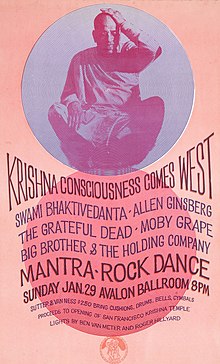
Mantra-Rock Dance is a music concert held on January 29, 1967 in the Avalon dance hall in San Francisco . [1] Grateful Dead , [2] [3] Moby Grape , [4] [5] Big Brother and the Holding Company with Janis Joplin , [6] as well as poet poet Allen Ginsberg and Hare Krishna bhaktivedanta Swami Prabhupada performed . Among the audience were such prominent counterculture leaders and LSD pioneers as Timothy Leary and Ousley Stanley . [7] The culmination of the concert was a kirtan organized by Ginsberg and Prabhupada, in which “thousands of people sang Hare Krishna .” [8]
The concert was organized by the students of Prabhupada in order to give his guru the opportunity to introduce the Hate Krishna hate-Ashbury hanti to the mantra and raise funds to support the opening of the Hare Krishna temple in San Francisco. [9] As a result of their participation in the Mantra-Rock Dance, Prabhupada and his followers received favorable media coverage [10] and attracted the attention of the American public. [7] Historian Robert Ellwood subsequently described Mantra-Rock Dance as one of the key events of the hippie era, and Allen Ginsberg called it “the peak of Haight Ashbury’s spiritual enthusiasm.”
Content
- 1 Background
- 2 Preparation
- 3 Concert
- 4 Reviews and Impact
- 5 notes
- 6 Literature
- 7 References
Background
The Bengali Vaishnava monk Bhaktivedanta Swami Prabhupada (also known as “Bhaktivedanta Swami” or simply “Prabhupada”) arrived from India to New York in 1965 with the goal of bringing Gaudiya Vaisnavism to the Western public. He ended up in America at a very opportune time for his mission, when many young people were interested in Indian culture and Hinduism , looking for new forms of "expanding consciousness of spirituality." [11] In 1966, Prabhupada opened the first Krishna temple in New York and founded the International Society for Krishna Consciousness . At the end of 1966, he asked his student Mukunda and his wife Janaki to establish a Hare Krishna temple in California. [12] [13] [14] Upon arriving on the West Coast , Mukunda and Janaki met their old friends, two pairs of young people interested in Indian spirituality. These were Sam Spierstra and Melanie Nagel , and Roger Siegel and Joan Campanella . With their assistance, Mukunda rented a former storehouse in the Haight-Ashbury area [15] [16] (which at that time was America’s largest hippie counterculture center) and opened the Radha Krishna Temple - the first Hare Krishna temple on the West Coast. [12] [17]
Preparation
Mukunda and other Hare Krishnas organized a concert with the participation of Prabhupada to introduce the Hate Krishna hate-Ashbury to the Hare Krishna mantra and raise funds to support the San Francisco temple. [9] Hayagriva and some other Prabhupada students from the New York Temple found it unacceptable for their spiritual teacher to participate in a concert with “roaring electric guitars, rattling drums, eye-catching floodlights and hundreds of drugged hippies.” [18] They believed that in such a place no one could "hear his pure message." [18] Despite their objections, Pradhupada, who was in New York at that time, agreed to take part in the Mantra-Rock Dance. [7] [approx. one]
Sam Spierstra was personally acquainted with the manager of the Grateful Dead Rock Scully , which helped him agree on the participation of this famous San Francisco band in Mantra-Rock Dance. [19] [20] With the help of Scully and the Grateful Dead, Big Brother and the Holding Company was invited to participate in the concert. Both bands agreed to perform at a concert for a minimum fee of $ 250. At the initiative of Melanie Nagel, Moby Grape , the still unknown group, was also invited to the concert at that time. [21] [approx. 2]
Hipster poet Allen Ginsberg agreed not only to take part in Mantra-Rock Dance, but also to introduce Prabhupada to a concert audience. [22] [23] Ginsberg met Prabhupada a few months earlier in New York. [12] He periodically attended Prabhupada’s lectures and kirtans at a New York temple and used his connections to help Prabhupada extend his US visa. [24] [approx. 3] Even before meeting with Prabhupada, Ginsberg visited the homeland of Krishna in Vrindavan , where he learned about the spiritual practice of chanting “Hare Krishna”. After returning to America, he actively engaged in popularizing the singing of this mantra, making kirtan a part of his philosophy. [22] Ginsberg told his audience that singing “Hare Krishna” would certainly bring them to an ecstatic state. [25] The poet was pleased that Prabhupada tried to spread the practice of chanting “Hare Krishna” in the United States, but was not in agreement with the Puritan spiritual standards established by the Bengali guru for his students. Like Ginsberg, other counterculture ideologists of the time ( Timothy Leary , Gary Snyder, and Alan Watts ) also found the Prabhupada-preached dogma and practice of singing “Hare Krishna” attractive. [approx. four]
Choosing the right venue for the concert, the organizers considered two possible options: the Fillmore audience and the Avalon dance hall. Their choice rested on Avalon, since his impresario, Chet Helms , agreed to provide the premises on conditions favorable to the Hare Krishnas, according to which all the proceeds from the concert, in addition to the musicians' fees, expenses related to maintaining order, and some other costs, should have go in favor of the san franciscan temple. [26]
The design of the advertising poster was made by one of the first students of Prabhupada Harvey Cohen. Information on the upcoming concert was posted on a psychedelic poster under the image of Prabhupada and requested to bring "pillows, drums, bells, cymbals." [27] In order to arouse interest in the upcoming Haight-Ashbury hippie concert, Mukunda published an article in the popular underground psychedelic newspaper San Francisco Oracle titled New Science. [28] The article stated that Haight Ashbury would soon visit Bhaktivedanta Swami Prabhupada, who would conduct daily spiritual programs in the small temple with lectures on the Bhagavad-gita , discussions, singing, playing musical instruments and dancing. At the end of the article, Mukunda noted that the chanting of the Hare Krishna mantra and dancing “more effective than hatha or raja yoga , or listening to Ali Akbar Khan under the influence of LSD ...” [29]
Prabhupada flew from New York to San Francisco on January 17, 1967. At the airport he was expected by a bright reception, organized with the participation of Allen Ginsberg. Together with Ginsberg, Mukunda and other followers, Prabhupadu was met by a crowd of more than 50 hippies singing “Hare Krishna”. [12] Roger Siegel subsequently described this episode as follows:
| Even for the San Francisco airport, we looked pretty extravagant. Mukunda dressed in the mantle of the magician Merlin, painted with colorful squares. Sam wore a Moroccan sheepskin coat with a hood - it even smelled of sheepskin, and I had a handmade blue and white speckled cloak like Japanese samurai. Everyone had long rosaries on their neck. Leather pants, boots, gymnasts, people in small round sunglasses - in a word, the San Francisco phantasmagoria in all its glory. [thirty] |
A few days after Prabhupada arrived, the San Francisco Chronicle , the largest newspaper in San Francisco , published an article entitled “Swami in the Hippie Kingdom — the saint opens a temple in San Francisco”. [31] The article began as follows: "A holy man from India, whom his friend beatnik poet Allen Ginsberg calls one of the most conservative representatives of his religion, began his missionary work yesterday in the San Francisco hippie paradise." [31] A newspaper correspondent asked Prabhupada whether he accepts hippies in his movement, to which he replied: “Hippies or someone else - I do not make any distinctions. Welcome to everyone. ” [32]
Concert
Mantra-Rock Dance was scheduled for Sunday evening, January 29, 1967. Chet Helms considered that the day and time for the concert were chosen poorly, [33] but his fears did not materialize: so many people gathered at the entrance to Avalon on the evening of January 29, that there was a queue for tickets for a whole block. A ticket cost two and a half dollars and was sold at the entrance. [34] More than 3,000 people arrived at 8 o’clock and Avalon was filled to capacity. [35] [36] LSD pioneers Timothy Leary and Ousley Stanley also attended the concert. [7] Leary paid for the ticket, while Ousley Stanley was skipped for free. [37] Before the concert began, the Hare Krishnas distributed prasadam from orange slices to the public. [5] Despite the ban on drug use, many of those who came smoked weed and took LSD. [35] [38] The role of bodyguards at the concert was performed by the “ Angels of Hell ”. [5] The biographer of Prabhupada Satsvarupa Dasa Goswami described the audience who came that evening as follows:
| Almost all who came to the concert were dressed in bright or unusual costumes: Native American raincoats, Mexican ponchos, Indian kurts , Gods-ays [T-shirts with a bright pattern in the form of concentric circles], many of them were decorated with feathers and beads. Some hippies came with their flutes, lutes, rattles, drums, horns, rattles, and guitars. Accompanied by their friends, the Hell Angels marched on - unkempt, with dirty hair, in jeans, boots, and coarse canvas jackets. Hung with chains, they smoked cigarettes on them were German helmets, emblems with emblems and other attributes, and they only had to leave their motorcycles at the entrance. [36] |
The first to enter the scene were the Hare Krishnas and chanted the Hare Krishna mantra on an Indian motif. [39] Men were dressed in the mantle of the magician Merlin, [39] and women were dressed in a sari . Some of the musicians played along with the Hare Krishnas on their instruments. Incense was smoked on the stage and in all corners of the room. Most of those present were under the influence of drugs, but despite this, the hall was calm. Multi-colored lights burned all around, bright colored highlights flashed across the ceiling, walls and floor. [39] Slides depicting Krishna and episodes from his life were projected onto the walls: “Krishna and Arjuna racing on a chariot; Krsna, stealing oil; Krishna, the killing demon who took the form of a tornado; Krsna playing the flute. " [40] Following the Hare Krishnas, Moby Grape entered the scene. [39] Their performance was met with an approving roar. [40]
Prabhupada arrived at Avalon at 10 o’clock. He was dressed in the saffron robes of a Hindu monk , a garland of gardenias hung on his neck. [40] When he appeared, the Hare Krishnas blew their sinks as a sign of greeting, and one of the musicians began to beat the drum roll. [40] The crowd parted, hummed and applauded in greeting. [9] Accompanied by Allen Ginsberg, Prabhupada went on stage, sat down on a pillow specially prepared for him and asked Ginsberg to say a few words about the mantra. [40] The poet told the audience about his understanding of the Hare Krishna mantra and what she personally gave him. Ginsberg introduced Prabhupada to the public and thanked the elderly swami for leaving his peaceful and quiet life in India with the goal of bringing the Hare Krishna mantra to where it was most lacking - to the Lower East Side . Ginsberg translated the meaning of the Sanskrit term mantra as "liberation of the mind." “For those who are moving away from LSD, they want to stabilize their consciousness and prepare it for new“ flights ”,” he recommended the “early morning kirtans” in the San Francisco Hare Krishna temple. [9] [41]
Ginsberg then passed the word to Prabhupada, who briefly told the story of the Hare Krishna mantra and invited the poet to sing it from the stage. Asking the audience to “just pause into the sound vibration and calm down,” [5] Ginsberg began to play harmonium and to the accompaniment of a sitar , tambours and drums sang “Hare Krishna” on an Indian motif. The projector highlighted the mantra text on the wall. [42] Gradually, the public began to sing along. One of the Hare Krishnas, a former drummer, pounded on the drums. [42] The pace of kirtana increased and singing spanned the entire hall. Prabhupada got up from his seat, raised his hands and began to dance, gesturing for those present to join. [43] Many jumped from their seats, and, following the example of Prabhupada, started to dance with their hands raised up. Members of the Grateful Dead , Big Brother and the Holding Company, and Moby Grape, too, became infected with enthusiasm and played musical instruments. [44] [45] Prabhupada sang into the microphone and his voice, amplified by powerful speakers, rang through the hall. [43] The pace of kirtana continuously increased and Prabhupada became wet with sweat. Kirtanananda, who was behind the scenes, asked to stop acting, claiming that Prabhupada was "too old for such things," and that "it could end badly." [43] However, the pace of kirtan became faster and faster. Soon, "it was almost impossible to make out the words of the mantra drowned in the amplified music of the speakers and the chorus of thousands of voices." [43] Allen Ginsberg subsequently recalled:
| We chanted the Hare Krishna mantra all evening. It was amazing - complete emancipation! It was the peak of Haight Ashbury’s spiritual enthusiasm. For the first time, a concert was held in San Francisco, in which all those present could take part. Everyone could dance and sing, and not just watch others sing and dance. [42] |
Singing lasted almost two hours. In conclusion, all those present prostrated themselves on the floor (as is customary during worship in Hare Krishna temples) and Prabhupada recited prayers in Sanskrit. After Prabhupada withdrew, Big Brother and the Holding Company with Janice Joplin stepped on the scene. They continued the concert by singing The House of the Rising Sun and Ball 'n' Chain . [5] [46]
Feedback and Impact
Timothy Leary called Mantra-Rock Dance “a beautiful night”, [38] and Allen Ginsberg - “the peak of Haight Ashbury’s spiritual enthusiasm.” [9] Historian Robert Ellwood described the concert as the “final“ flight ”of the hippie era. [9] [47]
After performing at Mantra-Rock Dance, a breakthrough occurred in the career of Moby Grape . Soon the band performed at Avalon with The Doors and signed a contract with Columbia Records . [four]
Mantra-Rock Dance raised $ 2,000, which went to the aid of the Hare Krishna temple in San Francisco. At the concert, many learned about the existence of the temple and began to attend kirtans and lectures held daily in it. Prabhupada's performance at Mantra-Rock Dance made a deep impression on the hippies of Haight Ashbury. A Krishna guru has become a cult hero for many of them, and this does not matter how they relate to the philosophy and moral principles that he preached. [48] The practice of singing “Hare Krishna” and dancing was more or less accepted by all layers of the counterculture, including the “ Angels of Hell ” [49] . This provided the hippies with a “free community”, reconciled them [48] and gave them a viable alternative to drugs. [50] The popularity of Hare Krishnas among hippies gradually increased, and soon the appearance of the Hare Krishnas singing and spreading prasadas became one of the hallmarks of the Haight Ashbury scene. [7] [35]
When the main group of San Francisco Hare Krishnas became more serious in their spiritual practices, Prabhupada ordained them as disciples, giving them names in Sanskrit. [approx. 5] He called the New San Francisco Temple “The New Jagannatha Puri,” and installed statues of the deities Jagannatha , Baladeva, and Subhadra in it for worship. [15] Small wooden copies of these deities immediately became a “psychedelic hit”: many of the local hippies wore them strung around their necks. [51]
Mantra-Rock Dance has attracted keen interest in the American public and media to the Hare Krishnas. [7] In particular, Prabhupada appeared on The Les Crane Show on ABC , and also talked about Krishna consciousness on the KPFK radio program hosted by American comedian Peter Bergman . [52] Prabhupada disciples were also invited to talk about their activities at the KFRC San Francisco radio station . [53]
On August 18, 2007, former members of the concert in Berkeley organized celebrations to mark the 40th anniversary of the Mantra-Rock Dance. [54]
Notes
- Comments
- ↑ Witnessing the atmosphere that prevailed in Avalon, Prabhupada noted that it was “not a place for the brahmacari ” ( Brooks, 1989 , p. 79)
- ↑ All sources talk about participating in the concert of Grateful Dead, Janice Joplin with Big Brother and the Holding Company and Moby Grape. A number of sources also claim that Jefferson Airplane , Quicksilver Messenger Service and Grace Slick performed at the concert. ( Brooks, 1989 , p. 79 Siegel, 2004 , pp. 8–10 and Satsvarūpa Dāsa Gosvāmī, 1981 , p. 10)
- ↑ Addressing speculation that he was Ginsberg's guru, Prabhupada answered by saying, “I am nobody's guru. I am everybody's servant. Actually I am not even a servant; a servant of God is no ordinary thing. ”( Greene, 2007 , p. 85; Mukunda Goswami, 2011 , pp. 196–7)
- ↑ From the “Houseboat Summit” panel discussion, Sausalito, Calif., February 1967 , Cohen, 1991 , p. 182:
Ginsberg: So what do you think of Swami Bhaktivedanta pleading for the acceptance of Krishna in every direction?
Snyder: Why, it's a lovely positive thing to say Krishna. It's a beautiful mythology and it's a beautiful practice.
Leary: Should be encouraged.
Ginsberg: He feels it's the one uniting thing. He feels a monopolistic unitary thing about it.
Watts: I'll tell you why I think he feels it. The mantras, the images of Krishna have in this culture no foul association. ... [W] hen somebody comes in from the Orient with a new religion which hasn't got any of these [horrible] associations in our minds, all the words are new, all the rites are new, and yet, somehow it has feeling in it, and we can get with that, you see, and we can dig that! - ↑ Sam Spirstra and Melanie Nagel became Shyamasundara and Malati, and Roger Siegel and Joan Campanella respectively received the names "Gurudas" and "Yamuna".
- Sources
- ↑ Cohen, 1991 , p. 106
- ↑ Schinder & Schwartz, 2008 , p. 335
- ↑ Buckley, 2003 , p. 444
- ↑ 1 2 Mukunda Goswami, 2011 , p. 160
- ↑ 1 2 3 4 5 Siegel, 2004 , pp. 8-10
- ↑ Buckley, 2003 , p. 91
- ↑ 1 2 3 4 5 6 Chryssides, 1999 , p. 173
- ↑ Fadiman, 1988
- ↑ 1 2 3 4 5 6 Greene, 2007 , p. 85
- ↑ Mukunda Goswami, 2011 , pp. 201, 262, 277
- ↑ Ellwood, 1989 , p. 102
- ↑ 1 2 3 4 Muster, 2001 , p. 25
- ↑ Satsvarūpa Dāsa Gosvāmī, 1981 , p. 17
- ↑ Mukunda Goswami, 2011 , pp. 100–1
- ↑ 1 2 Knott, 1986 , p. 33
- ↑ Mukunda Goswami, 2011 , pp. 132-5
- ↑ Mukunda Goswami, 2011 , p. 110
- ↑ 1 2 Satsvarūpa Dāsa Gosvāmī, 1981 , p. 9
- ↑ Mukunda Goswami, 2011 , pp. 119, 127
- ↑ Satsvarūpa Dāsa Gosvāmī, 1981 , p. 10
- ↑ Mukunda Goswami, 2011 , p. 130
- ↑ 1 2 Brooks, 1989 , pp. 78–9
- ↑ Ginsberg & Morgan, 1986 , p. 36
- ↑ Mukunda Goswami, 2011 , pp. 76–7
- ↑ Szatmary, 1996 , p. 149
- ↑ Satsvarupa das Goswami, 2007 , p. 187
- ↑ Mukunda Goswami, 2011 , pp. 141–2
- ↑ Mukunda Goswami, 2011 , p. 125
- ↑ Cohen, 1991 , pp. 92, 96
- ↑ Satsvarupa das Goswami, 2007 , pp. 175–176
- ↑ 1 2 Satsvarupa das Goswami, 2007 , p. 182
- ↑ Siegel, 2004 , p. eleven
- ↑ Mukunda Goswami, 2011 , p. 127
- ↑ Mukunda Goswami, 2011 , p. 141
- ↑ 1 2 3 Brooks, 1989 , p. 79
- ↑ 1 2 Satsvarūpa Dāsa Gosvāmī, 1981 , p. 12
- ↑ Satsvarupa das Goswami, 2007 , pp. 187-188
- ↑ 1 2 Muster, 2001 , p. 26
- ↑ 1 2 3 4 Mukunda Goswami, 2011 , p. 152
- ↑ 1 2 3 4 5 Satsvarupa das Goswami, 2007 , p. 189
- ↑ Mukunda Goswami, 2011 , p. 154
- ↑ 1 2 3 Satsvarupa das Goswami, 2007 , p. 190
- ↑ 1 2 3 4 Satsvarupa das Goswami, 2007 , p. 191
- ↑ Tuedio & Spector, 2010 , p. 32
- ↑ Joplin, 1992 , p. 182
- ↑ Mukunda Goswami, 2011 , p. 159
- ↑ Ellwood & Partin, 1988 , p. 68
- ↑ 1 2 Brooks, 1989 , pp. 79–80
- ↑ Oakes, 1969 , p. 25.
- ↑ Ellwood, 1989 , pp. 106–7
- ↑ Brooks, 1989 , p. 80
- ↑ Mukunda Goswami, 2011 , pp. 262, 277
- ↑ Mukunda Goswami, 2011 , p. 201
- ↑ Berkeley Daily Planet. Arts Calendar . Berkeley Daily Planet (August 17, 2007). Date of treatment February 7, 2011. Archived on September 10, 2012.
Literature
- In English
- Brooks, Charles R. (1989), The Hare Krishnas in India , Princeton, NJ: Princeton University Press , ISBN 0-691-00031-X , < https://books.google.com.au/books?id=5tjtDZ438h4C >
- Buckley, Peter (2003), The Rough Guide to Rock (3rd ed.), London: Rough Guides, ISBN 1-8435-3105-4 , < https://books.google.com/books?id=7ctjc6UWCm4C >
- Chryssides, George D. (1999), Exploring New Religions , New York: Cassell , ISBN 0-8264-5959-5 , < https://books.google.com/books?id=S4_rodMYMygC >
- Cohen, Allen (1991), The San Francisco Oracle: The Psychedelic Newspaper of the Haight-Ashbury (1966–1968) , Berkeley, CA: Regent Press, ISBN 0-916147-11-8 , < https://books.google .com / books? id = 2AkeAgAACAAJ >
- Ellwood, Robert S. (1989), "ISKCON and the Spirituality of the 1960s" , in Bromley, David G. & Shinn, Larry D. , Krishna Consciousness in the West , Lewisburg, PA: Bucknell University Press , ISBN 0-8387 -5144-X , < https://books.google.com/books?id=F-EuD3M2QYoC >
- Ellwood, Robert S. & Partin, Harry B. (1988), Religious and Spiritual Groups in Modern America (2nd ed.), Englewood Cliffs, NJ: Prentice-Hall, ISBN 0-13-773045-4 , < https: / /books.google.com/books?id=1BPcAAAAMAAJ >
- Fadiman, Anne (November 20, 1988), " Not What Krishna Had in Mind ", The New York Times , < https://www.nytimes.com/1988/11/20/books/not-what-krishna-had -in-mind.html? pagewanted = all >
- Ginsberg, Allen & Morgan, Bill (1986), Kanreki: A Tribute to Allen Ginsberg, Part 2 , New York: Lospecchio Press , < https://books.google.com/books?id=wWmuAAAAIAAJ >
- Mukunda Goswami (2011), Miracle on Second Avenue , Badger, CA: Torchlight Publishing, ISBN 9780981727349 , < https://books.google.com.au/books?id=Q2RSYgEACAAJ >
- Greene, Joshua M. (2007), Here Comes the Sun: The Spiritual and Musical Journey of George Harrison (reprint ed.), Hoboken, NJ: John Wiley & Sons , ISBN 0-470-12780-5
- Joplin, Laura (1992), Love, Janis , New York: Villard Books, ISBN 0-679-41605-6 , < https://books.google.com/books?id=Oj4IAQAAMAAJ >
- Knott, Kim (1986), My Sweet Lord: The Hare Krishna Movemenent , Wellingborough, UK: Aquarian Press, ISBN 0-85030-432-6
- Muster, Nori J. (2001), Betrayal of the Spirit: My Life Behind the Headlines of the Hare Krishna Movement (2nd ed.), Urbana, IL: University of Illinois Press , ISBN 978-0-252-06566-8 , < https://books.google.com/books?id=Dw3-xD05wnoC >
- Oakes, Philip . 'Chanting Does Wonders' For New Missionary Group (February 1, 1969), p. 25.
- Prat i Carós, Joan (2008), "Sobre vidas y relatos de santidad" , in Julio Martín Sánchez, Sacra loca toletana: los espacios sagrados en Toledo , Cuenca: Ediciones de la Universidad de Castilla-La Mancha, p. 19-50, ISBN 8484275663 , < https://books.google.pt/books?id=htNLtS2AqFEC&printsec=frontcover >
- Satsvarūpa Dāsa Gosvāmī (1981), Srila Prabhupada Lilamrta, Volume 3: Only He Could Lead Them, San Francisco / India , vol. 3, Los Angeles, CA: Bhaktivedanta Book Trust , ISBN 0-8921-3110-1 , < https://books.google.com/books?id=6WV4JYYdkK8C >
- Schinder, Scott & Schwartz, Andy (2008), Icons of Rock: Velvet Underground; The grateful dead; Frank Zappa; Led Zeppelin; Joni Mitchell Pink Floyd; Neil Young; David Bowie; Bruce Springsteen; Ramones U2; Nirvana , vol. 2, Westport, CT: Greenwood Publishing Group , ISBN 0-31-333847-7 , < https://books.google.com/books?id=CzWE_J3ZZfoC >
- Siegel, Roger (2004), By His Example: The Wit and Wisdom of AC Bhaktivedanta Swami Prabhupada , Badger, CA: Torchlight Publishing, ISBN 1-887089-36-5 , < http://www.worldcat.org/title/ by-his-example-the-wit-and-wisdom-of-ac-bhaktivedanta-swami-prabhupada / oclc / 52970238 & referer = brief_results >
- Szatmary, David P. (1996), Rockin 'in Time: A Social History of Rock-and-Roll (3rd ed.), Upper Saddle River, NJ: Prentice-Hall, ISBN 0-13-440678-8 , < https : //books.google.com/books? id = kjzaAAAAMAAJ >
- Tuedio, James A. & Spector, Stan (2010), Grateful Dead in Concert: Essays on Live Improvisation , Jefferson, NC: McFarland, ISBN 978-0-7864-4357-4 , < https://books.google.com / books? id = 0WdG60ECkekC >
- In Russian
- Satsvarupa das Goswami (2007), Prabhupada: Man. St. His life. His legacy. , M .: Bhaktivedanta Book Trust , ISBN 978-5-902284-22-2 , < https://books.google.pt/books?id=_pVRAAAACAAJ >