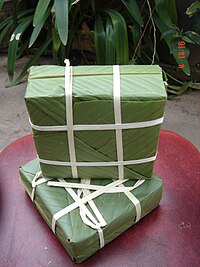
Bantying ( Vietnamese. Bánh chưng , steamed pie) - a dish of Vietnamese cuisine, a cake of glutinous rice , mung bean and pork . Its origin is explained in the legend of Lang Liêu ( Vietnamese. Lang Liêu ) , the heir of the sixth Hungwong ( Vietnamese. Hùng Vương ) . He became a hungwong thanks to the fact that he created bantyang and banzei ( Vietnamese. Bánh giầy ) , symbolizing Heaven and Earth. The preparation and use of banting at the family altar in Tet is a widespread tradition of the Vietnamese. Bantyung is not only eaten on New Year's Eve, it is a delicacy and symbol of Vietnamese cuisine, along with nemran ( Vietnamese. Nem rán ) and pho ( Vietnamese. Phở ) .
Banting
| |||||
|---|---|---|---|---|---|
| Vietnamese | |||||
| Vietnamese language : | bánh chưng | ||||
| cyrillization : | banting | ||||
Content
Legends and Symbolism
According to the Lin Nam tit quai published in 1965 ( Vietnamese. Lamnh Nam chích quái , The Livn Land 's Amazing Narratives) , the bantying was coined by Lang Liu after defeating the Shang dynasty . Hungwyong gathered his sons and ordered them to bring food that would reflect a sincere respect for the ancestors in Tet; the one who presents the most delicious delicacy will become the owner of the country.
The princes were looking for rare products in the sea and forests, Lang Liu, the poorest son of Hungwong, could not afford to buy expensive foods, so he had to cook ordinary foods, rice and pork. In the end, Lang Liuu came up with a square pie symbolizing the earth and a round pie symbolizing the heavens. Hungwyong found the banjing and banzei delicious, but also well conveying respect for their ancestors. Hungwyong passed the throne to Lang Lieu, and the bantying and banzei became traditional dishes for Theta [1] [2] [3] .
Judging by archaeological finds, the bantying was still being prepared during the reign of the Hong Bang dynasty , in the second millennium BC. The form of the bashing and the banzei corresponded to the primitive notions “of a square earth and a round sky” [4] .
You cannot meet Tet without a bashing. Bantying should lie on the family altar to honor the ancestors and ask them to pray for the family in the new year [5] .
Ingredients and Cooking
The essential ingredients of banning are glutinous rice, mung bean, fatty pork, black pepper, and salt. Sometimes green onions are added to the dish. Seasoning is served for nykmam [6] . The cake is wrapped in strips of leaves la zong ( Vietnamese. Lá dong ) , sometimes a form is used for this. Bantyung can also be wrapped in banana palm leaves or, for example, Terminalia catappa [7] . The leaves must be thoroughly washed, soaked in salt water or doused with steam to soften them.
For the preparation of a bow-thing, usually choose expensive high-quality products. Mying beans are soaked in water for two hours, and rice - 12-14 hours. Pork is usually chosen oily, as it is better combined with the taste of rice and mung. Pork is cut into large pieces, then rubbed with pepper, onion or novokamom. In Baknin , a recipe was added with the addition of sugar [8] .
When preparing a banhting, first a square shape is made from banana leaves, into which sticky rice, mung bean, pork, and another layer of rice are placed. Then the cake is carefully wrapped in leaves and tied with separated thin strips. So that the cake does not mold, it is wrapped very carefully.
After preliminary preparations, the banntings are laid out in a pot, filled with water, and then boiled for several hours. Rice adjacent to the leaves turns green [6] . In order to add green color to their banning, some manufacturers even put electrolytes in the pot for banning [9] .
Bantyung is cut into 8 parts separated by thin stripes from leaves [10] . Bantyung is usually served with pickled onions, vegetables, Vietnamese ham ( Vietnamese. Giò lụa , zelua) and fish sauce . Expanded banning remains edible for several more days [10] , and undeveloped banjing for two weeks [11] .
Illustrations
Ingredients for Banting
Wrapping a bow with a form
Detailed banning, cut into 8 parts and ready to be served
Bantyung with Zelois
History and Traditions
Since ancient times, Bantying was considered an obligatory element of the New Year's Eve, which is reflected in the famous duylan : [12] .
Fatty meat, salty onions, red dulyany
Christmas tree, crackers, green bantingOriginal text (vietn.)Thịt mỡ, dưa hành, câu đối đỏ
Cây nêu, tràng pháo, bánh chưng xanh- [12]
Traditionally, they begin to prepare banting for Theta on December 27 or 28. All family members are engaged in preparations: washing the leaves, rubbing pork with spices, cooking mung beans, and most importantly - wrapping the filling in the leaves and cooking. Bantyung need to be cooked from 10 to 12 hours, the family at this time sits by the boiling boiler [12] . In rural areas, for the poor, a month before Theta, they collect money for the hô banthing fund ( Vietnamese họ bánh chưng ) , later the funds are distributed among the members of the fund, so that everyone has a banting table [1] .
In the 21st century, the tradition of self-cooking bantinga gradually dies, as the family has become smaller and its members do not have time to cook. Instead, the Vietnamese began to visit stores where you can buy ready-made bantyangs, or order them from families who specialize in their manufacture. Thus, banning is an indispensable component of the New Year's Eve, but it is no longer a purely family product [12] . Some villages have recently become famous for preparing banting, for example, Chankhuk ( Vietnamese. Tranh Khúc ) and Zuyenha ( Vietnamese. Duyên Hà ) (both located in the Hanoi region of Thanchi ( Vietnamese. Thanh Trì ) [13] [14] .
Every year, on the commemoration day of Kings Hung in the temple of Hung ( Futho ), a competition is held in the preparation of banjing and banzei pies. Participants represent nine regions, including Laokai , Hanoi and Can Tho ; they are given 5 kg of rice, beans and a kilogram of pork, from these ingredients you need to prepare 10 banjing in 10 minutes. The bandages of the winning team are placed on the altar of the holiday [15] . In 2005, Ho Chi Minh City's culinary specialists presented a couple of giant cakes to the Hung Temple: bantyang and bansei, bantyang measuring 1.8 x 1.8 x 0.7 meters and weighing two tons. [16] .
Varieties
Although usually bantyung is eaten warm, it is sometimes fried, such a dish is called bantyang ran ( Vietnamese. Bánh chưng rán , fried bantyang) [17] . Writer Wu Bang mentions bantyung ran in his book Thyong nyo myoi hai ( Vietnamese. Thương nhớ mười hai ) as a dish served in cold February in Hanoi [18] . In some areas, instead of banning , a banquet is prepared, a cylindrical pie with a similar banting filling [12] [17] . In the north of the country bantets are called bantei ( Vietnamese. Bánh tày ) or bantying zay ( Vietnamese. Bánh chưng dài , long banting) [19] [20] . Bantei is cooked with fewer beans and pork, or no pork at all, so it lasts longer. Bantei can also be cut into pieces and fried. The sansiu people make special bantyung with a crest in the middle, they are called bantyng gu ( Vietnamese. Bánh chưng gù ) . Bantyung gu is wrapped not only in ladong, but also in a latit plant ( Vietnamese. Lá chít ) [21] .
There are vegan bantyngs for Buddhists: bantyng chai ( Vietnamese. Bánh chưng chay ) and bantyng ngot ( Vietnamese. Bánh chưng ngọt ) , they start with molasses and brown sugar instead of pork [1] . Rice for their preparation is sometimes mixed with gak , so that the cake turns red. In ancient times, bashing ngot was prepared in poor families who could not afford to buy pork. Instead, cardamom , black pepper and mung bean were put in the pie, the finished dish was used with molasses [22] .
See also
- zongzi
- ttok - Korean rice pastry dish
- ttokkuk - Korean New Year's soup
Notes
- ↑ 1 2 3 Monica Janowski, Fiona Kerlogue. Kinship and food in South East Asia. - NIAS Press, 2007. - P. 251–257. - ISBN 8791114934 .
- ↑ Alice M. Terada, Janet Larsen. Under the Starfruit Tree: Folktales from Vietnam. - University of Hawaii Press, 1993. - P. 105-108. - ISBN 9780824815530 .
- ↑ Spagnoli, Cathy. Asian Tales and Tellers. - August House, 1998. - P. 66–67. - ISBN 0874835275 .
- ↑ History of Vietnam. - Science, 1983 .-- S. 30 .-- 309 p. - 5,000 copies.
- ↑ Agar, Charles. Frommer's Vietnam. - John Wiley and Sons, 2006. - P. 22. - ISBN 0764596764 .
- ↑ 1 2 Chi Nguyen, Judy Monroe. Cooking the Vietnamese Way. - Twenty-First Century Books, 2002. - P. 66–67. - ISBN 0822541254 .
- ↑ Ngô Chí Tùng. Tết ở Trường Sa (Vietnamese) (link not available) . Laodong.com.vn (February 4, 2008). Archived October 24, 2009.
- ↑ Nguyễn Nhã. Bánh chưng ngày Tết (Vietnamese) (inaccessible link) . Tuoitre.com.vn (January 25, 2006). Archived December 23, 2009.
- ↑ Yến Trinh - Võ Hương. Bánh chưng xanh nhờ ... pin? (Vietnam) . Tuoitre.com.vn (February 5, 2007). Archived on September 10, 2012.
- ↑ 1 2 Caitlin Worsham. Banh chung: leafy chunks of love and lore . Vietnamnet.vn (February 10, 2008). Archived July 18, 2009.
- ↑ Pam Mailand, Robert Lewis. Vietnam, young people, old country: primary. - Curriculum Corporation, 1997. - P. 21. - ISBN 1863663819 .
- ↑ 1 2 3 4 5 Laurel Kendall, Nguyễn Văn Huy. Vietnam: journeys of body, mind, and spirit. - University of California Press, 2003. - P. 75–77. - ISBN 0520238729 .
- ↑ Craft village's banh chung gets trademark . Vietnamnet.vn (February 6, 2008). Archived on November 9, 2009.
- ↑ Minh Nguyen. The cake of mystique . Vietnamnet.vn (January 22, 2004). Archived on April 14, 2010.
- ↑ Festival to honor nation's ancestors . Vietnamnet.vn (April 3, 2009). Archived on April 14, 2009.
- ↑ Van Tien. Biggest cakes for Hung Kings . Vietnamnet.vn (April 13, 2005). Archived March 16, 2008.
- ↑ 1 2 Andrea Quynhgiao Nguyen, Bruce Cost, Leigh Beisch. Into the Vietnamese kitchen: treasured foodways, modern flavors. - Ten Speed Press, 2006 .-- P. 259. - ISBN 1580086659 .
- ↑ Vũ Bằng . Tháng Hai, tương tư hoa đào // Thương nhớ mười hai: [ vietnam. ] . - Literature Publishing House.
- ↑ Hội thảo Tết Việt 2005: Tôn vinh VH dân gian (Vietnamese) (link not available) . Vietnamnet.vn (January 31, 2005). Archived on April 15, 2005.
- ↑ Kong Foong Ling. The Food of Asia. - Tuttle Publishing, 2002. - P. 172. - ISBN 0794601464 .
- ↑ Trần Thanh Hà. Xôi đen, bánh chưng "gù" của người Sán Dìu (Vietnamese) (link not available) . Vinhphuc.gov.vn (March 10, 2006). Archived on May 17, 2006.
- ↑ Quang Anh. Bánh chưng mặn, bánh chưng chay và những chiếc ô tô (Vietnamese) (link not available) . Vietnamnet.vn (February 7, 2005). Archived on March 5, 2005.