The plumage of a palm raven is completely black, the top has a noticeable shine of violet and bluish tint, the bottom is paler, less shiny, brown-black. It reaches a length of 43 cm. It is found in large flocks.
According to the results of comparison , palm raven DNA differs by 6% from ordinary raven DNA and by 8-10% from Antillean raven ( C. leucognaphalus ) and Cuban raven ( C. nasicus ).
There are two subspecies, although their external differences are small:
- C. palmarum palmarum (Paul von Württemberg, 1835); actually a palm raven - Hispaniola ;
- C. palmarum minutus (Gundlach, 1852) - Cuba .
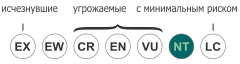
The danger of extinction
In Espanyol, the species abundance decreased due to the widespread deforestation for agriculture and, probably, hunting (for food and sports). However, in some places the view remains quite ordinary; in particular, in the west of the island ( Republic of Haiti ), the threat to its numbers is less, because fewer people own weapons there. In Cuba, the reasons for the decline in numbers are unknown, but there is an assumption that this happened due to the crow crow being replaced by his Cuban congener Corvus nasicus , as the destruction of the habitat led to the overlap of their habitats.
Actions taken to conserve the population:
- ensuring effective protection of the habitat in national parks;
- preventing the deforestation of agricultural forests;
- every obstacle to hunting this species;
- monitoring of the species and study of the effect of hunting on the number of populations, a survey to assess the current prevalence;
- continued research into the reasons for the decline in Cuba.
National parks that participated in this campaign: Sierra de Bahoruco (Dominican Republic) and La Bélen (Najasa, Cuba)
Lives on the island of Haiti (both in the Republic of Haiti and in the Dominican Republic ) and in Cuba .
Palm crows were previously widespread in forested areas from lowlands to mountains in Haiti, but now they are fewer. Nowadays, they are locally found in the Dominican Republic and in Haiti near the Massif de la Selle mountain range, as well as in places where weymouth pine grows.
The Cuban subspecies ( C. p. Minutus ) occupies a very limited area. From time to time, reports of their discovery come from Sierra de Najasa (mountain ranges of the city en: Najasa ), Tayabito, San Miguel, San Pablo, Jimaguayu, Jimanayagua and El Jardín ( Camaguey province). In Najasa, their numbers have declined in recent years. Historically, this subspecies is known from Pan Valley, Guajibon and Vinales Valley ( Pinar del Rio Province), Yaguaramas (near Cienfuegos ), Trinidad Valley and Sierra de Banao ( Sancti Spiritus Province )
In Haiti, birds are usually found in small flocks, feed on the ground or trees with fruits, seeds, insects, snails and lizards, and were even spotted near local grocery stores.
A palm raven arranges its nest on the tops of tall palms, and displays chicks in March - July.
The sound made by a palm raven is described as a rough nasal arrr.