The correct seventeenth angle is a geometric figure belonging to the group of regular polygons . It has seventeen sides and seventeen angles , all its angles and sides are equal to each other, all the vertices lie on the same circle . Among other regular polygons with a large (more than five ) simple number of sides, it is interesting in that it can be built with the help of a compass and a ruler (thus, it is impossible to build seven- , eleven- and thirteen- triangles with a compass and a ruler).
| Seventeen | |
|---|---|
 Regular seventeen | |
| Type of | Regular polygon |
| Ribs | 17 |
| Shlefly Symbol | {17} |
| Coxeter - Dynkin diagram |    |
| Type of symmetry | Dihedral group (D 18 ) order 2 × 18 |
| Inside corner | ≈158.82 ° |
| The properties | |
| convex , inscribed , equilateral , , isotoxic | |
Properties
The central angle α is 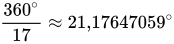
The ratio of the side length to the radius of the circumscribed circle is

A regular seventeenthagon can be constructed using a compass and a ruler , which was proved by Gauss in the monograph Arithmetic Studies (1796). He also found the value of the cosine of the central angle of the hexagon:


In the same work, Gauss proved that if the odd prime divisors of n are different Fermat primes ( Fermat numbers ), that is, primes of the form 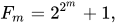
Facts
- Gauss was so inspired by his discovery that at the end of his life he bequeathed that a regular seventeenthagon be carved on his grave. The sculptor refused to do this, claiming that the construction would be so complicated that the result could not be distinguished from a circle.
- In 1893, published an explicit description of constructing a regular seventeenthagon in 64 steps. The following is this construction.
Build
Exact construction
- Draw a large circle k ₁ (the future circumscribed circle of the hexagon) with center O.
- We draw its diameter AB .
- We construct a perpendicular m to it that intersects k₁ at points C and D.
- Mark the point E - the middle of DO .
- In the middle of EO, mark point F and draw a segment FA .
- We construct the bisector w₁ of the angle ∠OFA.
- We construct w₂, the bisector of the angle between m and w₁, which intersects AB at the point G.
- Draw s - perpendicular to w₂ from point F.
- We construct w₃ - the bisector of the angle between s and w₂. She crosses AB at point H.
- We construct the Thales circle ( k ₂) on the diameter HA . It intersects the CD at points J and K.
- Draw a circle k₃ with center G through points J and K. It intersects with AB at points L and N. It is important not to confuse N with M , they are located very close.
- We construct a tangent to k₃ through N.
The points of intersection of this tangent with the original circle k₁ are the points P₃ and P₁₄ of the desired seventagon. If we take the middle of the resulting arc for P₀ and lay the arc P₀P₁₄ three times in a circle, all the vertices of the hexagon will be built.
Approximate construction
The following construction, although approximately, is much more convenient.
- We put a point M on the plane, build a circle k around it and draw its diameter AB ;
- Divide the radius AM in half three times in succession towards the center (points C , D and E ).
- Divide in half the segment EB (point F ).
- draw a perpendicular to AB at point F.
- In short: build the perpendicular to the diameter at a distance of 9/16 of the diameter from B.
The intersection points of the last perpendicular with the circle are a good approximation for the points P₃ and P₁₄.
With this construction, a relative error of 0.83% is obtained. The angles and sides are obtained in this way a little more than necessary. With a radius of 332.4 mm, the side is longer by 1 mm.
Erhinger's Animated Build
Star Shapes
A regular seventeen has 7 regular star shapes.
{17/2}
{17/3}
{17/4}
{17/5}
{17/6}
{17/7}
{17/8}
See also
- Gauss - Wantsel theorem
Links
- Karin Reich . Die Entdeckung und frühe Rezeption der Konstruierbarkeit des regelmäßigen 17-Ecks und dessen geometrische Konstruktion durch Johannes Erchinger (1825). // In: Mathesis, Festschrift zum siebzigsten Geburtstag von Matthias Schramm . Hrsg. von Rüdiger Thiele, Berlin, Diepholz 2000, pp. 101-118.
- Weisstein, Eric W. Hexagon on the Wolfram MathWorld website.