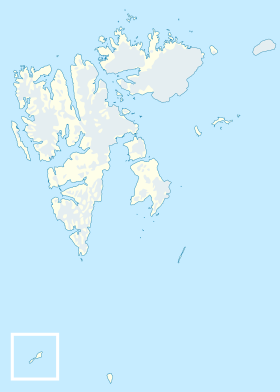
The Thousand Islands Archipelago ( Norwegian. Tusenøyane , Tusenoyane) - a group of small islands south of the island of Edge . They are part of the Svalbard archipelago. The group consists of more than forty islands and islets.
| Thousand Islands | |
|---|---|
| Norwegian Tusenøyane | |
 Map of the Thousand Islands | |
| Specifications | |
| Population | 0 pax (2012) |
| Location | |
| Archipelago | Svalbard |
| Water area | Arctic Ocean |
| A country |
|
| Territory | Svalbard |


History
The Dutchman Joris Carolus was the first to clearly notice a group of small islands south of Edge in 1614 . A Moscow company map (1625) shows an indefinite mass of islands, some of which were named. G. Valk and P. Schenk (c. 1662) were the first to visit them. William Scorsby (1820) is believed to be the first to give them the name Thousand Islands, which has survived to this day. In 1868, Adolf Eric Nordenscheld tried to reach the islands on the Sofia ship, but to no avail. A group of a thousand islands has always been uninhabited. It was only used as a wintering place for Russian whalers in the period from 1700 to 1850 .
Literature
- Conway, WM 1906. No Man's Land: A History of Spitsbergen from Its Discovery in 1596 to the Beginning of the Scientific Exploration of the Country. Cambridge: At the University Press.
- Norwegian Polar Institute: Place names in Norwegian polar areas .
- Purchas, S. 1625. Hakluytus Posthumus or Purchas His Pilgrimes: Contayning a History of the World in Sea Voyages and Lande Travells by Englishmen and others. Volumes XIII and XIV (Reprint 1906 J. Maclehose and sons).