Radiant snake [1] ( lat. Xenopeltis unicolor ) - a species of snakes that lives in Southeast Asia.
| Radiant snake | ||||||||||||||||
|---|---|---|---|---|---|---|---|---|---|---|---|---|---|---|---|---|
 | ||||||||||||||||
| Scientific classification | ||||||||||||||||
| ||||||||||||||||
| Latin name | ||||||||||||||||
| Xenopeltis unicolor Reinwardt , 1827 | ||||||||||||||||
| Synonyms | ||||||||||||||||
|
Appearance
The average size of a snake, the length of adults is usually 60-90 cm, but individuals more than a meter are found. The tail is about 1/10 of the body. The body is cylindrical in shape, the head is flat, adapted for digging. Cervical interception is not pronounced. Eyes are small, turned up.
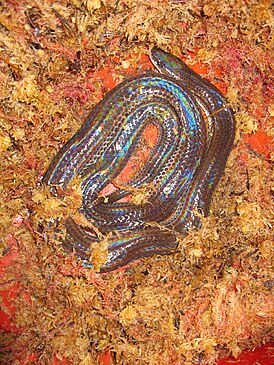
The upper half of the radiant snake's body is painted in dark brown color, the belly is cream or light gray; sometimes the light color of the abdomen extends to the upper lip scales. The scales are large, smooth. Young individuals are similar to adults, but have a white “collar” on their neck. Juvenile coloration persists for up to a year.
A distinctive feature of the radiant snake, for which it received its name, is a rainbow tide, clearly visible even under artificial lighting.
Distribution
It lives in southeastern China , Myanmar , Vietnam , Laos , Cambodia , Thailand , West and East Malaysia , on the islands of Indonesia , Sumatra , Borneo , Java and the Philippines .
Lifestyle
A digging snake, well adapted for living in a layer of loose soil or forest litter. It lives on cultivated fields, forests, orchards, rice fields and other wet biotopes with loose soils or a sufficient layer of leaf litter. It leads a nocturnal lifestyle , in the daytime it hides in holes, under stones and snags.
When meeting a person, he tries to leave. Captured, breaks out and can be protected by the release of fetid liquid from the cloaca (do not confuse this liquid with excrement), sometimes bites.
Nutrition
Can eat a wide range of food objects - amphibians , lizards , snakes , small rodents . Prey is strangled by body rings. Food is swallowed very quickly - this way the snake minimizes its presence above the surface of the soil when it is especially vulnerable.
Reproduction
Very little is known about the reproduction of the radiant snake. This is an egg-laying snake, captive females laid up to 17 eggs. The incubation period is, according to some reports, 7-8 weeks. In captivity, reproduction is extremely rare. In Russia, the successful breeding of these snakes was carried out in the Tula Exotarium .
Significance for man
Non-toxic. Often found in terrariums.
Notes
- ↑ Ananyeva N. B. , Borkin L. Ya. , Darevsky I.S. , Orlov N.L. The five-language dictionary of animal names. Amphibians and reptiles. Latin, Russian, English, German, French. / edited by Acad. V. E. Sokolova . - M .: Rus. Yaz., 1988 .-- S. 365 .-- 10,500 copies. - ISBN 5-200-00232-X .