
Van der Grinten projection for the globe
The Van der Grinten projection is a compromise cartographic projection that is neither isometric nor equiangular. It projects the surface of the earth in a circle, the maximum distortion occurs in the regions of the poles. The projection was proposed by Alfons van der Grinten in 1904. It gained fame when the National Geographic Society in 1922 adopted it as a standard world map. As such, the projection existed until 1988 [1] .
The projection is expressed by the following formulas [2]
- {\ displaystyle x = {\ frac {\ pm \ pi \ left (A \ left (GP ^ {2} \ right) + {\ sqrt {A ^ {2} \ left (GP ^ {2} \ right) ^ {2} - \ left (P ^ {2} + A ^ {2} \ right) \ left (G ^ {2} -P ^ {2} \ right)}} \ right)} {P ^ {2} + A ^ {2}}} \ ,;}

- {\ displaystyle y = {\ frac {\ pm \ pi \ left (PQ-A {\ sqrt {\ left (A ^ {2} +1 \ right) \ left (P ^ {2} + A ^ {2} \ right) -Q ^ {2}}} \ right)} {P ^ {2} + A ^ {2}}},}

Where {\ displaystyle x}  has the same sign as {\ displaystyle \ lambda - \ lambda _ {0}}
  , but {\ displaystyle y}
  - the same as {\ displaystyle \ phi}
  and
and
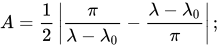
- {\ displaystyle A = {\ frac {1} {2}} \ left | {\ frac {\ pi} {\ lambda - \ lambda _ {0}}} - {\ frac {\ lambda - \ lambda _ {0 }} {\ pi}} \ right |;}
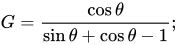
- {\ displaystyle G = {\ frac {\ cos \ theta} {\ sin \ theta + \ cos \ theta -1}};}
- {\ displaystyle P = G \ left ({\ frac {2} {\ sin \ theta}} - 1 \ right);}

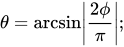
- {\ displaystyle \ theta = \ arcsin \ left | {\ frac {2 \ phi} {\ pi}} \ right |;}
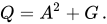
- {\ displaystyle Q = A ^ {2} + G \ ,.}
If a {\ displaystyle \ phi = 0}  then
then
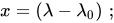
- {\ displaystyle x = \ left (\ lambda - \ lambda _ {0} \ right) \ ,;}
- {\ displaystyle y = 0 \ ,.}

If a {\ displaystyle \ lambda = \ lambda _ {0}}  or {\ displaystyle \ phi = \ pm \ pi / 2}
  then
then
- {\ displaystyle x = 0 \ ,;}

- {\ displaystyle y = \ pm \ pi \ tan {\ theta / 2}.}

In all formulas {\ displaystyle \ phi} - latitude {\ displaystyle \ lambda}  - longitude {\ displaystyle \ lambda _ {0}}
  - the central meridian of the projection.
