John Henry Mackay ; February 6, 1864 , Greenock , Scotland - May 17, 1933 , Berlin ( Germany ) - German writer of Scottish descent, anarchist-individualist .
| John Henry Mackay | |
|---|---|
| John Henry Mackay | |
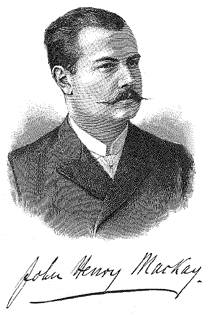 | |
| Aliases | Sagitta |
| Date of Birth | February 6, 1864 |
| Place of Birth | Greenock , Scotland |
| Date of death | May 16, 1933 (69 years old) |
| Place of death | Berlin , Germany |
| Citizenship (citizenship) | |
| Occupation | writer |
| Direction | Political philosophy |
| Genre | Documentary prose |
| Language of Works | |
| Autograph | |
Content
Young years
Born in Scotland, but after the death of his father from the age of two, he lived and was brought up in Germany. At the beginning of his life, he was engaged in book trade , attended university courses, then became interested in literary work .
Literary work
Always slandered, damned, never understood You are the fierce horror of our time. “You are the destruction of all order,” the crowd screams, "War and the rampant spite of the killings." Let them scream. To those who have never sought Find the truth behind the word Those are not given to understand its true meaning. They will remain blind among the blind. But you, oh word, so clear, so strong and pure, You proclaim everything that I set as my goal. I give you to the future! You will live, When everyone wakes up in himself. Will it come in the light of the sun or under the whistle of a storm I can’t say, but the earth will see it. I am an anarchist! Therefore I will not To manage, but I do not want to be controlled. - - John Henry Mackay [2] |
In 1885, he published his first cycle of poems, "Songs of the Mountains," dedicated to his childhood in Scotland. Fame for the young poet brought collections of poems "Arma parata fero" (1886) and "The Tempest" (1888). Meanwhile, the works of Mackay already at that time were distinguished by anarchist rebellious moods. “Arma parata fero” was even banned in Germany on the basis of the law against the socialists , and after the publication of “The Tempest” Mackay was called the “Singer of Anarchy”. At that time he traveled extensively throughout Europe and America , living for a long time in Switzerland , Great Britain , Italy , France and Portugal . [3]
Anarchist novel
The novel "Anarchists" was first published in 1891 in Zurich , the book has withstood dozens of editions in English, French, Dutch, German, Czech and other languages. Only in Russian, a novel was published at least six times, not counting individual passages that appeared at different times. The novel tells of the anarchist movement of the late XIX century. The political views of Mackay are described in detail in the book on behalf of the protagonist Karar Oban.
Soon, Mackay's novels The People of Marriage (1892) and The Last Duty (1893) are published.
Later work
At the beginning of the XX century. in his work he addresses the problem of freedom of relations for sexual minorities . Under the pseudonym "Sagitta" Mackay writes a series of short stories "Books of Nameless Love" (1905-1913), the fantastic story "Holland" (1924), the novel "The Hired Boy" (1926), in which he promotes freedom of homosexual relations between adult men and adolescents. These works were banned in Kaiser Germany , and then in the Weimar Republic . In 1920, the novel “The Seeker of Freedom,” dedicated to Benjamin Tucker , was published. [3]
Political Activities
Since 1890, Mackay was considered the leading representative of the anarcho-individualistic trend in Germany, he published the "Leaflets of individualistic anarchism", and since 1905 - a series of books " Advocacy of individualistic anarchism ." At that time, one of his followers was the philosopher Rudolf Steiner , who later departed from anarchism and became the founder of anthroposophy. [3]
Views
Mackay was a supporter of the ideas of the anarchist-individualist Benjamin Tucker. Mackay devoted two of his most famous novels to him: Anarchists and The Seeker of Freedom. [3]
The ideal of political structure according to Mackay is a stateless society of small private owners building relations on the basis of a free agreement and free unions. So, the fight against crime is made dependent on the organization of self-defense, or hiring security. The economic relations of an anarchist society, according to Mackay, will be based on the principles of a market economy ("free and unrestricted exchange of values inside and out"), which implies free, unlimited competition and the right to private property, based on the seizure and personal work of the individual. He also promoted the ideas of P.-J. Proudhon about the organization of free credit, borrowed his free bank project. Speaking about the means and methods of the struggle for an anarchist society, Mackay strongly denied violence, contrasting it with methods of passive resistance (refusal of citizens to pay taxes and work for government) and propaganda in a word.
Mackay and Stirner
In 1888, while doing research at the British Museum in London, Mackay came across a reference to Max Stirner's work, “The One and His Property,” which was firmly forgotten in Europe at that time. A year later, he managed to get acquainted with the work itself, which made a huge impression on him. [four]
Needless to say, that huge, incomparable impression that this book made on me at that time and subsequently made every connection how I took it. Suffice it to say that, having subtracted from the reference dictionaries scanty and clearly inaccurate information about the author’s life and nowhere finding more accurate and complete data, and meeting only in some places short and fleeting references to him, I made a firm decision to devote part of my life to researching this obviously completely forgotten personality- John Henry Mackay, “Max Stirner, His Life and Work”
In 1889, Mackay published a proclamation through European newspapers in which he addressed everyone “who remembers the impression caused by the appearance of the work“ The One and His Property ”and was in some kind of near or distant contact with Max Stirner ”, with a request to share memories and information about Stirner and his personality. After receiving feedback, Mackay found the house in which Stirner lived the last years of his life, and his grave, which was threatened with complete destruction. [four]
In 1892, having arrived in Berlin, Mackay, with the assistance of Hans von Bülow, who personally knew Stirner and was a fan of his work, erected a memorial plaque on house number 19 on Philipsstrasse and a tombstone on the grave of Stirner. Along the way, he continued to collect materials about the life of the philosopher. After some time, Mackay managed to find Stirner’s widow in London, Maria Dengardt, who had converted to Catholicism by that time and was rather cool about Mackay’s intentions. However, in the correspondence she nevertheless answered some questions and reported some facts from Stirner’s biography. [four]
In 1898, the book "Max Stirner, His Life and Work" was published. Like the novel Anarchists, he also withstood a large number of reprints, two of them in Russia. [3]
The almost impenetrable veil that hid the life of Max Stirner from us still has not fallen - and we must forever abandon the hope of seeing his image in full daylight, as if alive.But this cover, nevertheless, has become more transparent, and this image now seems to us not so alien as before; there are times when it seems to us that we came very close to him: we hear Stirner speaking in his composition
- John Henry Mackay, “Max Stirner, His Life and Work”
Mackay Foundation at RGASPI
Materials about Stirner, which John Henry Mackay has collected for many years, are currently in the Russian State Archive of Socio-Political History (RGASPI) . [3]
In the mid-1920s, Mackay was in a difficult financial situation, and in 1925 his materials on working on Stirner’s biography on the initiative of D. B. Ryazanov , director of the Institute K. Marx and F. Engels, were bought for four thousand francs, and in June 1925 he entered the archive of the Institute. [3]
In RGASPI there is a special archival fund of Mackay. [3]
Major works
- 1885 - "Songs of the Mountains"
- 1886 - Arma parata fero
- 1888 - The Tempest
- 1891 - The Anarchists
- 1892 - The People of Marriage
- 1893 - The Last Debt
- 1898 - "Max Stirner, his life and work"
- 1905-1913 - “Books of anonymous love”
- 1920 - The Seeker of Freedom
- 1924 - The Netherlands
- 1926 - The Hired Boy
Notes
- ↑ BNF ID : 2011 Open Data Platform .
- ↑ Cit. according to the book E. Goldman Anarchism / Per. from English - M.: Voice of Labor, 1920
- ↑ 1 2 3 4 5 6 7 8 D.I. Rublev. Max Stirner and his biographer John Henry Mackay // ed. Mackay J.G. Max Stirner: His life and work . Per. with him. Vol. 2, add. M .: URSS - 2010.208 s. ISBN 978-5-397-00965-2
- ↑ 1 2 3 Mackay J.G. History of my work. 1888-1897 // in the ed. Mackay J.G. Max Stirner: His life and work . Per. with him. Vol. 2, add. M .: URSS - 2010.208 s. ISBN 978-5-397-00965-2