SS 20th Grenadier Division (1st Estonian) ( German: 20. Waffen-Grenadier-Division der SS (estnische Nr.1) ) - Estonian SS troops division , formed in February 1943. In accordance with the SS troop charter, manning was made on a voluntary basis, and those who wanted to serve in this unit should, for health and ideological reasons, meet the requirements of the SS troops.
| 20th SS Grenadier Division (1st Estonian) | |
|---|---|
 Emblem of the 20th Grenadier (1st Estonian) SS Division | |
| Years of existence | February 8, 1943 - May 11, 1945 |
| A country |  Germany Germany |
| Subordination | Reich Commissariat Ostland |
| Included in | SS troops |
| Type of | grenadiers , special forces |
| Number | 11 thousand people (1942) no more than 3 thousand people (May 1945) |
| Motto |
|
| Colors | blue , black and white |
| March | Laul surnupealuu sõdurist |
| Participation in | World War II :
|
| Marks of Excellence | 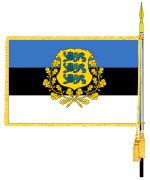  |
| Commanders | |
| Famous commanders |
|
Formation History
The beginning of the formation of Estonian regular units for participation in hostilities on the side of Nazi Germany was laid on August 25, 1941, when, in accordance with the order of the commander of the Army Group North, Field Marshal von Leeb was allowed to take the Baltic states to serve in the Wehrmacht and create special ones teams and volunteer battalions for anti-guerrilla warfare [1] . In this regard, Colonel General von Kühler, Commander of the 18th Army , out of scattered Omakaitse detachments, 6 Estonian security detachments were formed on a voluntary basis (with a 1-year contract). At the end of that year, all six units were reorganized into three eastern battalions and one eastern company.
In addition to the aforementioned units for the security service and the fight against the partisan movement in the rear of Army Group North, in September 1941 the German command began the formation of Estonian auxiliary police battalions (“noise”). In total, during the war in Estonia, 26 battalions of “noise” were formed. Unlike similar units in Ukraine and Belarus , in which the entire command staff consisted of Germans, there was only one German observer officer in Estonian police battalions manned by national personnel. An indication of the Germans' particular confidence in the Estonian police battalions was the fact that the military ranks of the Wehrmacht were introduced there. On October 1, 1942, all Estonian police forces amounted to 10.4 thousand people, to whom 591 Germans were seconded.
Police and eastern battalions were used primarily to carry out punitive actions against the civilian population, to combat the partisan movement and to guard concentration camps.
The direct formation of the Estonian SS legion began only on February 8, 1943 , and until that time, preparatory work was carried out by the efforts of the German authorities and local collaborators. During this time, the "Society of Friends of the Estonian SS Legion" was created, which was entrusted with the work of recruiting and primary training of volunteers.
In accordance with the charter of the SS troops, the Estonian SS legion was manned on a voluntary basis, and those who wished to serve in this unit had to meet the requirements of the SS troops for health and ideological reasons. After the probationary period, persons who were enlisted in the legion and previously had officer and non-commissioned officer ranks were assigned the corresponding military ranks of the SS troops. Those who entered the legion were sent to a training center in Debitz , where after 3 months of study, they took the oath of allegiance to Nazi Germany . By March 31, 1943, the legion numbered 37 officers, 175 non-commissioned officers and 757 soldiers of Estonian nationality. It also included 2 senior, 24 junior officers and 62 privates of the special Ostland battalion.
According to archival documents of the German command of that period, the 3rd Estonian SS volunteer brigade, together with other units of the German army, carried out punitive operations “Heinrik” and “Fritz” to liquidate the Soviet partisans in the area of Polotsk - Nevel - Idritsa - Sebezh , which took place in October December 1943 TsGA of the Lithuanian SSR, f. R-1399, op. 1, unit x.61, personal file No. 195. According to the same archive, 288, 286, 313 and other Estonian police battalions that were part of the Estonian SS brigade also took part in the punitive expedition “Fritz”. They participated in battles with partisans, executions of civilians, robberies, the destruction of entire villages in Belarus and the mass sending of civilians to Germany. In the same place, f.240, op.1 d.7, personal file 52-55) The punitive raids of the 3rd Estonian SS brigade continued until the end of December 1943. [2]
History of the 20th SS Grenadier Division
Statistics
Replenishment of a division with manpower
The 20th SS Grenadier Division was formed in the spring of 1944 from various Estonian military units and recruits mobilized after the moment the division was announced [3] [4] .
| Action date | Formation | Source of personnel |
|---|---|---|
| March 31, 1944 | 4th Battalion of the 20th SS Division | Personnel of the SS Beneschau Artillery School |
| April 4, 1944 | The personnel of the 20th SS artillery regiment; 2nd and 3rd battalion of the division | The 53rd SS Artillery Battalion and recruits. |
| April 1944 | The regiment "Tallinn" | Recruits of 1944 draft |
| April 1944 | 1st border regiment | Recruits of 1944 draft |
| April 1944 | 2nd border regiment | Recruits of 1944 draft |
| April 1944 | 3rd border regiment | Recruits of 1944 draft |
| April 1944 | 4th border regiment | Recruits of 1944 draft |
| April 1944 | 5th Frontier Regiment | Recruits of 1944 draft |
| April 1944 | 6th border regiment | Recruits of 1944 draft |
| April 1944 | Reserve Border Regiment | Recruits of 1944 draft |
| April 1944 | 20th SS Artillery Regiment, 1st Battalion | 53rd SS Artillery Battalion |
| April 13, 1944 | SS Signal Battalion 20 | 20th Signal Company and Recruits |
| April 14 1944 | 2nd battalion of the 45th SS grenadier regiment: reinstatement | 1st battalion of the SS "Revel" border regiment |
| April 18, 1944 - early May 1944 | 3rd battalion of the 46th SS grenadier regiment | 660th East Wehrmacht battalion and recruits. |
| April 18, 1944 | 20th Volunteer Fusilier Battalion of the SS Division (Separate Infantry Battalion) | Former “Narva” battalion of the 5th SS Viking Panzer Division and recruits. |
| April 24, 1944 | 1st battalion of the 47th SS grenadier regiment | Former 659th East Wehrmacht battalion and recruits. |
| April 24, 1944 | 2nd Battalion of the 47th SS Grenadier Regiment | Former 658th East Wehrmacht battalion and recruits. |
| May 3, 1944 - July 10, 1944 | 20th SS Anti-Tank Battalion | 14th anti-tank company (as the 1st company of the 20th battalion of the 45th regiment) and recruits. |
| April 16, 1944 | 20th Transport Company SS | |
| April 16, 1944 | 1st Transport Company of the 20th SS Division | |
| April 16, 1944 | rear forces of the 20th SS division | |
| April 16, 1944 | 20th SS Supply Company | |
| May 3, 1944 | New 14th anti-tank company of the 45th SS Grenadier Regiment | Division anti-tank platoon and recruits. |
| May 4, 1944 | 20th Light Artillery Supply Column | before that was under the command of the 20th Air Defense Battalion |
| May 8, 1944 | 1st mechanized medical company of the 20th SS division | 20th SS Medrot and recruits |
| May 8, 1944 | 2nd mechanized medical company of the 20th SS division | 1st platoon of the 20th medical company SS and recruits. |
| May 15, 1944 | 2nd Transport Supply Company of the 20th SS Division | Formed from the personnel of the field reserve battalion |
| May 17, 1944 | rear company of the 20th SS division | Troops of the 3rd battalion of the 46th grenadier regiment |
| June 1, 1944 - July 13, 1944 | 20th SS Engineering Battalion | 3rd engineering company of the 20th SS division and recruits. |
| July 1944 | 3rd battalion of the 25th SS grenadier regiment | 200th Finnish Army Infantry Regiment |
Connection Rename History
- Estnische SS Legion 10.1942 - May 1943Buttonhole officer of the 20th SS division. One can see the emblem of the division (symbolism of the insignia of the Liberation War of 1918-1920) , worn without official sanction. Initially, emblems cut out of tin were attached, later in some cases they began to be embroidered. The Germans tried to ban the use of such emblems, demanded to wear standard SS runes on the buttonholes, the required number of which, however, could not be provided for the entire division. In June 1944, the command of the SS was ordered to remove the "non-statutory" emblems and replace them with officially installed ones - with a capital "E" and a sword crossing it at an angle of 45 °. In this case, until May 1945, many were worn and "non-statutory" emblems [5] .National Patches - located under the SS eagle on the left sleeve, but some Estonian SS men carried it on the right sleeve.Less common version of the shield with three lions. There was another option with colored stripes sewn from colored fabrics on which metal lions were attached [6] .Cuff tape; was distributed in the 45th regiment of the 20th SS division
- Estnische SS Freiwilligen Brigade May 1943 - October 1943
- 3.Estnische SS Freiwilligen Brigade October 1943 - January 1944
- 20.Estnische SS Freiwilligen Division January 1944 - May 1944
- “20.Waffen Grenadier Division der SS (estnische Nr. 1)” May 1944 - May 1945
Command
- SS brigadeführer Franz Augsberger ( German: Franz Augsberger ) 24.1.1943 - 03.19.1945
- Oberführer SS Maak ( German: Maack ) 19.3.1945 - 8.5.1945
Division Composition
For 1943
- 45th Grenadier Regiment SS ( German: Waffen-Grenadier Regiment der SS 45 )
- 46th Grenadier Regiment SS ( German: Waffen-Grenadier Regiment der SS 46 )
For 1944
- 45th Grenadier Regiment SS ( German: Waffen-Grenadier Regiment der SS 45 )
- 46th Grenadier Regiment SS ( German: Waffen-Grenadier Regiment der SS 46 )
- 47th Grenadier Regiment SS ( German: Waffen-Grenadier Regiment der SS 47 )
- 658th Estonian battalion (general army unit) ( German 658.Estonische Battalion (Heer) )
- 659th Estonian battalion (all-army unit) ( German 659.Estonische Battalion (Heer) )
- 20th SS Fusilier Battalion ( German: SS-Füsilier Battalion 20 )
- SS Volunteer Tank Grenadier Battalion Narva ( German: SS-Freiwilligen-Panzer-Grenadier-Batallion Narwa )
- 20th SS Artillery Regiment ( German: Waffen-Artillerie Regiment der SS 20 )
Creation Initiative
The initiative to create the Estonian national SS unit and its detailed formation belongs to the head of "Estonian self-government" H. Mäe , who made an appeal on August 26, 1942 with a call to create the Estonian SS legion. A few days later, the Estonian General Commissioner Karl Sigmund Litzmann announced the order of A. Hitler on the formation of the “Volunteer Estonian SS Legion”, created as part of the German SS troops subordinate to the SS Reichsfuhrer G. Himmler [7] .
History in 1944
At the beginning of 1944, it was decided to increase the Estonian contingent of SS troops due to the inclusion of battalions from the Wehrmacht and the most combat-ready police units, which would make it possible to organize a full-fledged division. The newly formed division was named the 20th Estonian SS Volunteer Division on January 24, 1944 (since May 26, 1944 , the “20th SS Grenadier Division - Estonian No. 1”). In April, the Narva battalion withdrawn from the Viking division, renamed the 20th SS fusilier battalion, was transferred to it. In addition, the connection included an artillery regiment and an engineer battalion, as well as companies: anti-aircraft, anti-tank and communications. The total number of the division reached 15 thousand soldiers and officers.
In the summer of 1944, the 20th SS Division took part in battles with units of the Red Army, including the 8th Estonian Rifle Corps , near Narva and Sinimäe ( Narva Operation ). Narva was liberated by Soviet troops on July 26. As of September 1944, the division numbered 15,400 fighters, a third of which were volunteers [8] . In the Rakvere region ( Tallinn operation ), the division suffered heavy losses. In September 1944, the remnants of it were sent to a training camp in the German city of Neuhammer , where in October 1944, the 20th Estonian Division was re-formed from disparate units, as well as officers from the Estonian Luftwaffe units disbanded in East Prussia [9] . SS as part of the three Estland SS grenadier regiments.
1945 year. Destruction
Until January 1945, units of the division participated in battles in East Prussia . On January 13, 1945, the entire division was sent to the front in the area of the German city of Wittenberg , where, together with other German formations, it was surrounded by units of the Red Army.
With battles, the division left the encirclement and retreated to Czechoslovakia , where it remained until the complete defeat of the German troops. May 11, 1945 near the town of Melnik , near Prague , the bulk of the personnel was captured by units of the Red Army [10] . However, part of the Estonian soldiers and officers (including 3 thousand people from the reserve training regiment of the division) retreated to the west and surrendered to the Anglo-American troops.
Awarded the Knight's Cross of the Iron Cross
Knight's Cross of the Iron Cross (6)
- Alphonse Rebane - February 23, 1944 - SS Obersturmbannführer, commander of the 46th SS Grenadier Regiment.
- Harald Nugisex - April 9, 1944 - SS Unterscharführer, platoon commander of the 1st company of the 46th SS Grenadier Regiment.
- Paul Maitla - August 23, 1944 - SS Sturmbannfuhrer, commander of the 1st battalion of the 45th SS Grenadier Regiment.
- Harald Riypalu - August 23, 1944 - SS Obersturmbannführer, commander of the 45th SS Grenadier Regiment.
- Franz Augsberger - March 8, 1945 - SS brigadefuhrer, commander of the SS division.
- Bernhard Langhorst - April 5, 1945 - SS Sturmbannfuhrer, commander of the 20th SS anti-tank division.
Knight's Cross of the Iron Cross with Oak Leaves (1)
- Alphonse Rebane - May 9, 1945 - SS Obersturmbannführer, commander of the 46th SS Grenadier Regiment.
After World War II
Service in Allied Militias in Germany
After the war in the western occupation zones of Germany, the command of the US and British forces formed a number of paramilitary groups consisting of refugees and prisoners of war - citizens annexed by the Soviet Union of the Baltic states. These groups included relatively fewer Estonians than Latvians and Lithuanians, probably due to the fact that there were few refugees from Estonia in the western occupation zones and the Estonian 20th SS division suffered heavy losses at the end of the war, being encircled in Czechoslovakia . So in the British Rhine army for a short time there were only three Estonian watch platoons. For the first time, Estonians together with Latvians were involved in a watch platoon formed in the suburb of Nuremberg Fürth in late June 1946. At the beginning of 1947, the 4221st Estonian watch company ( Guard Company ) began guarding war criminals at the Nuremberg Palace of Justice [12] .
In addition to watchdog units, several Estonian construction companies were also formed. Общее число эстонцев задействованных в послевоенных вспомогательных подразделениях союзников, за всё время их существования, оценивается приблизительно в 5000 человек [12] .
Современные оценки эстонских соединений войск СС
Согласно опубликованному на сайте МИД Латвии мнению докторов исторических наук Инесиса Фелдманиса и Карлиса Кангериса, автора статьи в газете эстонских эмигрантов в Канаде «Эстонская жизнь» ( эст. Eesti elu ) Тыну Наэлапеа, а также известного своими публикациями в защиту эстонских легионеров СС Марта Лаара и создателей фильма о бывших легионерах СС в Нюрнберге «Забытые солдаты» ( эст. Mehed Unustatud Armeest ), в 1946 году при английской и американской армиях из бывших латышских и эстонских легионеров СС были основаны т. н. сторожевые роты [13] [14] [15] [16] .
Современная историография за пределами России в качестве юридической базы для оценок эстонских соединений войск СС, как правило, ссылается на приговор Международного военного трибунала от 1 октября 1946 года и документ Высшей комиссии США в Германии. Так, 13 апреля 1950 года руководством «Высшей Комиссии США в Германии» ( англ. US High Commission in Germany (HICOG) ) и государственным секретарём США Джоном Макклоем, был подписан документ, в частности, указывалось [17] :
Балтийские части войск СС (Балтийские легионы) должны рассматриваться отдельно, у балтийских легионов были отличные от немецких частей СС цели, идеология, действия и условия членства; поэтому Комиссия не считает это движение враждебным Правительству Соединённых Штатов.
Original textThe Baltic Waffen SS Units (Baltic Legions) are to be considered as separate and distinct in purpose, ideology, activities, and qualifications for membership from the German SS, and therefore the Commission holds them not to be a movement hostile to the Government of the United States
Напротив, МИД России считает, что решения Иммиграционной комиссии США являются внутренним американским документом, и совершенно неправомерно считать его законным основанием для реабилитации всех служивших в СС. Отмечается, что после капитуляции Германии часть перебравшихся на запад легионеров использовалась американскими разведывательными службами в « холодной войне » против Советского Союза [18] .
Слёты ветеранов войск СС
Каждый год, со времён обретения независимости, на территории Эстонии организуется слёт ветеранов войск СС . Так очередной слёт прошёл 28 июля 2007 года у высот Синимяэ , где летом 1944 года проходили самые ожесточённые бои на территории Эстонии во Второй мировой войне. Ветераны под штандартами частей, в которых они воевали, выслушали молитву пастора Александровской лютеранской церкви города Нарва Велло Юрье. Пастор заявил, что эстонцы, воевавшие в гитлеровской армии, «проливали кровь за вечные истины» [19] . Среди примерно 250—300 [20] собравшихся были также ветераны войск СС из Норвегии и Австрии . Мероприятие проходило под усиленной охраной полиции, которая проверяла прибывающих ещё задолго до Синимяэ. Министр обороны Эстонии Яак Аавиксоо направил приветствие проходящему в субботу в волости Вайвара слёту ветеранов 20-й дивизии СС: «Государство нуждается в защите и сейчас. Подтверждением тому являются недавние события в Эстонии», — заявил министр, указав на прошедшие в конце апреля массовые беспорядки, вызванные переносом памятника советским воинам . Глава военного ведомства сравнил ветеранов дивизии войск СС с участниками освободительной войны 1918 — 1920 годов , в ходе которой была закреплена независимость Эстонии.
Для участников Второй мировой войны, воевавших в составе немецкой армии, это была вторая освободительная война за нашу независимость.
— обращение Министра обороны Эстонии Аавиксоо к слёту ветеранов СС [21] .
Documentary
See also
- Таллин (полк)
Notes
- ↑ Hoffman J. Die Ostlegionen 1941—1943. Freiburg, 1976, s.18-19
- ↑ ЦА ФСБ. Ф.25 Оп. 1. Д. 152. Л.258
- ↑ [ Хронология на suomenpojat.fi (фин.) (недоступная ссылка) . Дата обращения 3 августа 2007. Архивировано 6 апреля 2008 года.
- ↑ THE 20TH DIVISION Архивная копия от 9 июня 2007 на Wayback Machine at IHC
- ↑ Дробязко С. И.: Вторая мировая война 1939—1945. Восточные добровольцы в вермахте, полиции и СС. — М.: ООО «Издательство АСТ», 2000. — (Военно-историческая серия «СОЛДАТЪ»)
- ↑ Aleks Kivinuk. Eesti sõjalised. Autasud ja rinnamärgid 1918—1940. — Tallinn: 2005.
- ↑ РГВА. Ф 451, Оп.7 Д.123. Л.299
- ↑ Каасик П. Эстонский легион . Эстоника (7.11.2009). Дата обращения 31 июля 2014.
- ↑ Laar Mart — Eesti sõdur II Maaimasõjas. — Kirjastus Grenader, Tallinn 2009 l.468
- ↑ Ready J. Lee. The Forgotten Axis. Germany's Partners and Foreign Volunteers in World War II. Jefferson, North Carolina and London, 1987 . R. 491
- ↑ Diamond Law Library Архивная копия от 22 июня 2010 на Wayback Machine , Pictured here in one of the wings of the Nuernberg Prison, discussing guard matters are, left to right, Technical Sergeant Edward Gibson, chief warden of Newark, New Jersey; Corporal James Kelley, escort sergeant, from Madison, Georgia; and First Lieutenant Warren GH Crecy, prison officer, from Corpus Christi, Texas. Behind them, peering into individual cells, are Baltic guards utilized by the US Army to supplement American personnel in such work.
- ↑ 1 2 Kukainis, V. Baltiešu, vācu, poļu un citu tautību palīgvienības ASV armijā un citās armijās pēckara Vācijā (латыш.) // Latvijas Kara muzeja gadagrāmata. — 2006. — S. VII . — L. 295-315 . — ISBN 9-799984-965740.
- ↑ О латышском добровольческом легионе СС , Dr.hist Инесис Фелдманис, Dr.hist. Карлис Кангерис]]
- ↑ Esprits de corps — Nuremberg Tribunal Guard Co. 4221 marks 56th anniversary
- ↑ Mart Laar. Sinimäed 1944: II maailmasõja lahingud Kirde-Eestis (Sinimäed 1944: Battles of World War II in Northeast Estonia). — Tallinn: Varrak, 2006.
- ↑ Документальний фильм «Забытые солдати» , ( эст. Mehed Unustatud Armeest ).
- ↑ Справка на сайте МИД Латвии
- ↑ Об участии эстонского легиона СС в военных преступлениях в 1941—1945 гг. и попытках пересмотра в Эстонии приговора Нюрнбергского трибунала
- ↑ Лютеранский пастор назвал эстонских эсэсовцев борцами за вечные истины
- ↑ В Эстонии бывшие эсэсовцы провели традиционный ежегодный сбор
- ↑ Министр обороны Эстонии приветствовал ветеранов СС
Literature
- Jurs, August. Estonian freedomfighters in World War Two. — ISBN 096948271X ; ISBN 978-0969482710 .
- Tieke, Wilhelm. Tragedy of the Faithful: A History of III. (Germanisches) SS-Panzer-Korps. — 482 с. — ISBN 0921991614 .
- Landwehr, Richard. Estonian Vikings.
- Wendel, Marcus. 20. Waffen-Grenadier-Division der SS (estnische Nr.1) . — 2005.
- 20. Waffen-Grenadier-Division der SS (estnische Nr.1) . . Статья на немецком языке на www.lexikon-der-wehrmacht.de. Retrieved June 2, 2005.
- Conclusions of the Estonian International Commission for the Investigation of Crimes Against Humanity - Phase II: The German occupation of Estonia in 1941-1944
- Estonia. The bloody trace of Nazism: 1941-1944. Collection of archival documents
- Zalessky K.A.S. Security detachments of the NSDAP. - M .: Eksmo , 2005 .-- 672 p. - 5,000 copies. - ISBN 5-699-09780-5 .