Failure is a natural well of karst-tectonic origin on the southern slope of Mount Mashuk in Pyatigorsk [1] . The well is a cone-shaped funnel 41 m high, at the bottom of which is a karst lake of turquoise mineral water .
| Lake | |
| Failure | |
|---|---|
| Location | |
| A country |
|
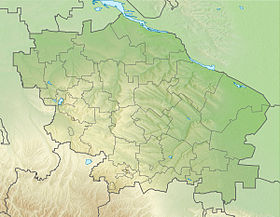
| The subject of the Russian Federation | Stavropol region |


Content
Description
Failure is an underground cave formed under the influence of mineral waters. The hydrogen sulfide contained in them, evaporating, gradually destroyed the limestone rock. As a result, the cave vault could not stand it, and a funnel with a diameter of about 15 meters, a grotto and a lake with a depth of 11 meters formed. The beautiful turquoise color of the mineral water that fills the reservoir is due to the high sulfur content (which causes a very unpleasant odor) and the presence of certain bacteria in it [1] . Water temperature from 26 ° to 42 ° C.
History
The failure was first investigated by Peter Simon Pallas in 1793. The scientist studied the cave from above, measured the depth of the funnel and described its appearance. At that time, at the bottom of the failure there were two lakes connected by a narrow strait.
Locals called the lake “hellish abyss” and believed that it was inhabited by a fire-breathing monster that circled the city at night in search of victims. Nevertheless, one of the funs of the “water society” was dancing over the abyss: on the initiative of Prince V. S. Golitsyn, the architects brothers Bernardazzi built in 1837 a platform over the Failure, on which everyone danced a quadrille [1] . In 1837, on the initiative of Prince Golitsyn, a bridge was built over the cave, from which a basket of tourists descended.
The first descent into Failure for scientific purposes was carried out in 1857. The famous mineral water researcher Fedor Alexandrovich Batalin , the director of the Tiflis Physical Observatory A. F. Moritz , topographic officers and surveyors took part in it [1] . The depth of the lake, temperature and composition of the water were measured.
After breaking through a tunnel with a length of about 58 m in 1858, access to the lake became much easier, the number of visitors increased many times, and water was taken for medicinal purposes.
In 1864, there was an unprecedented inflow of water in Lake Failure. Water flowed directly through the tunnel and reached two thousand buckets per hour [2] .
In 1866, the site at the entrance to the failure is fenced with a stone wall [3] .
After the ceremonial consecration of the tunnel and the lake in 1885 in the grotto of failure, the icon of the Mother of God “ Joy of All Who Mourn ” was installed in a special niche, which was then replaced by the icon of the Great Martyr and Healer Panteleimon [4] .
The sculptures of two lions guarding the entrance to the cave were made according to the sketch of I.F.Shakhovskaya and were installed in the middle of the 20th century. In 2008, a metal sculpture of Ostap Bender with a chair from the book “ Twelve Chairs ” was also set at the entrance, in the story of which the main characters visit Pyatigorsk [1] .
Gallery
Failure Scheme. Engraving of 1837
Failure in 1859
Sculpture of Ostap Bender at the entrance
Tunnel to Lake Failure
Lake inside
View from the dip from the bottom up
Reflection in Art
M. Yu. Lermontov wrote in " Princess Mary " [5] :
“In the evening, a large society went on foot to Failure. According to local scholars, this failure is nothing but an extinct crater; It is located on the slope of Mashuk, a mile away from the city. A narrow path between shrubs and rocks leads to it ... ”.
In the work of Ilf and Petrov, “ Twelve Chairs ” (1927), Ostap Bender was very surprised to learn that “the city has not yet guessed to take dimes for the entrance to the failure” [6] and started selling tickets. A year after the release of The Twelve Chairs, they really began to charge a fee. Entrance to Failure is now free.
In the film adaptation of The Twelve Chairs (1971), L. I. Gaidai played the role of Failure by Lermontov's Grotto in Pyatigorsk [7] .
Notes
- ↑ 1 2 3 4 5 Lake Failure . Culture.RF . www.culture.ru. Date accessed August 23, 2019.
- ↑ Newspaper Pyatigorskaya Pravda. April 2, 2015. No. 40 [8261]
- ↑ Newspaper Pyatigorskaya Pravda. December 11, 2014. No. 223 [8198]
- ↑ Lake of Failure . CMS Line. Date of treatment June 25, 2013. Archived June 30, 2013.
- ↑ Mikhail Yurievich Lermontov. Complete works / Irakliy Andronikov. - M .: True, 1953. - T. 4. - S. 248. - 536 p.
- ↑ I. Ilf, E. Petrov. Twelve Chairs; Golden calf. - M .: OLMA Media Group, 2003 .-- S. 199. - 637 p. - ISBN 9785948500836 .
- ↑ “12 Chairs”: O. Bender collects money from “Failure” . YouTube (01/12/2010). Date accessed August 23, 2019.
Literature
- Pyatigorsk in historical documents, 1803-1917 / S. And Nesmachnaya. - Stavropol Book Publishing House, 1985. - 350 p.
- Pyatigorsk / V.A. Manuilov. - Lermontov Encyclopedia. - M .: Soviet Encyclopedia , 1981. - S. 457. - 784 p.