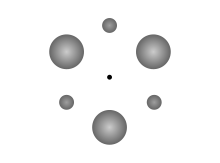
Rosetta Klemperera is a gravitational system of light and heavy bodies orbiting in regularly repeating orbits around a common center of mass . It was first described by Wolfgang Klemperer in 1962 [1] . Klemperer described the system as follows: “Such symmetry is also inherent in a peculiar family of geometric configurations, which can be described as“ rosettes “. They contain an even number of “planets” of two (or more) types, one (or several) sets of which are heavier than others, and all planets belonging to the same set (having the same mass) are located in the corners of two (or more) alternating regular polygons so that light and heavy alternate (or follow each other in a cyclical manner). ”
The simplest rosette will consist of a series of four alternating heavy and light bodies located at an angular distance of 90 degrees from each other, in a rhombic configuration [heavy, light, heavy, light], and two heavy bodies have the same mass as two light bodies. The number of types of bodies by mass can be increased while the arrangement remains cyclical: for example, [1,2,3 ... 1,2,3], [1,2,3,4,5 ... 1,2,3,4, 5], [1,2,3,3,2,1 ... 1,2,3,3,2,1]. Klemperer mentioned octagonal and rhombic rosettes.
Content
Misuse
The term “Klemperer rosette” (often in misspellings: “Kemplerera rosette”) is often used to describe a configuration of three or more equal masses located at the vertices of an equilateral polygon having the same angular velocity relative to their center of mass . Klemperer mentions such a configuration at the beginning of his article, but only as a representative of the already well-known set of equilibrium systems, before describing the rosette itself.
In Larry Niven's novel Mir-Ring , the " fleet of worlds " of Pearson's puppeteers is located in such a configuration (5 planets at the tops of the pentagon ), which Niven calls the Kemplerera Rosette. This (possibly intentional) distorted spelling (and erroneous use) may be the source of such a misunderstanding. Another possible source of spelling distortion is the similarity between the names of Kemplerer and Johannes Kepler , who described the laws of planetary motion in the 17th century.
Instability
Modeling of this system [2] (or a simple linear analysis of perturbations) shows that such a system is certainly unstable: any deviation from the ideal geometric configuration causes oscillations that ultimately lead to the destruction of the system (Klemperer also notes this fact in the original article) . The result does not depend on whether there is an empty space in the center of the rosette, or whether it revolves around a star.
The instability is explained by the fact that any tangential perturbation leads to the fact that one of the bodies approaches one of its neighbors and moves away from the other, as a result of which the force of attraction to the nearest neighbor becomes larger, and with respect to the far neighbor it becomes smaller, as a result bringing the perturbed object begins to move towards its nearest neighbor, which increases the perturbation, but does not compensate for it. The radial perturbation directed inward causes the perturbed body to become closer to all other objects, as a result of which their interaction force and orbital velocity increase, which indirectly leads to tangential perturbation (the result of which is described above). Thus, the Rosetta Kukolnikov described by Larry Niven would require artificial stabilization.
Notes
- ↑ Klemperer, WB Some Properties of Rosette Configurations of Gravitating Bodies in Homographic Equilibrium // Astronomical Journal : journal. - 1962 .-- April ( vol. 67 , no. 3 ). - P. 162-167 . - DOI : 10.1086 / 108686 . - .
- ↑ Jenkins, Bob Klemperer Rosettes . Date of treatment January 12, 2007. Archived on September 8, 2012.