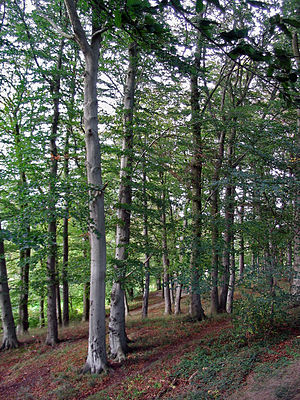
Beech forest - a forest with a predominance of beech [to 1] .
Beech is the main forest-forming species of European forests. More often than other broad-leaved species, it forms pure forest stands [1] , and is also part of mixed forest stands with dark coniferous and other broad-leaved species, forming a second tier in them. European beech in Europe forms its own zone of beech forests, which occupies both plain and mountainous areas; in the mountains, beech forests often serve as the upper boundary of the mountain forest belt . The beech range is determined by climatic and soil conditions. If in the center of its range it does not have competitors from other tree species, then when approaching its borders it gives way to hornbeam , oak , and coniferous species . European beech grows in Europe from the UK , northern Spain in the west to the Kaliningrad region , Poland , western Ukraine , southern Crimea in the east and from southern Norway and Sweden in the north to northern Sicily , Central Albania , Greece in the south.
On steep mountain slopes, beech forests have great soil protection and water conservation significance. In forestry, beech is valued as a forest-forming, climate-regulating and soil-improving breed . Beech forest had a great influence on the culture of the peoples inhabiting Europe. Its aesthetic impact is still appreciated: many sanatoriums and rest houses have been built in beech forests.
In the past, beech forests in Europe occupied a vast territory. As a result of human economic activity, they were mostly exterminated. If earlier, on the site of cut down beech forests, other types of trees were planted, now foresters are returning to their restoration due to the great value of this type of forest. Natural beech forests are protected in many European countries. See also Protected forests with European beech .
Title
The following names are used:
- beech forest - in biology, in the territory of Moldova and Podolia [2] ;
- buknyak - in ecology;
- Buchina ( Fagetum ) - in forestry, in the Czech Republic and Poland [2] ;
- Bukovina - in Poland, Moldova and Podolia [2] ;
In the Explanatory Dictionary of V. I. Dahl , more names are given: beech grove, bukovnik [3] .
Soil and moisture
According to soil requirements, beech belongs to mesotrophs and even megatrophs [4] , and according to moisture requirements, it belongs to mesophytes [4] . Soils in places where European beech grows on the plains - brown forest , in the mountains - with signs of podzolization . Much less often, beech forests develop on gray forest soils [5] . Beech grows also on acidic and calcareous soils, on loess paraborazems . On slopes with a shallow soil layer there are massive windfalls . Beech does not grow on stagnantly moist and waterlogged soils. He does not even tolerate spring flooding [4] . Beech does not grow on light sandy soils and dry slopes. Beech forests reach their best development on fertile, mineral-rich soils [6] . Beech has a high need for calcium [7] ; therefore, it grows best on calcareous soils and does not grow on leached soils in the Atlantic regions. And according to the content of ash elements, beech is in fourth place after white acacia , elm and ash [4] .
Pure beech forests require more soil fertility than mixed with other species, since the need for the same minerals in different tree species at different times of the year is not the same. For example, fir has a strong need for nitrogen in the spring, before the leaves of the beech tree , and moderate in the fall, after the leaves fall. Beech has a moderate need for nitrogen from late spring to early summer and strong from early summer to early autumn. Therefore, these two rocks with respect to nitrogen are not competitors, and nitrogen is used more evenly [8] . Beech in its effect on soil chemistry takes an intermediate position between spruce and fir. Under spruce forests, podzolic soils are formed, and under fir forests brown forest soils. Therefore, fir and spruce, as well as fir and beech in their effect on the soil complement each other [9] . It is not by chance that spruce-fir-beech stands are considered the most productive in the Carpathians [4] . Pure stands are formed when there is a deficiency or excess of any substances in the soil [4] , and also when some other conditions are distinguished by their one-sidedness, exclusiveness (dry or cold climate, dry or with excess soil moisture, and so on) [8] ] . The effect of beech on the soil also depends on climatic conditions. For example, in some types of moist beech forests of the Carpathians, there is a rather strong soil podzolization, which is caused by the vital activity of the beech itself. Under certain conditions, it leads to the cessation of beech renewal and the replacement of beech forest with spruce [9] .
Beech is demanding on the high moisture content in atmospheric air [4] . In the mountains, as the temperature rises, the temperature decreases and the humidity increases, so beech forests in the north of the range are plains, and in the south they grow only in the mountains. Beech forest has the ability to retain a relatively small amount of rainfall . The foliage of beech trees in the forest allows from 53.3% to 68.9% of rainfall to pass under the forest canopy. In addition, up to 21% of rainfall flows down the trunks of beech trees with a smooth bark. The total amount of delayed precipitation in beech is half that of spruce [8] . For this reason, and also because of the small amount of light transmitted by the crowns of beech trees, the humidity under the canopy of the beech forest is higher. Rainfall flowing down the trunks contributes to the fact that the beech suffers less than other trees from lightning strikes, as an electric current passes through the flowing water and goes into the ground [4] .
A beech forest that grows in the mountains moisturizes the mountains due to horizontal precipitation, that is, precipitated on its foliage and branches of dew , drizzle and drizzle . In addition, it converts surface runoff to groundwater and raises the level of groundwater [4] .
The powerful root system of beech, the bulk of which is located at a depth of 70-80 cm, prevents soil erosion on the mountain slopes. The soil is well preserved and accumulates under beech forests [10] .
Attitude towards light
Beech, which is a tree species that is demanding on soil fertility, at the same time has high shade tolerance , and at a young age, significant shade tolerance . According to estimates on different scales, it is ranked third in terms of shade tolerance, for example, on the Medvedev scale Ya. S. - in third place after fir and yew [8] [11] , and on the Tursky scale M.K. - second after fir [8] , according to Wiesner's method - to the first [11] . These two properties (exactingness to soil fertility and shade tolerance) work in the opposite direction during forest formation: greater exactingness to the composition of the soil leads to the creation of mixed and complex communities, and great shadowing tolerance to the formation of pure plantings. As a result of the struggle of these two principles, along with some other reasons, pure beech forests are formed, as well as mixed with shade-tolerant and demanding soil species such as fir, spruce and others [8] . The ability to form zonal vegetation in beech trees is primarily associated with its high shade tolerance and long life span. It displaces photophilous rocks and forms a cohesive cover, if other factors that reduce its competitiveness do not interfere [12] .
Beech trees, being broad-leaved, themselves create a shadow. Of all the trees in Central Europe, beech forms the thickest crown [12] . According to one data, the illumination in a dead-covered beech forest is 5% [5] , according to other sources it is no more than 2% [13] from the illumination in an open place. Under such conditions, only ferns with underdeveloped axial organs can exist, forming only spores , mosses and algae [12] . Less heat produced affects the temperature of the surface layer of air and soil in the forest. At the same time, in a beech forest there is a smoother temperature change and higher air humidity compared to other forests [5] . The beech forest has the lowest carrying capacity of physiologically active radiation under the forest canopy among hardwoods, which creates the least favorable conditions for the development of the second tier [11] [4] . Differences in the species composition of the grassy layer of the beech forest from other types of forest are determined primarily by lighting conditions [12] .
Forest litter and the role of beech in soil formation
A characteristic feature of the beech forest is a powerful layer of leaf litter [5] . By the amount of litter, that is, the totality of annually falling leaves, branches, bark and other things, beech forests in Russia are in first place [11] . According to the experiments of the German scientist Ebermeier , which he conducted at the forest experimental stations in Bavaria since 1866, the amount of litter in the beech forest is 11 311 kg / ha, and the annual leaf fall is expressed in 4426 kg / ha with dry air [8] . The amount of litter is two and a half times more than its annual growth. Such a large layer of litter prevents the formation of ground moss cover. At the same time, moss covers bare sections of soil near tree trunks, stones and trunks themselves. Precipitation flowing down the beech trunks has an acid reaction (pH = 4–4.5), and the soil around the trunks is depleted of lime, which creates favorable conditions for the growth of mosses [14] . The beech revealed the lowest content of ash elements in the litter, a lower percentage of its decomposition and a lower pH value compared to other trees [11] .
Decaying litter forms the soil, especially its top layer. Leaf litter of beech decomposes more slowly than litter of all deciduous trees, its decay period is three years, and decomposition is slowest in the first half of this period [12] . Beech leaf litter is slowly decomposing due to low air permeability; when mixed with needles, for example, pine, the litter is looser and decomposes faster [4] . Beech leaves are very reluctant to be eaten and processed by saprophages [12] . At the same time, the presence of beech in the forest stands contributes to the humification of the forest litter and the conversion of coarse humus to soft. Professor Ramann explains this phenomenon by the fact that fallen beech leaves are interspersed with pine needles and this makes the litter more breathable [8] . Therefore, in Western Europe, beech has long been called a soil doctor if it is in the second tier of pine forests. This property is used by foresters in the process of soil management [11] . In Germany, after the negative experience of growing spruce forests in place of beech forests, which led to depletion of soils, they are returning to the restoration of indigenous beech forests. In the Carpathians, due to the intensification of the process of soil podzolization and the development of the root sponge, foresters also refuse to grow monocultures and move to growing forests of beech and oak mixed with sycamore, maple, elm and other species [4] . Beech litter is characterized by a high nitrogen content [4] . Beech reacts negatively to litter removal, since in this case a large amount of calcium and nitrogen is carried out and contained in it and participating in the circulation of minerals [12] .
Beech, like other trees, is able to form different types of litter, both soft and rough humus. On lime-rich soils, in a mild, humid climate, beech forms soft humus, with a neutral or slightly acidic reaction, rich in nutrients. The soil under it is loose, fluffy. On more leached and poorer soils, in cold and humid climates, high in the mountains, a denser and more powerful litter layer is formed, coarse humus, with an acid reaction that promotes soil podzolization. The soil under such a litter is dense. The properties of the sheet litter change if other tree species are mixed with the beech [8] [4] . The properties of the sheet litter also determine the species composition of the grass cover [12] . In the Atlantic regions, where only carbonate soils are favorable for beech, beech forests (unlike oak) due to the formation of coarse humus quickly degrade to hens [15] .
The most important soil component for plants is nitrogen. In forest litter it is contained in the form of organic matter, and for the possibility of assimilation by plants it must be processed by inorganic compounds by microorganisms . The total amount of mineral nitrogen is greater in soils with rough humus than in mullah burozems. This phenomenon is characteristic only of the uppermost soil layer. In soils with coarse humus, with an increase in depth, a sharp decrease in the content of mineral nitrogen occurs, in soils with soft humus its content remains high up to the subsoil [12] .
Due to its low thermal conductivity, forest litter protects the soil from drying out in summer and from freezing in winter, it prevents surface runoff of water during rain and snow melting , filtering water, prevents soil from silting and contributes to its looseness [4] .
Attitude towards heat
European beech grows in a zone of temperate but relatively mild climate and stands in a row of winter hardiness of tree species in front of yew, that is, it does not differ in high winter hardiness [4] . The beech can withstand a short-term drop in temperature in the winter to −30–35 ° C, but it is damaged by long-term frosts of −13-23–23 ° C. Especially fatal to beech are spring frosts . Late frosts at –2–5 ° C kill seedlings and young beech leaves [16] . According to other sources, late spring frosts at −0.5–2.0 ° C kill leaves and young shoots of beech. Lowering the air temperature can adversely affect beech flowers and result in seed failure [4] . It is the late frosts that determine the upper boundary of beech distribution in the mountains, and the lack of heat, especially in the soil, inhibits its spread to the north. In the eastern direction, the spread of beech is prevented, in addition to a lack of heat, by dry air and winds, causing moisture loss. After damage to young leaves, new leaves grow from sleeping buds , but the trees at the same time weaken and do not withstand competition with other species. If you protect the plant from competition in a botanical garden, then beech can grow far beyond its range; thus, it grows in Kiev and southern Finland [12] . In the mountains, where the beech grows on the upper border of the distribution of trees and does not experience competition from other species, when leaves are damaged by late frosts, new ones may not have time to grow due to the short growing season . This is confirmed by the Müller-Stoll environmental studies from beech observations at the Feldberg summit in the Black Forest [17] . The same phenomena are observed in mountains with a pronounced oceanic climate: the Southern Alps and the Apennines , in Crimea , on the northern slope of Yaila . On the eastern border of the range, the beech gives way to the hornbeam [12] , and where the climate becomes too dry, to the oak oak [12] . The growing season of beech in Germany is 148-152 days [4] .
Reforestation
As a shade-tolerant breed, beech has an advantage over other species in renewal under the forest canopy . In the old oak forests, unfavorable conditions are created for the oak undergrowth and this entails the replacement of the oak by other more shade-tolerant breeds and better adapted to changing conditions. For this reason, in Western Europe, oak forests over a significant area were replaced by beech forests [18] . Despite the high shade tolerance, self-sowing of beech appears only when the density of the canopy is 0.9 or lower. Under these conditions, no more than a thousand specimens of undergrowth per hectare reach 2 m in height. With the closeness of the canopy, 0.8 undergrowth grows to a height of 3-4 m and lives up to 50 years [4] . A too large layer of leaf litter prevents the germination of seeds, since it is dry and does not allow the roots of seeds to reach moist soil. Some herbaceous plants can interfere with the germination of self-seeding. So, usually narrow-leaved , which favorably affects the renewal of beech, with a density of 100 or more stems per 1 m 2 prevents the germination of its seeds. Prevents the renewal of beech raspberries in combination with blackberries [4] .
The growth of beech, like other trees, differs from young trees growing in freedom, its oppression. In beech, like other shade-tolerant trees, it is distinguished by a crown growing in width and having a shallow depth, which gives it the appearance of an umbrella. Developing his crown in this way, the young tree is trying to get a large surface for the perception of a small amount of light passing through the forest canopy. A teenager has a more stunted appearance compared to trees grown on the loose. It is smaller in height, has a smaller trunk thickness, smaller shoots, a weaker root system compared to trees grown outside the forest on the same soil. All this is due to the competition of undergrowth with mature trees and shrubs growing in the forest [8] . The oppression of beech undergrowth begins when the illumination values are less than 10% of the illumination in the open, and in rich soils and at lower values. With a light content of 12%, the size of the leaf blades in the undergrowth is 2 times their size in trees that have grown freely [12] .
At the same time, undergrowth of beech trees, sensitive to spring frosts, experiences protection from them under the maternal canopy and at large, most likely, they would die from adverse conditions. In the beech forest, the grass cover and shrub layer are either insignificant or completely absent. Thus, the forest canopy, eliminating photophilous vegetation, eliminates competitors both for itself and, to a greater extent, for its undergrowth [8] .
A beech adolescent is able to survive unfavorable conditions for a long time, mainly associated with a small amount of light in the forest, thereby forming a stock of young individuals who, when light conditions change (for example, the appearance of light windows) can replace adult trees. To maintain the conditions of deep shading undergrowth helps its ability to reduce the intensity of respiration after leafing trees [12] . The average life expectancy of beech undergrowth under oppression is 11 years [19] . But he can live (at a certain stage of development) with insufficient lighting for further development up to 50-70 years. With a significant improvement in light conditions, beech undergrowth develops rapidly and forms tall trees. A feature of the development of beech undergrowth is that this is not an exception, but a rule. In case of a normally formed root system, beech undergrowth, which was delayed in development under the forest canopy for a long time, develops faster with the appearance of a light window than the same undergrowth, formed from seeds just or 1-3 years before the light regime improves [20] .
In Germany, in the Middle Ages, oak forests served for fattening pigs with acorns. In the interests of animal husbandry, measures have been taken to protect oak forests. These events restrained the natural change of beech oak. In the XVIII century, after the introduction of potatoes into food and the transition to a stall economy, the replacement of oak forests by beech began to occur. In beech forests where cattle were grazed, among other negative phenomena, undergrowth was also destroyed. This led to thinning of forests, their sodding and degradation to forest meadows (park forests). Such forests dominated Central Europe in the Middle Ages and are sometimes found at present [12] .
Beech Forest Plants
Beech trees determine the vegetation cover in the forest, acting on it not only directly, but also through the sheet litter, the soil created by the microclimate. The decisive factor in the species composition of the beech forest, like any other, is the root competition. Some plants are associated with a certain type of soil, have a narrow ecological niche and therefore are indicator plants.
According to the Brown Blanca forest classification, European beech forests belong to the class of plant communities Querco-Fagetea (deciduous forests on moderately acidic, neutral, and carbonate soils) [21] and the order of Fagetalia sylvaticae .
Rock oak , white maple, white maple , rough elm , common ash, common hornbeam , heart-shaped linden , white fir and others are involved in the stand [22] .
A well-developed undergrowth in beech forests is usually absent. There are scattered shrubs in them: hawthorn monoecious , daphne ordinary , alpine currant , black honeysuckle [5] , pincer pinnate , common hazel [22] . Some botanists consider blackberries a typical plant of the Carpathian buchin [23] .
In the grass cover of the beech forest, mainly spring ephemeroids and geophytes are present, which are adapted to flowering and ripening of the fruits until the leaves of the trees completely open and during the long daylight hours. These plants have underground storage organs ( rhizomes , bulbs , tubers ) located at a shallow depth directly under the litter. The sheet laying, having a low heat capacity, quickly warms up, which contributes to the rapid development of such plants. These include perennial perennial , spring nomad , odoriferous woodruff , ranunculus anemone , various species of goose onions and Corydalis [5] [13] , some species of equal fruition , spring stalk [22] . Typical beech companions are various types of denticulate , for example, ferruginous dentate , five-leaf dentate [22] . Compared to other forests, ephemeroids are less developed in buchins and do not form a coherent cover, but because of greater humidity they have a longer vegetation period. After the leaves bloom on the trees in the grassy layer of the beech forest, mainly cereals develop, such as European barley and European gingerbread , as well as large perennial grasses and ferns [13] . All the originality of the beech forest is primarily associated with the lighting conditions under its canopy [12] . Despite this, plant cover is formed by plant species, partly characteristic of other broad-leaved forest formations, partly of mountain coniferous forests . Beech forests are characterized by lianas [5] , although only ivy grows with the European beech, as, for example, in the Eastern Carpathians [24] .
In beech forests, there are also evergreens related to relics of the tertiary thermophilic flora: laurel wolf [13] , holly holly , ivy and colchis , boxwood evergreen , Caucasian blueberries [25] ; as well as winter greens : European ungulates, yellow Zelenchuk .
At the upper limit of the mountain forest belt, beech creates a band of crooked forests ; in the Carpathians, at an altitude of 1200–1300 m above sea level, along with white maple, common mountain ash, common juniper, common wolfberry. Above, it is replaced by curved wood from juniper and green alder [16] .
A small species diversity of beech forests is associated with human activities (the use of forests as pastures for livestock , landfill, low levels of forestry). In virgin beech forests, the species composition of shrub and grass layers is very diverse. Some species of shrubbery and herbaceous plants can be preserved from extinction only when protecting beech forests. So, 15 species of plants growing in the beech forests of the Ukrainian Carpathians are becoming rare and are listed in the Red Book of Ukraine : yew berry, Polish larch , European cedar pine , cirrus pinnate, autumn colchicum , forest lily , snowdrop white snow , spring wildflower, spring saffron, spring astrania large , the lunar comes to life , dwarf spindle tree , Hungarian lilac , bear onion and carniolian scopolia [26] .
The greatest species diversity is observed in beech forests in the southeastern Alps , northern Apennines and on the Dinaric Highlands . As you move away from this center of species diversity, beech forests become depleted in the direction from the central Apennines to the southern Apennines and Sicily ; from the southwestern Alps to the Central Massif , the Pyrenees to the Cantabrian Mountains ; from the central and eastern parts of the Dinaric Highlands to the Carpathians, northwestern and central-eastern Greece ; from the northern outskirts and foothills of the Alps to the eastern, central and western parts of the Middle Mountains , to western France , England and the Dutch- North German Lowland , as well as Jutland , northeastern Germany and the south of the Baltic States [27] .
Deadly and Rare Grass Beads
Beech forests with a thick layer of leaf litter, deprived of undergrowth and almost without grass cover, belong to the dead-cover-rare-grass beaks. The layer of leaf litter in them reaches 2-3 [5] , and in the Moldavian Codri 2-5 (8) cm thick [28] . Soils - podzolized burozems [5] .
Beech grows in a community with oak oak or rock oak, white maple, hornbeam , linden and heather , which serves as an indicator of soil acidity. In Codri, the accompanying tree species is a hornbeam; single-leaved maple, silver linden , rough elm , ash , and rock oak are occasionally found. Rare grass cover is made up of few species typical of broad-leaved forests. In the Carpathians, it consists of odoriferous woodruff, bipartite , perennial woodland, sticky sage , Zelenchukova cloves , European ungulate , sedge hairy and others. In Codri it is mainly odorous woodruff and hairy sedge, according to other sources - ivy [5] . Grass coverage is 10% (for the Moldavian Codri no more than 5%), and in some places there is no grass cover at all [5] [28] . In this regard, they distinguish between a dead cover ( Fagetum nudum ) and a half dead cover ( Fagetum subnudum ) [29] .
Studies by scientists have shown that the suction power of roots in trees is much superior to that of grasses [30] . Therefore, beech at the borders of its range, determined by dryness, as a result of competition for moisture displaces grass from the forest cover. Thus, dead cover beads arise. Dryness also hinders the decomposition of leaf litter, which in such cases reaches high power [12] .
Such forests grow in the Carpathians [29] [31] [32] at an altitude of 300-400 (500) m above sea level [16] . The same forests grow in the Moldavian Codri at an altitude of 280-340 m above sea level [28] and in the Crimea at an altitude of 300-400 (500) m above sea level. From a height of about 400 m above sea level in the Carpathians, white fir begins to mix with a beech, and from about 700 m above sea level - ordinary spruce . Starting from an altitude of 800–900 m above sea level, they already prevail over beech or grow in the first tier, and beech in the second. Lingonberries and blueberries appear in the grassy cover, and forest shiny mosses appear on the soil [16] . According to other sources, fir-beech forests grow in the Carpathians at an altitude of 600-900 m above sea level [24] .
Ivy is close to dead-covered bucks, with a cover of ordinary ivy. They are found in the Carpathians and in Moldova [16] .
Shallow Weed
Small grass beads ( Fagetum herbosum or Fagetum asperulosum ) have an oak-type grass cover. In the Carpathians, these forests are confined to the lower parts of the slopes and develop on moisture-rich and drained brown forest soils. In the most fertile areas, sycamore and some other tree species are mixed with beech. Of the herbs, the woodruff is odoriferous and the budra is hairy . Most herbs belong to a typical oak forest complex: perennial perennial, Paris bifurcation , oak spider , sticky sage, European hoofed grass and others [5] . Such forests are characteristic of the Carpathians. A variety of small grasses is the acidic beads found in the Carpathians with a cover of common sour [33] , woodruff bouquets with a cover of odoriferous woodgrass [ 34] , woodruff-toothed bunches with a cover of odoriferous woodgrass and chives [33] , and bursa with plum common sour [33] , beads with a cover of periwinkle small , beads with a cover of godson [34] , beads with a cover of apozeris and sedge hairy [32] , and in Moldova there are bunches with a cover of sedge hairy, odoriferous odoriferous, canine violets , violets amazing , European undergrowth [35] .
Plants in the forest are fighting not only for moisture, but also for nutrients, primarily for nitrogen. On soils with soft humus, trees develop a root system in the lower soil layer, and herbaceous plants in the upper. Therefore, grasses demanding on soil fertility can grow on such soils if they do not feel a great need for light. On thin soils with rough humus, tree roots are located in the upper soil horizon, where they also find a sufficient amount of nitrogen. For herbaceous plants, less nitrogen remains, in such forests only species with low soil composition can grow [12] .
On smaller, often gravelly soils, shallow-fern beads develop. In the grass layer among the shallow grasses there are ferns ( Brown mnogoryadnik, female coder, and others). Such are the Carpathian beads with a cover of woodgrass odoriferous and Brown mnogoryadnik [34] . The same association includes beech forests with the participation in the stand, in addition to beech, of many broad-leaved species (sycamore, acutifolia, ash, elm) and with the prevalence of perennial perennial in the grass cover. They develop on humus-rich gravelly soils [5] . Apparently, the same beech forest growing in the Pyrenees and Cantabrian mountains can be attributed to this association.
Dams of Wet Habitats
In humid habitats, with an influx of groundwater, under conditions worse for beech growth, fern beads are formed, with a tier of ferns from the coydon female [16] , Brown mnogoryadok , Skolopendrov’s bones , male thyroid [16] and Cartesian [22] and other species. In the Carpathians, fern beads are characterized by an admixture of white fir and European spruce, as well as other broad-leaved species. They are found along river valleys or on deep deluvial loops, at an altitude of 800–1200 m above sea level [16] .
Comfrey buccules ( Latin: Symphyto cordatae-Fagion ) have much in common with them, with a predominance of comfrey heart-shaped in the grass layer, and in the wettest places - whitewash bucks with a cover of whitewashed [5] . Comfrey buchin can be found in the Carpathians. In the grass cover, in addition to comfrey, a Zeusin orchid prevails [32] . Comfrey buchins are also found in the Sudetenland . A. Zlatnik combined all these associations into one under the name Fagetum sylvatica - Acer pseudoplatanus - Athyrium - Symphytum cordatum [23] .
In Codra, the indicator of wet conditions of the beech habitat is a wilting . Dandy buknyak is located in the lower parts of the Kodr slopes, in the narrow valleys of small streams - the source of rivers, at an altitude of 280-300 m above sea level. Coverage with herbs 25-100%. The grass layer is rich in species. In addition to dreams, dog violet, hoofed grass, fragrant woodruff, unclear lungwort and parvian sedge are constantly found. Litter thickness 2-3 (4) cm [28] .
Sedge and Grain Bucks
On drier and shallower soils, beech forests grow mainly on steep slopes. Since under such conditions the beech forest does not grow quite dense, light-loving and heat-loving species of plants prevail in it, most often sedges . This is a sedge bead ( Fagetum caricosum ). This forest also grows on the border of its range, determined by the dryness of the soil, as, for example, in Moldova. Sedge beech forests are also found on soils of moderate depth, from wet to alternately dry, calcareous and dolomite , often on the southern slopes of the mountains. Among them, some botanists distinguish sedge buchins with a cover of sedge hairy , confined to the lower strip of the forest belt, and with a cover of fescue forest , characteristic of the middle mountains [32] . Forests with a cover of fescue in small areas are found on the southern slopes of the Carpathians at an altitude of 700–900 m above sea level [5] , and with a cover of sedge of hairy and parvian - in Codri at an altitude of 280-400 m above sea level, on gentle , well-drained slopes, in the middle of the mountains or on the watershed [28] . Sedge beads with a cover of sedge are also present in the Carpathians [34] . Sedge beads contain, in addition to sedges, typical oak groves in the grass layer: oak anemone, noble liver and others, and in the lower part of the Carpathian slopes border on hornbeam and oak and beech forests [5] . In the Ukrainian Carpathians, cereal beads with a cover of reed grass are found [34] .
In the forest stand in Codri there is a hornbeam, holly maple, rough elm, silver linden, less often white maple, ash, small-leaved linden , rock oak and sweet cherry . In places where groundwater emerges, aspen is found. The undergrowth is mostly absent. Moldovan euonymus , hazel , bent hawthorn , guelder-rose , dogwood and common sclerosis are found singly. Grass cover contains urban gravel , oak anemone, European ungulate, ivy, forest violet, was bought broadleaf , woodruff, fragrant lungwort is unclear. Constant presence of sedge parvian and hairy. Litter thickness 2–4 cm [28] .
Sedge beams, also attributed to the Carpathian, grow in the very west of Ukraine, in the region of Rastochya , western Pokutye and in adjacent places, on elevated plateaus. They grow on gray forest soils underlain by loess. In the tree layer, in addition to beech, hornbeam is found, in a small amount - plane -leaved maple , common ash, sweet cherry, heart-shaped linden, English oak, droopy birch . The undergrowth is absent; shrubs are represented by single specimens. The grassy layer is diverse, it is dominated by sedge, hairy, there are also sorrel , minnichok , Zelenchukov’s clot, chickweed , hoofed grass, woodruff, male thyroid and others [5] .
Bedstraws
Highly productive beech forests grow on well-moistened, nutrient-rich soils of the plains. The sheet litter in them is processed by earthworms and is almost absent in summer. The formation of soft humus is characteristic of the soil. Such forests grow primarily in the Middle German mountains. The grass layer is composed of shade-tolerant perennial grasses: fragrant bedstraw, oak anemone , single-flowered barley . Such a forest is called a lowland buchina, or, according to the most common herbaceous plant, the sweetmeat ( Galium odoratum ) and the cootweed ( Galio odorati-Fagetum ). Rock oak, white maple, common hornbeam , ash, acutifolia, and pine from conifers - ordinary pine are involved in the stand. The shrub layer is weak; it is only real honeysuckle [36] . A variety of stag beetle is a peresnikovy bead ( Mercuriali-Fagetum ), named after the dominant plant perennial perennial ( Mercurialis perennis ).
The loose texture of the soil contributes to the formation of horizontal shoots in herbaceous plants. They are formed by many species: oak anemone, buttercup anemone , odoriferous woodruff, perennial perennial , onion flax , oak starlet, lanceolate starlet , common oxalis, musk adoxa , woodpecker , Paris bipartite , tajymene lapys lapys majolis papillinacea , species of lapys lapys mice , yapel papilio , , lemon balm, one-flowered, and others. Saprotrophs develop on the sheet litter: nesting box ( Neottia ), frankincense , chin , Limodorum , piedmont . Terrestrial shoots form a bud-shaped budra , a loosestrife oak , a green-fronted zemlenchuk , an annual plunion [37] .
Lime Soil Builds
On mineral-rich sod-carbonate soils, beech forests grow from the north of Central Europe along the coast of the Baltic Sea to the south of Scandinavia . They are found at the exits of Triassic and Jurassic limestones. Such a forest is called a limestone bead, or, according to a characteristic herbaceous plant , the European chordalimus ( Latin: Hordelymus europaeus ), the chordalimus bead ( Hordelymo-Fagetum ). In these forests, the undergrowth is rich in species. Typical herbaceous plants are perennial perennial, spring rank , European hoof, bell-nettle , balm, single-flowered , short-legged cirrus , common daphne from shrubs, and spiky Voronets [38] .
In the west of Ukraine (in the region of Rastochya, western Pokuttye and adjacent places), beech grows on calcareous soils in a community with tree species common to these places. The grass cover is relatively well developed, it contains common sour acid and canine violet [5] .
On calcareous soils, there are beech forests with flowering orchids , such as the slipper present and various species of pollen-headed [38] . These forests are rich in thermophilic species of plants of oak mixed forests. Such a forest is called the orchid bead ( Cephalanthero-Fagetum ). In the forest stand, the field maple, the acutifolia, and the linden are flat-leaved [36] .
Buzz Beads
Beech forests of the most common type (from southern Sweden to Switzerland from the south to the north and from the Ardennes in the west to the Carpathian mountains [34] in the east) grow on acidic soils with a base of sand, sandstone and slate , both on the plains and in the mountains . Depending on the height above sea level, an oak tree , a false-maple maple , spruce and white fir are involved in the forest stand. Beech forest on acidic soils is called acidic, or acidophilous, and also the forest grass ( Latin Luzula sylvatica ), or beech forest ( Luzulo-Fagetum ), which is the most common herbaceous plant in them.
The soils in these forests are often already podzolized and poor in nutrients; therefore, the grassy layer is poor. In addition, the formation of coarse humus is characteristic of these soils; they do not explode with earthworms and are not ventilated; they are often dried and carried away by the wind together with leaf litter. Typically, plants grow here that are indicators of acidic soils, such as sinuous pike , common sour , whitish swine [13] , bifurcated maynik , European weekly, meadow meadow grass . The soil deprived of leafy litter is covered with various types of mosses, among them: cuckoo flax , hypnum , gilocomium , dicranum , leucobrium ; sometimes sphagnum settles. Often on such soil heather and blueberries grow, and then the soil approaches heathers . Beech can no longer grow on such soil, and beech forests are replaced by heather [37] . Buchiny with a cover of blueberries are found in the Carpathians [39] .
Seslerium beads
Forests exposed to winds on the ridges of dolomite and limestone, with shallow to moderately deep soil, are spread exclusively in the Alps and very rarely on the heights to the north of them. The soils in these forests are also dry. On such soils, European beech grows in the form of a bush . The shrub layer is also well developed, the grassy one is poorly developed and consists mainly of drought tolerant species. Typical species of such forests are Cesleria ( Sesleria albicans ), reedweed ( Calamagrostis varia ), oak buttercup , and boxwood istod . This forest is called the Seslerio bead ( Seslerio-Fagetum ).
Other types of buccinum
Depending on the climate, soil composition, altitude and other conditions in different territories, there are many other varieties of beech forests: forest beech forest ( lat. Scillo-Fagion ) in the Pyrenees and Cantabrian mountains , hyacinth beech forest ( lat. Endymio-Fagion ) in western France and southern England, honeysuckle beech forest ( lat.Lonicero alpigenae-Fagion ) in the Alps of northern Italy , clear beech forest ( lat.Lamio orvalae-Fagion ) in the Illyrian region of the southeastern Alps and on the Middle Danube lowland from the Dinar Highlands to northern Albania , Gera ievy beech forest ( lat. Geranio nodosi-Fagion) from the northern to central Italy and Latin. Geranio striati-Fagion in southern Italy, Sicily and northern Greece [27] . Pearl-wood beech forest is distributed primarily along the Baltic moraine ridge. The yew-beech forests growing on stony-gravelly, marl and calcareous soils of steep slopes stand out as a separate association.
There is a variety of mountain beech forests called the Carpathian buchin ( Latin Dentario glandulosae-Fagetum , or Latin Fagetum carpaticum ), which once occupied the entire lower tier of the Carpathian mountain forest belt at an altitude of 600 to 1150 m above sea level. This forest is characterized by an admixture of spruce, mountain elm and maple . Beech trees in them reach enormous size, have wide crowns, the undergrowth is poor and consists mainly of ephemeroids [36] .
The Soviet botanist Alekseev E.V. divided the beech forests of the Ukrainian Carpathians into dry, fresh and moist buchin [40] . A dry, or field-maple, bead occupies rocky peaks and upper parts of slopes with a small layer of soil. Along with beech, ash, holly maple and white maple prevail in these forests, then in the order of occurrence are hornbeam, cherry, oak , field maple, elm and birch . Quite a lot of shrubs: hazel , euonymus , hawthorn , viburnum , pride , swid , briar , blackthorn , black elder , joster , wolf bast , ivy and others. The grassy cover consists of a dream , woodruff , zelenchuk , lily of the valley , baten , liverwort and others [41] .
Fresh bead grows on slopes with a more or less deep soil layer. Soils are light forest loams with a complete absence of humus. Ash, ash, maple, sycamore, elm are mixed with beech, in the second tier there is a single hornbeam. No undergrowth. The grassy layer is characterized by woodruff, undergrowth , minnik , lunatic , male thyroid , female coomber and others. The wet bucket is confined to wide, sloping and flat-drained plateaus or ravines with constant moisture. The species composition differs little from a fresh bead [41] .
The more modern systematics of broad-leaved forests in Western Europe of the Franco-Swiss school (Tyuksev R., Moor M.), which uses floristic-cenological analysis, completely coincides with the above systematics of Alekseev E.V., based on soil composition [41] .
Lower beech forest plants
Above: Russula Mayra; below: mucosal udemansiella |
In beech forests, many mosses, lichens and mushrooms grow. In the beech forests of Bavaria, there are 106 species of mushrooms. Of these, lat is found to be closely associated with beech . Diatrype disciformis , lat. Eutypa spinosa , lat. Bispora monilioides , lat. Lopadostoma turgidum and lat. Melogramma spiniferum , as well as lat. Inonotus nodulosus , a mucosal udemanciella , playing a primary role in the decomposition of foliage and branches [27] . In Poland, more than 200 species of fungi were recorded on beech trees [42] . Mushrooms also perform the function of forming mycorrhiza with beech trees. The role of mycorrhiza in beech life is great, without mycorrhiza, beech cannot grow and develop normally. Mycorrhizal fungi provide chemical and mechanical protection of the roots against bacteria , improve water and mineral supply to trees. Beech is characterized by ectomycorrhiza [43] . Of the mycorrhizal fungi in beech forests, the dark-bronze form of the boletus edulis f. aereus , olive-brown oak , satanic mushroom [44] , various species of milkers , common chanterelle , russula , cobwebs , gebelomas , and some species of fly agaric . Mushrooms are mainly associated only with beech: Russula Mayre [45] , the cobweb most elegant [45] , Russula Russula violeipes , large garlic [44] . A large number of saprotrophic mushrooms grow on beech stumps and deadwood, including oak sponge [44] [46] , real tinder fungus [12] , brick-red false foil [44] , Mycena maculata [45] . Rare mushrooms in the beech forests of England were the satanic mushroom and blackberry crest .
In the forest, beech bark is usually covered with a thin layer of lichens , in moist forests the trunk and branches are covered with a thicker layer of leafy and bushy lichens, moss . Typically, moss covers the lower part of the tree, while the upper part can be covered with lat algae . Trentepohlia , lat. Mycoblastus fucatus and lichens [47] . Under the influence of air pollution, bark instead of lichens can become covered with pleurococcus ( Pleurococcus vulgaris ).
Beech Forest Fauna
In beech forests that are negatively affected by civilization, the fauna is poor. On the contrary, in the virgin beech forest, with dilapidated and fallen old trees, many species of animals find shelter. In natural hollows and burrows they build nests and find refuge and protection of rodents , birds , bats and other forest inhabitants.
In beech forests live up to hundreds of species of various birds, migratory and wintering. Some birds, for example, the small flycatcher , prefer to settle in beech forests of Central Europe [48] . In the old beech forests of Germany, the white-necked flycatcher prefers to settle, it is also found in areas of the mixed forest in the Carpathians [49] . In beech forests, black woodpecker , clintukh , rattle are often found [27] , vyakhir , woodcock , cuckoo . A hazel grouse descends from the border with a crooked forest into beech forests. Tall trees of beech forests attract small birds of prey to nesting, but they are few in number. Of these, the goshawk and the sparrowhawk , most often the spotted spotted eagle , the buzzard represented in the Carpathians by its large subspecies buzzard, and the red kite are found . A characteristic species nesting in beech forests is the black stork . Of the owls in beech forests, the common tailed owls are common , the common owl , and the eared owl ; the eagle owl is rare. A relatively rare goat and hoopoe . Of the woodpeckers, the most numerous is the white-backed woodpecker ; two to three times in number inferior to him a large spotted woodpecker ; medium and small woodpeckers are even more rare; arranges nests of a turntable ; in the beech forests of the Ukrainian Carpathians, a gray-haired woodpecker is common [50] .
Of the passerines, beech forests are characterized by the Oriole [50] , jay , and ladle . tits ( Parus ) are represented here by a large gadget ; other species come across along the wanderings along the way. A nuthatch is very common, a large pika . On the nesting groundbirds are blackbirds, sorrel and black ; at the upper border of the forest is a white-throated thrush . At the edges of the forest you can find a redstart, coot , a gray flycatcher , in the darkest parts of the forest, along the valleys and valleys, typical birds are the wind-horn , wren , and small flycatchers . On nesting sites in beech forests, a tenochka and a rattle were found . There is a forest swirl . The beech forests of the Carpathians are massively inhabited by the forest horse and finch . When the beech nuts ripen on the tops of the trees, oak stands feed, but they nest in alder trees.
Of the small mammals in beech forests, shrews can be found, for example, small and common shrew, bats, including the early dusk , dwarf bat , water night and many others; the yellow-throated mouse and the red forest vole are numerous.
Noble deer , roe deer , and wild boar are found in the beech forests of the Carpathians. In historical times, elk and bison were probably found. The number of brown bear is subject to great fluctuations. In the Carpathians, the existence of this species is in danger. Often a fox mumbles in beech forests. There is a wolf , but it is not confined to a certain type of forest. A wild cat is characteristic of beech forests, but it is not numerous anywhere; lynx just comes into them. The hare is common in beech forests, but it cannot be called forest animals. Occasionally, pine marten , ferret , ermine, and weasel are found ; a badger is more common. In beech forests squirrel , dormouse, forest and hazel are common .
Woodpeckers, tits, clintuches [51] , owls [51] , nuthatching [51] , redstart [51] arrange nests in hollows; other birds make nests in trees; bats also sit in the hollows (night-lights, evening parties, and others) [51] . The squirrel settles in hollows of trees or spherical nests, but can use bird nests as a dwelling [51] . Hollows of beech trees are used for their dwelling by a dormouse, forest dormouse, although they can settle in holes [51] or in spherical nests located above the ground among branches [50] . Chipples, forest horses [51] build their nests on the ground, which indicates the secondary nature of their adaptations to life in the forest [51] .
Of the reptiles, the most common are the fast-moving and viviparous lizards, the spindle-hen , of the snakes - the coppers , in the Carpathians - the Aesculapian snake . Of the caudate amphibians for beech forests, a fire salamander is characteristic. Frogs are represented, along with the usual, widespread species of the beech frog, characteristic of beech forests. In insignificant quantities common tree frog comes across, common toad inhabits, rising to curved forest, yellow-bellied toad is found in places in spring water bodies with spring water.
In the forest litter of the beech forest, many species of insects find suitable conditions for their existence, as well as foottails , armor mites , millipedes, and others, crustaceans from the isopods order, nematodes, and many gastropod mollusks [52] . In the beech forests of Bavaria, there are from 155 to 160 species of terrestrial gastropods [27] . In addition, a lot of butterflies and beetles inhabit the beech forest, up to 5000 insect species in total [52] . Endemic to the Crimean beech forests are the weevil Urometopus rufifrons and the scythe Otiorhynchus atronitens [49] .
Of the ants in the beech forest, Aphaenogaster subterranea , Westwood stenogram , Myrmecina graminicola , Ponera coarctata, and dendrobionts Lasius emarginatus , odorous woodcarving ant , Dolichoderus quadripunctatus [49] are common.
As a result of human intervention and its economic activities, many animals that previously lived in beech forests disappeared, while the number of others decreased significantly. So, in the Suan Forest near Brussels , which currently consists of 80% European beech and 10% English oak, bison, elk, red deer, lynx, wild boar, roe deer, brown bear, and wolf disappeared before 1815. and the badger, otter , marten and hare disappeared recently. Insects have disappeared even more. Today, of the largest mammals in this forest, there is one deer, recently reappeared. The disappearance of these animals resulted in a high degree of urbanization, fragmentation of forest areas by roads and railways, and the absence of old trees and undergrowth in the forest necessary for their shelter. Measures taken to protect these forests have led to the fact that since the beginning of 2007 the situation began to improve. At least 14 species of bats live in the Suan Forest, some of which are endangered [53] . There were 38 species of beetles (including deer beetle and Belgian endemic Carabus auronitens var. Putzeysi ) and 137 species of spiders . There were 16 different species of ants and species of bees such as a honey bee .
Deforestation and changes in natural landscapes have also led some steppe animals to enter the forest strip, for example, brown hare and field mouse [50] .
Food Chains
Above: the caterpillar of a large beech sawfly; below: alpine barbel on a beech tree , Neiffen , Germany |
Beech nuts are fed by mice , squirrels , dormouse [50] , badgers, wild boars, birds; they are also included in the diet of roe deer. Leaves serve as food for numerous insects, as well as some ungulates and rodents . Herbivorous animals also find grassy vegetation in the beech forest as food. In many places, beech forests have long been used by the population for grazing livestock . Unlike other types of forests, in a beech forest, which has a small undergrowth and grass layer , which means that a small number of berries , fruits , grassy plants, birds and mammals find little plant food. But it has a well-developed leaf litter, creating conditions for the development of numerous invertebrates , serving as food for amphibians , mammals and some birds, such as thrushes [51] . Of great importance in animal nutrition are mushrooms growing in a beech forest. They serve as a nutrient substrate for the larvae of mushroom mosquitoes , and are also an important feed resource for grouse , voles, squirrels, and deer. Many insects, and sometimes squirrels, eat, except for cap mushrooms, tinder fungus [51] .
In winter, there is enough food for many birds in the beech forest and allows them not to fly south. The resting stages of insects and arachnids serve as food for tits, nuthatching and pikas; plant seeds - for tits, woodpeckers; birds and rodents - for goshawks and owls [51] .
In Central Europe, from 170 to 180 species of insects and arachnids feed exclusively on European beech [27] . In addition, some species of insects feed on beech along with other plants. In Germany, there are 275 species of herbivorous insects and arachnids on the beech [54] , although this figure has recently been considered overestimated. Among them are mites ( lat. Eriophyidae , lat. Acarina ), beetles , gall midges , dipterans , bedbugs , damselfly , aphids , whiteflies , worms , sawflies , hymenoptera , Lepidoptera , thrips , orthoptera [27] .
Beech leaves feed on caterpillars of the woodlice butterfly ( Apoda limacodes ), burro moth [55] , beech sickle-wing ( German Watsonalla cultraria ) [56] , Gera’s dipper [57] , plum cocoonworm ( German Pflaumenglucke ) [56] . There is an opinion that on a beech no caterpillars of any species of diurnal butterflies or butterflies-moths develop [58] . But even among the large butterflies seen on the beech caterpillars, there is not a single species that feeds exclusively on European beech. Even species that are classically considered species of beech forest, such as the red-eyed peacock , and species whose name uses beech, such as beech tail , are beet eaters [59] .
The beech leaves feed on the caterpillars of the large beech sawfly ( Cimbex fagi ) [56] .
The beech forest fauna of Central Europe is poor in ground beetle species (34 species). Ground beetles are more common in the mountains than on the plains. But even there their habitats are not closely related to beech. For example, roaming ground beetles and other species of heat-loving ground beetles are also found in oak forests [27] .
Larvae of the barbel-tanner , various types of ragia [56] , Klits, other species of barbel [56] , red-winged Koehler [56] , common deer , common driller ( Hylecoetus dermestoides ) [60] , oak moss [60] and many other beetles feed on the wood of weakened and dying beech trees. They complement the destruction of dying trees and are not forest pests, but some can damage beech wood during harvesting. Alpine barbel larvae make moves in old trunks at the border of healthy and rotten wood. This beetle species in Ukraine inhabits mainly beech forests of Transcarpathia and Crimea [56] [49] . Among the xylobionts seen on the beech, there is also not a single monophage [27] . If the larvae of beetles can feed on both beech wood and other trees, as well as other parts of plants, then adult beetles tend to feed only on the green parts of plants. Along with fungi and microbes that destroy dead wood, beetles accelerate its destruction, not only directly using it for nutrition, but also facilitating, and sometimes causing, the settlement of wood-destroying mushrooms in wood [51] .
The mollusks inhabiting the beech forest eat both fungal hyphae and green parts of plants [51] .
The abundant and diverse fauna living at the expense of the tree causes the development of a diverse fauna of predators and parasites, existing at the expense of the first. Larvae of bark beetles and sapwoods harmful to beech make up the diet of woodpeckers and tits, as well as carnivorous beetles from the genera Pteromalus , Eurytoma , Carpophilus , Bracon , Spathius , Dendrosoter protuberans , Nemozoma elongatum , Laemophloeus monilis , and thripsentris 56 [ lat ] . Woodpeckers, cods, nuthatch, tits, thrushes, scallops and other birds destroy many harmful insects in the forest, and harmful insects are exterminated by birds in greater quantity than useful ones [61] . A large number of insects at all stages of development is also destroyed by bats, mouse rodents, dormouse, badgers, foxes, martens, bears and others. Along with birds and mammals, insects are exterminated by amphibians and reptiles. Animals and birds destroy mouse-like rodents, which are serious pests of the forest.
The main food of Sonya regiment , outwardly resembling a squirrel, is beech nuts, acorns, hazelnuts and walnuts, seeds and pulp of sweet fruits [50] . Sonya-polchok stocks beech nuts, burying them in the ground, which contributes to the spread of beech. In the case of a beech nut crop failure, it can be harmful to orchards. In addition to Sonya-polchka, beech seeds are distributed by jays , mammals of the Mouse family ( yellow-necked and forest mice, red vole ) and common squirrel. They also make stocks, some of which remain unused, and also lose beech nuts on the way to the storerooms [19] . The beech seeds of the corvidae family are carried to the greatest distance: the spacing range is 100-450 m [62] [63] [64] .
Beech flowers give pollen pollen to honey bees [65] .
Eastern beech forests
Beech forests of the east belong to the Querco-Fagetea class and the order of Fagetalia orientalis . In addition to deciduous, in them there are evergreen species in the undergrowth: laurel cherry , Pontian needle , hypodermic needle, Colchis needle , Hyrcanus needle , Pontic wormberry, Colchis holly , boxwood evergreen , Caucasian blueberry , honeysuckle capricorifa , Epidea epichea gaifuidae , Epidea epaumea gaepulera , Caucasian epighea , epigesa gaepulea , Greek wallcover and others. They belong to the union Lauroceraso-Fagion , named after the main plant of the shrub layer of laurel cherry ( lat. Prunus laurocerasus ). Representatives of the tropical families Ebony , Tutov , Hamamelis , Orekhovye , and Padubov are also found in these forests [66] [67] [68] [69] . Winter-green hemicryptophytes and chamephites are abundantly present in the beech forests of the Caucasus [5] .
I. Bondich and V. Mishich, having studied the morphological characteristics of beech growing in the Balkans, came to the conclusion that oriental beech grows there only along the Black Sea coast and in the lower mountain belt, to an altitude of 650 m above sea level, in conditions of sufficient humidity. With a distance from the seashore, a decrease in humidity, and at the same time a decrease in air temperature, the eastern beech is replaced by the Crimean beech. Further studies showed that in the Caucasus, eastern beech grows only along the Black Sea coast from Sochi to Batumi, that is, in the Colchis forests, as well as along the Caspian coast in Lenkoran and at the foot of the Talysh Mountains. Higher, in the mountains, and away from the sea coasts, forests of Crimean beech grow [66] . But in later studies of A. Zernov, S. beech is indicated for all areas of the North-West Caucasus, except for the steppe Taman region [70] . Eastern beech is also indicated for the Caucasian Biosphere Reserve , located on the territory of the Krasnodar Territory , Adygea and Karachay-Cherkessia . There, beech forests often cover all slopes, from the foot to the upper border of the forest, from 500 (600 [71] ) to 1,500 (1,800 [71] ) m above sea level, and higher in a mixture of fir. On the upper border of the forest, it forms a beechen crooked forest [72] . According to the long-standing point of view in the Caucasus, only oriental beech grows, occupying vast territories there from the Black Sea coast to the upper border of the forest, usually in the middle and upper mountain belts, forming both pure beech forests, and oak-beech, beech-fir and beech-spruce [73] [74] [75] . According to P. D. Yaroshenko, over the past 150-200 years, the climate in the Caucasus has become more continental. This is a consequence of massive deforestation in the East Caucasus. The result of this climate change was a decrease in the upper border of beech forests, since beech seedlings perish massively in summer due to dry air [76] .
In the forest of buchins in the North Caucasus, there is an eastern hornbeam , in Dagestan - the maple of Troutfutter and some species of birches. Forests from eastern beech in the Caucasus are characterized by the presence of European chestnut in their stand; they contain vines: Colchis ivy and sassaparil . Above the chestnut distribution band in the North-West Caucasus, a strip of pure beech and beech-fir forests stretches, among them there are a small number of dark-coniferous forests from Nordman fir , with separate interspersed hornbeam and oak forests [70] .
The most common type of buchin in the Caucasus is Fagetum nudum . In this type of buccinus, the beech develops a very powerful root system. Beech roots grow together and form a continuous horizon at a shallow depth, withering the topsoil. It is possible to distinguish a small grass, blackberry, fern bean, azalea with an undergrowth from yellow rhododendron , blueberry with an undergrowth from Caucasian blueberries, cereal, or fescue beet from mountain fescue and a beet with evergreen undergrowth [70] . Depending on the conditions, shallow grass beetles are dominated by odoriferous woodruff, European undergrowth, large-leaved pachyphragm, eastern trachistemon , and sour. The humid regions of Armenia are characterized by tall grass beech forest, spread from 1200 to 1700 m above sea level, characterized by high soil moisture with prevailing odoriferous woodgrass, Paris bivalves and other herbs in the grass cover. With less full stand, broadleaf forbs develop, reaching 1 m in height. In beech crooked forests, the undergrowth is Caucasian rhododendron . On the Talysh ridge, there are widespread buzzards with Danai undergrowth and Pastukhov ivy creeping on the ground, and holly buchins with undergrowth from Hyrcanic holly up to 3 m high are also found [5] . In spring, ephemeroids bloom here: various species of goose onions, forest stands ( Siberian , bifolia and others [70] ), snowdrops ( alpine , Voronova and others [70] ), chives, bear onions , Abkhaz cyclamen [1] and Caucasian , eastern doronicum , Voronov ’s poultry house, Italian and eastern Aronniki , Caucasian Kandyk [70] .
Eastern beech forests are also found in Anatolia , in the mountains of Amanus , where there is sufficient rainfall and there is a cloud belt [12] .
Crimean beech forests
There are different opinions as to the attribution of Crimean beech to a particular species or subspecies of European beech, and the attribution of Crimean beech forests to one type or another. V. I. Lipsky, A. N. Krishtofovich (1908) [25] and many other botanists recognized the existence of only European beech in Crimea. Later he was ranked as an oriental beech [25] . E. V. Wulf believed that both European and Eastern beech are found in Crimea, as well as transitional forms between them [77] ; Palibin I.V. — that European beech grows in the western part of Crimea, and eastern beech in the eastern part [78] . G. Poplavskaya singled out the whole beech growing in the Crimea in a special form - Crimean beech - and considered it as a hybrid between a European beech and an Eastern beech [79] . And according to modern data, the beech in the Crimea, according to the morphological characteristics of the leaves (the number of veins, the ratio of length and width), occupies an intermediate position between the oriental and European beech and is identical to the beech growing in the Balkans [66] . Crimean beech forests, similar to the Balkans, belong to the Querco-Fagetea class , the order Fagetalia sylvaticae, and in the Balkans they are singled out as a special union Fagion illyricum [80] .
Crimean beech forests are closer in structure and floristic composition to European beech forests than to eastern beech forests. In Crimea, they form the upper zone of vegetation: on the southern macro slope they form a narrow, often discontinuous strip at an altitude according to some data from 800 to 1300 m above sea level, according to others - 1000–1300 m above sea level [5] , according to the third - from a height of 800-900 m above sea level [81] ; in the north - from 600 to 1300 m above sea level, in others - 400-500 m above sea level [5] . Everywhere they grow on the slopes of northern expositions, in moist gorges, places most favorable for beech growth. The types of beech forests here are diverse, the soils are brown forest. Crimean beech in Crimea also forms mixed forests with Crimean and ordinary pine, maple, hornbeam, euonymus [24] [80] . There is a tendency for the transition of mixed beech-pine forests to beech forests [80] , as well as the expansion of the territory occupied by Crimean beech forests. This is explained by the great shade tolerance of beech and its creation of a powerful phytogenic field [80] . In the upper part of the beech belt, old yew trees are occasionally found. Beech near the border with Yaila is characterized by bushy growth, with 2-15 trunks, often curved and bent in the form of a ring. On the border of beech forests and mountain meadows thickets of creeping juniper ordinary and Cossack grow. Apparently, they appeared on the site of former forests [81] . On the northern slope of the Crimean mountains there is a mossy beech forest growing on poor gravelly soil. The beech is clumsy, and the soil is covered with an almost continuous moss cover, absent in all other beech associations [82] [83] . Of the ephemeroids, the most characteristic plant is five-leafed dentate [1] .
Beech forests on the southern coast of Crimea grow in community with a red-trunked pine, a variety of common pine Pinus sylvestris var. hamata steven . Among the shrubs, both mesophytes and xerophytes are found, and among the grassy layer, in addition to the usual plants of beech forests, there are a number of woody species and weeds. Beech itself on the south coast is smaller in height than on the northern slope [81] .
Crimean beech forests also grow in Podolia in the form of islands in the most elevated areas exposed to humid westerly winds and are relict in nature; as well as in Bessarabia and Dobrudja . According to their conditions, these places are close to the limit of the ecological range of beech. Podolsk beads differ from the Carpathian ones in the absence of mountain species, such as bought whorled , apozeris lat. Aposeris foetida . But in them there is an evergreen shrub dwarf spindle tree . Bessarabian buchins are characterized by even greater poverty of mountain species and a greater presence of heat-loving species, such as mountain ash glogovin , single-pied hawthorn , common dogwood, and cricket pogo [41] .
Some botanists attribute the beech growing in Moldavian Codri to the Crimean beech [5] .
Beech forests in other parts of the world
In North America, in the Great Lakes region, there are both pure beech forests from large-leaved beech and forests from beech and sugar maple mixed with Allegan birch , American linden , Canadian Tsuga, and tulip tree [84] [85] . They correspond to beech forests of Central Europe. Canadian Tsuga plays the same role in them as white fir in Europe [13] . On the shady side of the Appalachian mountains maple-beech forests grow. They are characterized by a greater species diversity of tree species (more than 40 species [86] ) than in Europe, since the Quaternary glaciation did not affect this region. Ancient species of plants that disappeared in Europe during the glaciation have been preserved here. Many vines grow in these forests: several types of grapes , vineyards , girl's grapes , sassaparil. Some creepers reach a rather large trunk diameter. For example, the diameter of the trunk of a fox grape is 50-60 cm [84] . American beech forests are less shady, their grass cover is richer [86] . It grows splendidly in spring and late autumn, and is weakly expressed in summer. To the east coast, beech forests are replaced by oak forests formed by various species of oak, and to the west, oak-hickory forests [85] .
In East Asia, beech forests grow only in Korea and Japan in mid-altitude mountains. In Korea, they are formed by a European beech , and in Japan, a multi-veined beech is a type of Japanese beech [13] . Forests are preserved only in small areas, such as in the Shirakami Nature Reserve on Honshu Island. Some beech species are part of the deciduous forests of Japan and China, formed by numerous tree species. The broad-leaved forests of East Asia also did not suffer from glaciation and retained greater species diversity. Both deciduous and evergreen trees, evergreen shrubs, various lianas and epiphytes are found in these forests [85] .
Beech forests are also called forests of South America, formed by some deciduous species of notophagus . They are common at the southernmost tip of South America.
Beech Forest in Culture
In titles
The name Osso-Iraty ’s sheep cheese, produced in southwestern France, is associated with the Irati beech-fir forest in the French Basque country [87] .
In Poland, the Czech Republic and Slovakia, there are several settlements with the name Buchina, there is a village Buchina in Ukraine. Beech forest in Germany Buchenwald literally translated it. Buchenwald means "beech forest", while "beech forest" in German sounds like it. Rotbuchenwald , which literally can be translated as "a forest of European beech." One of the synonyms of the beech forest gave the name Bukovina - a historical region in Eastern Europe .
In legends and legends
- Among the British and northern European peoples, natural forests have long been considered sacred, religious rites were performed in sacred groves, in which every tree was sacred. Jacob Grimm, on the basis of an analysis of the Teutonic words for “temple,” concluded that the first sanctuaries of the ancient Germans were natural forests [88] . Perhaps for this reason, in the middle of the 19th century, the custom arose to perform religious services in the beech forest, the so-called “Beech Hall” ( German: Heilige Hallen ), Bad Kösen. Some of them were captured in the paintings of artists, and later in photographs. In Germany, there are several beech forests of the same name [89] , one of which is a nature reserve, Heilige Hallen ( German: Heilige Hallen ).
- In Sweden, on the island of Öland , in the Trollskogen nature reserve, winding-shaped beeches grow on a site 500 m wide and 2,000 m long. This forest is called the “Troll Forest”, the trees themselves are called “troll-beeches”. There is evidence that these beeches grew at a time when Sweden belonged to Denmark, that is, at the beginning of the XVII century or even earlier. Many legends are associated with “troll books”. According to one of them, trolls , appearing in this place, spun trees for fun or stupidity. Why in such a small area? Very simple. They quickly got tired and returned to the mountains to the north [90] .
- There is a legend about the Hayedo de Montego forest in Spain, which says that this forest is inhabited by elves and fairies , who lure visitors to the forest with their sweet and gentle singing into holes, where they turn them into lizards , hares and other inhabitants of the forest, thereby reinforcing his charm [91] .
- In the Slovak fairy tale “The marksman”, three brothers, finding themselves in a “beech thicket where you can’t get a small bird,” fight dragons and giants. From beech branches, they take turns burning a fire every night, and to inspect the surroundings, the younger brother climbs to the top of the highest beech [92] .
In art
A beech forest called “Beech Hall” ( German: Buchenhalle ) near Bad Kösen in Germany gained great fame in art. This forest was used for a romantic vacation for citizens, religious services , festivals and city holidays. The expression "Beech Hall" became known thanks to a poem by Joseph Eichendorf of 1836 by him. "Durch Feld und Buchenhallen . " Composer Justus Lyra ( German: Justus Wilhelm Lyra ) wrote music on these words, and the song became popular among students. Artists Adolf von Menzel and Max Lieberman created paintings depicting the Beech Hall in Bad Kösen.
In the literature
Swedish poets Albert Ulrik But ( Swedish Albert Ulrik Bååth ) (1853-1912) and Wilhelm Eklund ( Swedish Vilhelm Ekelund ) (1880-1949) dedicated poetry to the Beech Forest. The Danish poet Adam Gotlob Elenschleger in his 1819 poem praises the beech forests of Denmark, calling them "the hall of the goddess Freyja" [93] .
Alexander Mazin in the book “Panic-Upgrade. Brother of God ”describes the sacred beech grove [94] .
In Fine Art
The Swiss artist Robert Zund (1826-1909) painted the painting “Beech Forest” (1887). Swiss beech forests inspired the Russian artist I. I. Shishkin , who painted several paintings entitled “Beech Forest in Switzerland”, as well as the painting “Beech Grove” (1870) [95] . He also created etchings "Beech Forest" in the mountains (1864), "Beech Grove" (1870). The famous Russian artist Serov created the impressionistic landscape “Beech Grove in the Outskirts of Munich” (1885) [96] . Famous painting by Gustav Klimt "Beech Grove" (1902).
Robert Zund . Beech forest. 1887 | I.I.Shishkin. Beech forest. 1863 | I.I.Shishkin . Beech forest in Switzerland. 1863-1864 |
P.K. Skovgaard ( Dates. PC Skovgaard ). Beech forest. 1857 | Picture of Adelaide von Kerner, daughter of A. Kerner von Marilown “Scribbler in a beech forest” | Adolf von Menzel . Liturgy in the Beech Hall Bad Kösen . 1868 |
Comments
- ↑ The article describes the forests of European beech , which occupy the largest area of beech forests in Europe and in general in the world. In appearance and ecology, forests of oriental beech and European beech are very similar.
Notes
- ↑ 1 2 3 Alekseev Yu. E. et al. Broad-leaved forests // Grassy plants of the USSR. In 2 t / Res. ed. doctor biol. Sciences Rabotnov T. A. - M .: Thought, 1971. - T. 1. - S. 35-36. - 487 p. - 60,000 copies.
- ↑ 1 2 3 Murzaev E. M. Buchina // Dictionary of popular geographical terms. - M .: Thought, 1984. - 654 p.
- ↑ Beech // Explanatory Dictionary of the Living Great Russian Language : in 4 volumes / auth. V.I. Dahl . - 2nd ed. - SPb. : Printing house of M.O. Wolf , 1880-1882.
- ↑ 1 2 3 4 5 6 7 8 9 10 11 12 13 14 15 16 17 18 19 20 Tikhonov A. S. Forest science. Textbook for university students . - Kaluga: SE Oblizdat, 2011. - 332 p. - ISBN 978-5-89653-229-3 .
- ↑ 1 2 3 4 5 6 7 8 9 10 11 12 13 14 15 16 17 18 19 20 21 22 23 Plant Cover of the USSR. Explanatory text for the "Geobotanical map of the USSR" / Ed. Lavrenko E. M., Sochava V. B. - M. — L .: Mir, 1956. - T. 1. - 460 p.
- ↑ Sokolova T.A. Ornamental crop production. Arboriculture . - M .: Publishing Center "Academy", 2004. - 352 p. - ISBN 5-7695-1771-9 .
- ↑ Dengler A. Waldbau auf ökologischer Grundlage. - Berlin, 1930.
- ↑ 1 2 3 4 5 6 7 8 9 10 11 G. Morozov, The Doctrine of the Forest / Ed. Matryoninsky V.V. - M. - L .: State Publishing House, 1930. - 440 p. (inaccessible link)
- ↑ 1 2 Yaroshenko P.D. Geobotany. Manual for students of pedagogical universities . - M .: Enlightenment, 1969. - S. 84-86. - 200 p.
- ↑ Kochkin M.A. Forests of Crimea / Under the general. ed. Acad. Pavlovsky E.N. - Simferopol: Krimizdat, 1952. - S. 46−53. - 102 p.
- ↑ 1 2 3 4 5 6 Tsvetkov V.F. Etudes of forest ecology. Monograph / Answer. ed. Cand. geo sciences Isachenko A. G. .. - Arkhangelsk: Publishing house of ASTU, 2009. - 354 p. - ISBN 978-5-261-00415-8 .
- ↑ 1 2 3 4 5 6 7 8 9 10 11 12 13 14 15 16 17 18 19 20 Walter G. Deciduous forests of the temperate zone of the Northern Hemisphere - non-moral zone // Vegetation of the globe. Ecological and physiological characteristics . - M .: Progress, 1974. - T. II. - 422 p.
- ↑ 1 2 3 4 5 6 7 Fukarek F., Hempel V., Hübel G., Schuster R., Sukkov M. Flora of the Earth. In two volumes / Ed. Fukareka F. - M .: Mir, 1982. - T. 2. - S. 205-207. - 184 p.
- ↑ Galoux A. Compts. Rend, 11 // Congr. Un. Internat. Inst. Rech. Forest: magazine. - Rome, 1953. - S. 343-356 .
- ↑ Galoux A. Le hetre et la degradation des sols forestiers loessiques. // Bul. Soc. Roy, Forest. Belgique: magazine. - 1953. - S. 225—235 .
- ↑ 1 2 3 4 5 6 7 8 Sokolov S. Ya., Svyazeva O.A., Kubli V.A. Areas of trees and shrubs of the USSR . - L .: Nauka, 1977. - T. 1. Yew - Kirkazonov. - S. 114-115. - 164 p. (inaccessible link)
- ↑ Muller-Stoll WR Beiträge zur Ökologie der Waldgrenze am Feldberg im Schwarzwald. // Angew. Pflanzensoz. (Klagenfurt): magazine. - 1954. - No. 2 . - S. 824-847 .
- ↑ Acad. Keller B. A. Fundamentals of plant evolution. Guiding theoretical positions, observations and experiments / Respons. ed. Acad. E. Sukachev. - M. − L.: Publishing House of the USSR Academy of Sciences, 1948. - 209 p.
- ↑ 1 2 Bekmansurov M.V. et al. Book 1 // Eastern European broad-leaved forests: history in the Holocene and modernity . - M. , 2004 .-- 479 p.
- ↑ Chistyakova A.A. European beech // Diagnoses and keys of age-related conditions of forest plants. Trees and shrubs . - M. , 1989. - S. 25-35. - 101 p.
- ↑ Alexandrova V. D. Classification of vegetation. Overview of the principles of classification and classification systems in different geobotanical schools . - L .: Nauka, 1969 .-- 275 p.
- ↑ 1 2 3 4 5 Bykov B. A. Dominants of the vegetation cover of the Soviet Union . - Alma-Ata: Nauka, 1965. - T. 3. - 462 p.
- ↑ 1 2 Zlatnik A. Vegetace a stanoviste reservace Stuzica, Javornic a Pop Ivan // Prozkum prirozenych lesu na Podkarpatske Rusi. - 1938. - 152 p.
- ↑ 1 2 3 Berg L. S. Nature of the USSR / Answer. ed. Cand. geo Sciences Isachenko A. G. .. - M .: GI of geographical literature, 1955. - 275 p.
- ↑ 1 2 3 prof. member of the Academy of Sciences of the Kazakh SSR Pavlov N.V. Botanical geography of the USSR / Ed. ed. prof. Kultaisov M.V. - Alma-Ata: Publishing House of the Academy of Sciences of the Kazakh SSR, 1948.
- ↑ III. Ukrainian Carpathians . www.nbg.kiev.ua. National Botanical Garden N.N. Grishka NAS of Ukraine. Date of treatment February 20, 2011. Archived March 2, 2012.
- ↑ 1 2 3 4 5 6 7 8 9 Walentowski, Helge et al. Sind die deutschen Waldnaturschutzkonzepte adäquat für die Erhaltung der buchenwaldtypischen Flora und Fauna? Eine kritische Bewertung basierend auf der Herkunft der Waldarten des mitteleuropäischen Tief- und Hügellandes. Forstarchiv . - 2010 .-- P. 195-217. Archived on September 11, 2011. Archived January 11, 2012 on the Wayback Machine
- ↑ 1 2 3 4 5 6 Geideman T. S., Ostapenko B. F., Nikolaev L. P., Ulanovsky L. S., Dmitrieva I. V. et al. Types of forests and forest associations of the Moldavian SSR / Ed. Prof. Dr. Biologist. sciences Vorobyova D.V. - GI Kartya Moldovenyaske: Naukova Dumka, 1964. - 268 p. (inaccessible link)
- ↑ 1 2 Domin K. Bucyni Podkarpatske Rusi s hlediska sociologickeho // Sp. Prirodov. Fac. Karlovy Univ: magazine. - 1930. - No. 107 .
- ↑ Slavikova J. Wechselbeziehungen der Wurzelsaugkraft bei einigen Komponenten der Eschenphytozonosen // Preslia. - Praha, 1966. - No. 38 . - S. 15-22 .
- ↑ Kossets N.I. Bukovi Lisi Zahidny Podill. // Bot. g. AN URSR: journal. - 1948. - No. 6 .
- ↑ 1 2 3 4 Kossets N.I. Bukovi Lisi // Roslinnist Transcarpathian region URSR. - К. , 1954.
- ↑ 1 2 3 Kolishchuk V.G. Virgin virgin beech forests of Transcarpathia // Science. app. Natural. Museum of Lviv. file. AN URSR. - 1956. - No. 5 .
- ↑ 1 2 3 4 5 6 Popov M. G. Essay on the vegetation and flora of the Carpathians. - M. , 1949.
- ↑ Sochava V.V., Lipatova V.V. Beech distribution in the forests of Moldova // Tr. BIN AN USSR. - 1952. - No. 8 .
- ↑ 1 2 3 Matuszkiewicz W. Przewodnik do oznaczania zbiorowisk roślinnych Polski. - Warszawa: Wydawnictwo Naukowe PWN, 2005 .-- ISBN 83-01-14439-4 .
- ↑ 1 2 Warming E. Ch. VI. Mesophytic forests with leaf fall // Oycological geography of plants. Introduction to the study of plant communities / Per. with him. ed., rev. and add. author, ed. M. Golenkina and V. Arnoldi. - M .: Type. I.A. Balandina, 1901 .-- 538 p. - (Library for self-education. I).
- ↑ 1 2 Lebensräume und Arten der Buchen-, Schlucht- und Hangmischwälder (German) . www.natura2000.munlv.nrw.de . Natura 2000. Date accessed February 20, 2011. Archived on September 8, 2012.
- ↑ Savelyev O. V. The root system of forest beech. // Scientific. app. Uzhgorodsk. un-that. - 1957. - No. 23 .
- ↑ Alekseev E.V. Types of Ukrainian forest. Right bank. - Kiev, 1925.
- ↑ 1 2 3 4 Kleopov Yu. D. Analysis of the flora of broad-leaved forests of the European part of the USSR . - Kiev: Naukova Dumka, 1990 .-- 352 p.
- ↑ Isikov V.P., Hemp N.I. Dendromycology . - Lugansk: Alma Mater, 2004 .-- S. 97 .-- 347 p. - ISBN 966-617-180-5 . (inaccessible link)
- ↑ Part 1. Flowering plants. Dicotyledons: magnolides, ranunculides, witch hazel, caryophyllides // Plant Life / Ed. Takhtadzhyana A. L. - M .: Education, 1980. - V. 5. - S. 293-295. - 430 s.
- ↑ 1 2 3 4 Gorlenko M.V. , Bondartseva M.A., Garibova L.V., Sidorova I.I., Sizova T.P. Mushrooms of the USSR . - M .: Thought, 1980. - S. 41-51. - 303 s.
- ↑ 1 2 3 Phillips R. WSOY Suuri Sienikirja. - WSOY, 1981-1992. - ISBN 951-0-17255-3 .
- ↑ Zhuravlev I.I., Krangauz R.A., Yakovlev V.G. Diseases of forest trees and shrubs . - M .: Forest industry, 1974. - 160 p.
- ↑ Kochaniewicz G. Epiphytische Moose und Flechten auf Buche, Tanne und Fichte im Südschwarzwald unter dem Einfluss von Klima und Bewirtschaftung. : Dissertation. - Waldbau-Institut Universität Freiburg, 2006.
- ↑ Bram A.E. Life of animals in three volumes . - M .: TERRA, 1992. - T. 2. Birds. - S. 93. - 352 p. - ISBN 5-85255-125-2 . (inaccessible link)
- ↑ 1 2 3 4 Vinogradov B.S. (editor of the volume). Mountainous regions of the European part of the USSR // Fauna of the USSR / Compiled by N. Akramovsky and others. Editor-in-chief of Acad. Pavlovsky E.N. - M. — L .: Publishing house of the Academy of Sciences of the USSR, 1958. - V. 5. - 657 p.
- ↑ 1 2 3 4 5 6 Bobrinsky N. A. Animal Kingdom and Nature of the USSR / Otv. ed. Dementiev G.P. - M .: Nauka, 1967 .-- 406 p.
- ↑ 1 2 3 4 5 6 7 8 9 10 11 12 13 14 Forest zone // Fauna of the USSR / Compiled by Arnoldi L.V. et al. Editor-in-Chief Pavlovsky E.N. - M. — L .: Publishing House of the USSR Academy of Sciences , 1953. - T. 4. - 180 s.
- ↑ 1 2 Olaf Schmidt. Die Buche . - Bonn: Schutzgemeinschaft Deutscher Wald. - No. 1 . - P. 2. (inaccessible link)
- ↑ Xuan Forest Archival copy of January 17, 2011 on the Wayback Machine on the Platforme de la Forêt de Soignes website (Fr.) (Retrieved February 20, 2011)
- ↑ Brändle M., Brandl R. Species richness of insects and mites on trees: expanding Southwood // J. Animal Ecology: Journal. - 2001. - No. 70 . - S. 491-504 .
- ↑ Part 1 // Insects and ticks - pests of crops / Ed. Kuznetsova V.I. - St. Petersburg. : Science, 1999 .-- T. III. Lepidoptera. - 216 p.
- ↑ 1 2 3 4 5 6 7 8 Harmful arthropods (continued), vertebrates // Pests of crops and forest stands / Ed. Vasiliev V.P. - K .: Harvest, 1974 .-- T. II. - 608 p.
- ↑ Part 2 // Insects and ticks - pests of crops / Ed. Kuznetsova V.I. - St. Petersburg. : Science, 1999 .-- T. III. Lepidoptera. - 410 s.
- ↑ Hacker H. Bayer. Forstverein (Hrsg.) Sträucher in Wald und Flur // Schmetterlinge und Sträucher. - Landsberg, 1998 .-- S. 510-521.
- ↑ Ebert G. Saturniidae (Pfauenspinner) u. Notodontidae (Zahnspinner) // Die Schmetterlinge Baden-Württembergs. - Stuttgart (Hohenheim), 1994 .-- T. 4 achtfalter II.
- ↑ 1 2 Nikitsky N. B. , Izhevsky S. S. Xylophagous beetles - pests of woody plants of Russia // Diseases and pests in the forests of Russia. Directory. - M .: Forest industry, 2005. - T. II. - 120 s. - ISBN 5-903082-02-5 .
- ↑ Pomerantsev D. In defense of our feathered friends. - Gomel, 1925.
- ↑ Levina R. E. Methods of distribution of fruits and seeds. - M. , 1957. - 360 p.
- ↑ Obraztsov B.V. Materials of experiments and observations on the distribution by wild animals of seeds of trees and shrubs into open forest-steppe biotypes // Messages lab. forest science. - M .: Soviet science, 1961. - No. 3 . - S. 69-88 .
- ↑ Formozov A. N. Beasts, birds and their relationship with the environment. - M .: Nauka, 1976 .-- 309 p.
- ↑ Abrikosov H.N. et al. Buk // Dictionary of the beekeeper / Scientific. editors: prof. Gubin A.F. et al .; comp. Fedosov N.F. - M .: Selkhozgiz, 1955. - P. 36 .-- 419 p.
- ↑ 1 2 3 Bondev I., Mishich V. Variability of populations of two beech species ( Fagus orientalis and Fagus sylvatica ssp. Moesiaca) at the junction of their ranges in Eastern Bulgaria // Problems of Balkan flora and vegetation: journal. - Sofia, 1975 .-- S. 247-263 .
- ↑ Wolf E.V. Historical geography of plants. - M., L .: Publishing House of the Academy of Sciences of the USSR, 1944 .-- 546 p.
- ↑ Didukh Ya. P. Systematics and the history of the development of beech and beech forests of the Crimean Mountains // Botanical Journal: Journal. - 1985. - No. 8 . - S. 1040-1050 .
- ↑ Dolukhanov A.G. Fern beads of the Caucasus // Tr. MOIP. Sep. Biology: Journal. - 1960. - No. 3 . - S. 95-108 .
- ↑ 1 2 3 4 5 6 Zernov A. S. Flora of the North-West Caucasus / Ed. ed. A. Yelenevsky. - M .: THI KMK, 2006 .-- 664 p. - ISBN 5-87317-338-9 .
- ↑ 1 2 Semagina R. M. Issue 76. Vascular plants of the Caucasian reserve (Annotated list of species) // Flora and fauna of reserves / Ed. Gubanova I.A., Onipchenko V.G. - M .: Thought, 1999. - P. 32. - 107 p.
- ↑ Golgotha K. Yu. Et al. Caucasian Reserve // Reserves of the USSR. Reserves of the Caucasus . - M .: Thought, 1990.
- ↑ Grossheim A.A. Saururaceae - Caryophyllaceae // Flora of the Caucasus. - Baku: Academy of Sciences of the Azerbaijan SSR, 1945. - T. 3. - P. 60.
- ↑ Mulkidzhanyan, Y. I. Rod Fagus L., Beech // Flora of Armenia = Հայաստանի Ֆլորան: in 11 vol. / Ed. A. L. Takhtadzhyana . - Yerevan: Publishing House of Academy of Sciences Arm. SSR , 1962. - T. 4: Mimosaceae - Juglandaceae. - S. 374-376. - 434 p. - 1000 copies.
- ↑ Kolakovsky. Magnoliophyta: Compositae - Labiatae // Flora of Abkhazia / Ed. ed. Sahokia M.F. - Tbilisi: Metzniereba, 1982. - T. 2. - S. 202−204. - 282 p.
- ↑ Shennikov A.P. Introduction to geobotany . - Leningrad: Publishing House of the Leningrad University, 1964. - S. 355. - 447 p.
- ↑ Wulf E.V. Caucasian beech, its distribution and systematic position // Botan. journal USSR: magazine. - 1935. - No. XX . - S. 354 .
- ↑ Palibin I.V. Stages of development of the flora of the Caspian countries since the Cretaceous period // Soviet Botany: journal. - 1935. - No. 3 .
- ↑ Poplavskaya G.I. Materials on the study of the variability of the Crimean beech // Zh. Russian bot general: magazine. - 1927. - T. 12 , No. 1-2 . - S. 59—86 .
- ↑ 1 2 3 4 Didukh Ya. P. Vegetation cover of the Crimean Mountains (structure, dynamics, evolution and conservation) . - K .: Naukova Dumka, 1992 .-- 256 p. - ISBN 5-12-003225-1 .
- ↑ 1 2 3 Bush N. A. Botanical and geographical sketch of the European part of the USSR and the Caucasus / Editor-in-chief of the publication Komarov V.L. - M. − L.: Publishing House of the USSR Academy of Sciences, 1936. - 326 p.
- ↑ Poplavskaya G. I. Materials on the study of vegetation of the Crimean State. reserve // Tr. by study. nature reserves: a magazine. - 1925. - No. 2 . - S. 1–89 .
- ↑ Poplavskaya G. I. About some mutually replacing beech associations in Crimea (essays on phytosociology and phytogeography). - Ed. The New Village, 1929.
- ↑ 1 2 Gordeeva T.N., Strelkova O.S. Practical course of plant geography . - M .: Higher school, 1968 .-- S. 239. - 336 p.
- ↑ 1 2 3 Kurnishkova T.V., Petrov V.V. Geography of plants with the basics of botany / Ed. Dr. geogr. sciences, prof. Voronova A.G. - M .: Enlightenment, 1987 .-- P. 166. - 207 p.
- ↑ 1 2 Alekhin V.V. Geography of plants . - M. , 1944.
- ↑ Cheese Oso-Irati . www.cheeser.ru . Cheeses from all over the world. Date of treatment January 28, 2011. Archived March 2, 2012.
- ↑ Sacred Groves . drunemeton.itersuum.ru . Drunometon. Date of treatment January 2, 2011. Archived March 2, 2012.
- ↑ Schirmbeck Georg, Dr. Vorher Wilhelm. Buchenwälder. Vielfältig. Einmalig. Nachhaltig . - DFWR, 1992. Archived January 3, 2016 on the Wayback Machine.
- ↑ TROLLSKOGEN, Sverige. THE TROLL FOREST, Sweden (Swedish) . www.zwoje-scrolls.com . Suentelbuchen. Date of treatment February 12, 2011. Archived March 2, 2012.
- ↑ Hayedo de Montejo (Spanish) . www.montejodelasierra.net . Montejo de la Sierra. Date of treatment January 3, 2011. Archived March 2, 2012.
- ↑ The Tale of the “Sharpshooter” . skazki.aspu.ru . Tales of the world (26-01-2011). Date of treatment January 22, 2011. Archived March 2, 2012.
- ↑ Leksikon. Bøg (Fagus sylvática) . skoven-i-skolen . Lex. Date of treatment July 26, 2012. Archived on September 8, 2012.
- ↑ Mazin A.V. Brother of God // Panic-Upgrade. Blood of the ancients. Brother of god. - M. — St. Petersburg: AST, Astrel, 2009 .-- 568 p. - ISBN 978-5-17-059720-8 .
- ↑ Pictures: Shishkin Ivan Ivanovich (1832-1998) . gallerix.ru . Gallerix. Great art gallery. Date of treatment February 4, 2011. Archived March 2, 2012.
- ↑ Serov’s work in the mirror of the collection of the State Russian Museum . www.virtualrm.spb.ru . Russian Museum: a virtual branch. Date of treatment May 16, 2012. Archived on September 8, 2012.
Literature
- Bobrinsky N. A. Animal kingdom and nature of the USSR / Otv. ed. Dementiev G.P. - M .: Nauka , 1967 .-- 406 p.
- Bykov B.A. Dominants of the vegetation cover of the Soviet Union . - Alma-Ata: Nauka, 1965. - T. 3. - 462 p.
- Walter G. Deciduous forests of the temperate zone of the Northern Hemisphere - non-moral zone // Vegetation of the globe. Ecological and physiological characteristics . - M .: Progress , 1974. - T. II. - 422 p.
- Warming E. Ch. VI. Mesophytic forests with leaf fall // Oycological geography of plants. Introduction to the study of plant communities / Per. with him. ed., rev. and add. author, ed. M. Golenkina and V. Arnoldi. - M .: Type. I.A. Balandina, 1901 .-- 538 p. - (Library for self-education. I).
- Geideman T. S., Ostapenko B. F., Nikolaev L. P., Ulanovsky L. S., Dmitrieva I. V. et al. Types of forests and forest associations of the Moldavian SSR / Ed. Prof. Dr. Biologist. sciences Vorobyova D.V. - GI Kartya Moldovenyaske: Naukova Dumka , 1964. - 268 p. (inaccessible link)
- Didukh Ya. P. Vegetation cover of the Crimean Mountains (structure, dynamics, evolution and conservation) . - K .: Naukova Dumka, 1992 .-- 256 p. - ISBN 5-12-003225-1 .
- Forest zone // Fauna of the USSR / Compiled by Arnoldi L.V. et al. Editor-in-Chief Pavlovsky E.N. — M. — L .: Publishing House of the Academy of Sciences of the USSR, 1953. - T. 4. - 180 p.
- Kleopov Yu. D. Analysis of the flora of deciduous forests of the European part of the USSR . - Kiev: Naukova Dumka, 1990 .-- 352 p.
- Morozov G. F. Teaching about the forest / Ed. Matryoninsky V.V. - M. - L .: State Publishing House, 1930. - 440 p. (inaccessible link)
- Plant cover of the USSR. Explanatory text for the "Geobotanical map of the USSR" / Ed. Lavrenko E. M., Sochava V. B. - M. — L .: Mir , 1956. - T. 1. - 460 p.
- Sokolov S. Ya., Svyazeva O. A., Kubli V. A. Areas of trees and shrubs of the USSR . - L .: Nauka, 1977. - T. 1. Yew - Kirkazonov. - S. 114-115. - 164 p. (inaccessible link)
- Tikhonov A.S. Textbook for university students . - Kaluga: SE Oblizdat, 2011. - 332 p. - ISBN 978-5-89653-229-3 .
- Fukarek F., Hempel V., Hübel G., Schuster R., Sukkov M. Plant world of the Earth. In two volumes / Ed. Fukareka F. - M .: Mir, 1982. - T. 2. - S. 205-209. - 184 p.
- Tsvetkov VF Etudes of forest ecology. Monograph / Answer. ed. Cand. geo sciences Isachenko A. G. .. - Arkhangelsk: Publishing house of ASTU, 2009. - 354 p. - ISBN 978-5-261-00415-8 .
- Walentowski, Helge et al. Sind die deutschen Waldnaturschutzkonzepte adäquat für die Erhaltung der buchenwaldtypischen Flora und Fauna? Eine kritische Bewertung basierend auf der Herkunft der Waldarten des mitteleuropäischen Tief- und Hügellandes. Forstarchiv . - 2010 .-- P. 195-217. Archived on September 11, 2011. Archived January 11, 2012 on the Wayback Machine
Links
- Samarina. Crimean beech forest . www.perekop.info . Crimea at Perekop. Info. Rest in Crimea, photo, travel, essays about Crimea (May 8, 2008). Date of treatment April 23, 2012. Archived May 18, 2012.