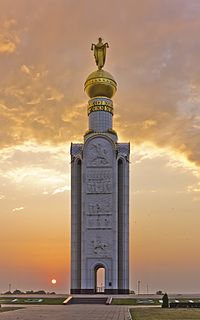
Victory Monument - The belfry on the Prokhorovskoye Pole - the belfry , the main monument of the Prokhorovskoye Pole memorial complex , located two kilometers from the outskirts of the village of Prokhorovka, Belgorod Region, at an altitude of 252.2 meters in memory of those who died here in a major tank battle on July 12, 1943 . Opened to the 50th anniversary of victory in the Great Patriotic War in May 1995 . Sculptor Vyacheslav Klykov , architect Roman Ivanovich Semerdzhiev, engineer G. Solokhin.
| Belfry | |
| Victory Monument - Belfry on Prokhorovsky Field | |
|---|---|
 | |
| A country |  Russia Russia |
| Location | Belgorod region , town of Prokhorovka |
| Denomination | Orthodoxy |
| Founder | Vyacheslav Klykov |
| Established | 1995 year |
| Status |  An object of cultural heritage of the peoples of the Russian Federation of regional significance. Reg. No. 311410657310005 ( EGROKN ). (Wikigid database) An object of cultural heritage of the peoples of the Russian Federation of regional significance. Reg. No. 311410657310005 ( EGROKN ). (Wikigid database) |
| condition | Acting |
Content
- 1 History of creation
- 2 Specifications
- 3 Composition
- 4 Value
- 5 Belfry in the mail and philately
- 6 See also
- 7 notes
- 8 References
Creation History
In the spring of 1992, a group of public figures of the Belgorod and Kursk regions made a proposal to build an Orthodox church in the district center of Prokhorovka in memory of those killed in the Battle of Kursk and to take part in raising funds for the construction of the monument. On November 3, 1993, the newspaper Pravda published an article by the authoritative Soviet statesman Nikolai Ryzhkov , which criticized the lack of construction in the Prokhorovka area over the past five decades. The article contained the following appeal:
Weeds overgrown with soldiers' graves, disappeared under the plow and cultivator evidence of fierce fighting. Dugouts and trenches were razed to the ground. But there is a wonderful folk tradition in Russia: in honor of the great victories over the enemy, to rebuild temples in memory of the fallen on the battlefields. They still make up the beauty and pride of the national spiritual culture.
On November 17, 1993, Ryzhkov published a new article entitled “We will build a temple near Prokhorovka,” in which the idea was put forward, following Kulikov and Borodino fields, to create a third field of military glory of Russia near Prokhorovka. “The temple will be not only an eternal monument, but also a hotbed of spiritual education of our descendants,” wrote Ryzhkov [1] .
Journalists and writers of Belgorod, secretaries of the Union of Writers of Russia led by chairman Valery Ganichev, as well as individual artists, sculptors, artists, war and labor veterans took part in shaping public opinion about the need to build a temple on the Prokhorovsky Field [1] .
The future governor of the Belgorod region, Yevgeny Savchenko , as the acting head of the region’s administration, wrote to the Council of Ministers of the Russian Federation on October 26, 1993 [1] :
Given the special significance of the Victory in the tank battle near Prokhorovka on the outcome of the Great Patriotic War, the regional administration requests that the objects indicated in the decree be included in the priority republican construction projects being built for Victory Day, and that funding be provided in 1994 for construction, installation and art works on the monument and museum and the House of Culture at the expense of the federal budget in the amount of 7.9 billion rubles.
The proposal was accepted and its implementation began. Also, over the first year and a half, 160 million non-denominated rubles were raised through public donations. Contributed to the construction of the temple and many creative teams. For example, the Moscow Art Theater Directorate . M. Gorky , headed by Tatyana Doronina, all the proceeds from the play "Profitable Place" was transferred to the construction in Prokhorovka. The Soviet opera singer Irina Arkhipova, together with the Bolshoi Theater Orchestra, organized several concerts in Belgorod, all the funds raised from which were transferred for construction to Prokhorovka. A number of enterprises supplied equipment and materials to Prokhorovka free of charge, and carried out special orders. The then-famous sculptor Vyacheslav Klykov was invited to the construction of the Orthodox belfry.
The Governor of the Belgorod Region, Yevgeny Savchenko, took work on the construction of facilities on the Prokhorovsky Field under personal control. It was decided to complete the construction of the complex on the occasion of the 50th anniversary of the Victory in the Great Patriotic War (May 9, 1995). By the end of April, all work was basically completed. On May 3, 1995, the grand opening of the facilities on the territory of the Prokhorovsky Field and the consecration of the belfry took place [1] .
Specifications
The height of the belfry is 59 meters [2] . Inside, under the dome, there is an alarm bell weighing 3.5 tons [1] . The height of the domed figure at the top of the belfry is 7 meters [2] . On 4 wall pylons 24 reliefs with 130 images are located [1] .
Composition
The walls of the belfry are four pylons separated from each other, made in white marble. Four pylons symbolize four years of war [1] . The reliefs on the pylons contain images on the themes of Orthodoxy and the heroism of the defenders of the Fatherland [1] . At the top of the pylons are combined into a quad . It carries a round drum made of white marble, which serves as the basis for a gilded spherical dome (which is a symbol of the Russian state [3] ). At the top of the dome is a gilded figure of the Virgin (patroness of Russia [2] [4] ).
In the upper part of the drum, on a copper plate, there are words from the Bible in Church Slavonic: “Sow no more love to you, but whoever puts his soul for his own friends” (There is no greater love for how to lay down life for your friends). Around the base of the drum there is a gilded laurel wreath (“as a symbol of the unfading glory of all those who fell for a just cause in this field and remained in it” [2] ).
A bell is fixed on the quadruple under the drum, which serves as a symbol of the victory announcement on Prokhorovsky Field. The bell rings every 20 minutes (or three times per hour: "The first ringing is about the heroes of the Kulikovo field, the deliverers of Russia from the Mongol-Tatars. The second is about the soldiers of Borodin, the faithful sons of Russia. The third - in memory of the victory in the Prokhorov battle, about all those who fell in the fight against fascism for the freedom of the Fatherland ” [1] ).
Value
The belfry, along with the Church of the Holy Apostles Peter and Paul , is considered a symbol of the third military field of Russia [4] .
Belfry in the mail and philately
On January 6, 2004, the Marka Publishing and Trading Center issued 200,000 copies with a postage stamp of No. 904 with a face value of five rubles from the series “Russia. Regions. ". The stamp depicts a monument to Prince Vladimir in Belgorod , a monument to the defenders of the Fatherland - a belfry installed on the Prokhorovsky field, an illustration of the extraction of iron ore in the Kursk magnetic anomaly deposit . The artist - Sukharev S [5] .
See also
- Museum-Reserve "Prokhorovskoye Field"
- Sculptures of Vyacheslav Klykov
- Church of the Holy Apostles Peter and Paul (Prokhorovka)
- The Battle of Prokhorovka
Notes
- ↑ 1 2 3 4 5 6 7 8 9 Borzunov Semen . Belogorye. Prokhorovskoe Field (Russian) // Our Contemporary: Journal. - 2003. - Issue. 5 .
- ↑ 1 2 3 4 “Objects of the Prokhorovskoye Pole Museum-Reserve.” - Official website of the local authorities of the Prokhorovsky District of the Belgorod Region. Archived on February 20, 2012.
- ↑ Prokhorovskoye Field - Belfry (emblems and symbols of the Belgorod region) (inaccessible link) . gerb.bel.ru. Date of treatment January 7, 2012. Archived on September 8, 2012.
- ↑ 1 2 State Military Historical Museum-Reserve “Prokhorovskoye Field” . museum.ru. Date of treatment January 7, 2012.
- ↑ Brand No. 904. Russia. Regions. . Date of treatment July 4, 2015.
Links
- Decree of the President of the Russian Federation “On the creation of the State Military Historical Museum-Reserve“ Prokhorovskoye Pole ”” dated April 26, 1995
- Panoramic video of the belfry in Prokhorovka
- Page dedicated to the belfry on the official website of the State Military Historical Museum-Reserve "Prokhorovskoye Pole"